
RollRestore Editorial Team · Reviewed June 2026
Key Findings
For travelers on flights longer than four hours, a 12-trial Cochrane review (n=2,918) found graduated compression stockings reduced asymptomatic deep vein thrombosis incidence from 1% to 0.1% in low-risk passengers and from 3% to 0.3% in high-risk passengers. Pair compression socks with movement breaks, a blackout sleep mask for circadian realignment, and one decompression tool, a 13-inch travel foam roller or a pocket massage gun, to address the documented muscle stiffness from prolonged immobilization. Top pick: the TriggerPoint Performance Therapy Mobility Kit. Lightest alternative: the BOB AND BRAD Q2 Mini Massage Gun at 0.95 lb.
- Best overall carry-on kit: TriggerPoint Performance Therapy Mobility Kit (foam roller + MB1 ball + strap)
- Lightest percussion option: BOB AND BRAD Q2 Mini Massage Gun (0.95 lb, pocket-sized)
- DVT-prevention essential: NuVein 15–20 mmHg Graduated Compression Socks
- Hotel-room workout fix: Fit Simplify Resistance Loop Exercise Bands (set of 5 with carry bag)
- Circadian recovery tool: Manta Original Sleep Mask (100% blackout)
Why travel disrupts recovery, the evidence
A long travel day stacks three physiological insults the body is poorly built to absorb at once: immobilization, circadian disruption, and dehydration. Each one has been measured in peer-reviewed literature, and the magnitude is larger than most travelers assume.
Prolonged sitting is not a benign posture. A 2024 scoping review in the journal Healthcare (PMC11845640) concluded that prolonged sitting induces measurable fatigue in deep trunk muscles, reducing spinal support and increasing mechanical stress on the lumbar spine. A separate 2024 mechanistic review in The Journal of Physiology (PMC11186857) documented that even short windows of skeletal-muscle disuse, including supine immobilization of five days or less, produce significant decreases in muscle size and measurable losses in maximal strength. Air travel concentrates that immobilization into a confined seat with minimal opportunity to load the lower body.
The clotting risk is also real, though small in absolute terms. A Cochrane systematic review of 12 randomized trials (n=2,918) reported high-certainty evidence that graduated compression stockings on flights longer than four hours cut asymptomatic deep vein thrombosis incidence by roughly tenfold from about 1% to 0.1% in low-risk passengers, and from 3% to 0.3% in high-risk passengers [1]. The American Heart Association notes that all travelers benefit from frequent leg movement and hydration regardless of compression-sock use [2].
Circadian disruption is the third insult. A 2024 systematic review on travel and circadian rhythm (PMC11554432) concluded that timed light exposure is the most potent realignment tool available, morning light for eastward travel and evening light for westward travel — and that meal timing also regulates the human circadian system [3]. Cleveland Clinic’s current jet lag guidance reinforces that adaptation typically takes one day per time zone crossed, with adults over 40 often requiring 5–10 days for long-haul recovery [4].
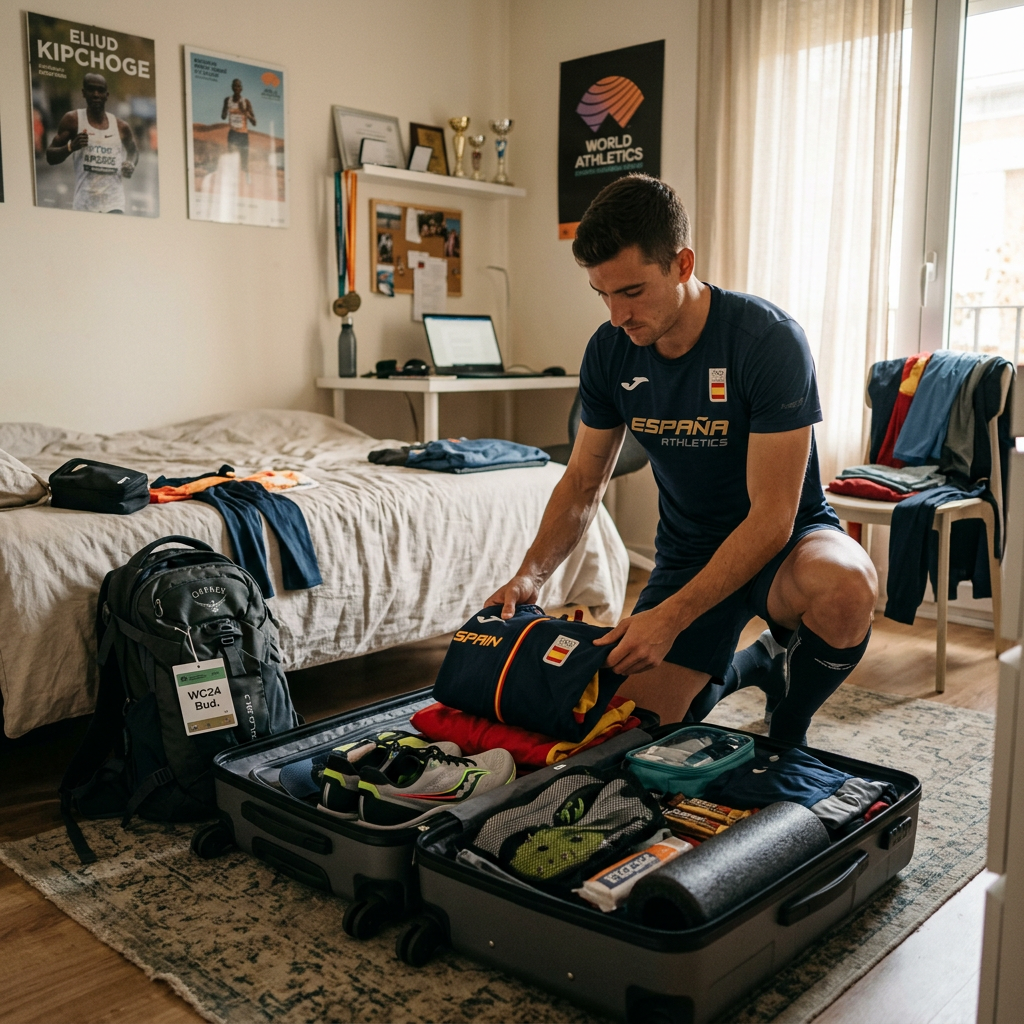
The implication for the kit: a small set of tools, compression for circulation, percussion or rolling for muscle stiffness, light blocking for sleep, and bands for hotel-room mobility, addresses each measurable insult without exceeding a personal-item weight allowance.
The 5-tool carry-on recovery kit
1. TriggerPoint Performance Therapy Mobility Kit: Best Overall Carry-On Kit

The TriggerPoint Mobility Kit meets the dimensional threshold for a personal-item bundle that addresses both lower-body and upper-back stiffness: the 13 × 5.5-inch GRID foam roller, the 2.5-inch MB1 massage ball, and the GRID strap that loops through the roller for portability. Manufacturer documentation lists a 500-pound weight limit on the GRID’s hollow-core, multi-density construction, and TriggerPoint’s literature confirms the roller is the same multi-density EVA foam used in the original GRID line.
Specs. Foam roller 13 × 5.5 in · MB1 ball 2.5 in / 1.2 oz · GRID strap loops through roller core · 500 lb weight limit · multi-density EVA foam · best for full-body travel kit.
Pros. Three tools in one bundle, covers spine, glutes, calves, and small-muscle trigger points · 13-inch length fits across most carry-on widths · strap doubles as a luggage tether.
Cons. Roller still occupies significant cubic volume vs. a soft tool · hollow-core design means no compression to shrink it.
Best use. The mobility kit is most appropriate for travelers who want one purchase that addresses spinal extension, glute and quad release, and upper-back trigger points without packing three separate items. Readers with acute disc injury or post-surgical restrictions should consult a physician before use.
2. BOB AND BRAD Q2 Mini Massage Gun: Lightest Percussion Option

Pocket-sized at 4.8 × 2.8 × 1.5 inches and 0.95 pounds with a hard carry case included, the Q2 is the percussion device the kit defaults to when carry-on weight is the binding constraint. Manufacturer specifications list up to 35 pounds of stall force and 3,000 RPM across speed settings, figures that meet the amplitude and frequency thresholds cited in current massage-gun fatigue-reduction literature for low-to-moderate intensity recovery work.
Specs. 0.95 lb · 4.8 × 2.8 × 1.5 in · up to 35 lb stall force · 3,000 RPM max · lithium-ion battery, USB-C charging · hard carry case + heads included.
Pros. TSA-compliant lithium battery; fits any carry-on or personal item · hard case protects the unit and stays organized in a packing cube · quiet enough to use in a hotel room without disturbing roommates.
Cons. Lower stall force than full-size guns, not ideal for very dense tissue · shorter handle limits self-treatment of mid-back without a partner.
Best use. The Q2 is most appropriate for travelers who already use percussion at home and want a 1-pound version for trips. The TSA explicitly permits massagers in carry-on and checked baggage, and devices under 100 Wh battery capacity are universally allowed in cabins.
3. NuVein 15–20 mmHg Graduated Compression Socks: DVT-Prevention Essential

Cochrane review evidence supports compression stockings as the most validated DVT-prevention intervention for flights longer than four hours. The NuVein knee-high pair sits squarely in the 15–20 mmHg graduated range, pressure highest at the ankle and decreasing up the calf, which is the same pressure profile evaluated in the Cochrane analysis. The American Society of Hematology recommends compression for high-risk passengers on long flights specifically; healthy passengers on short flights see smaller absolute benefit but no documented harm [1].
Specs. 15–20 mmHg graduated compression · knee-high length · nylon/spandex blend · S–XL unisex · seamless toe · ~2 oz packed per pair.
Pros. Pressure profile matches the range used in the Cochrane DVT trials · negligible carry-on weight and volume · doubles as recovery wear for the day after travel.
Cons. Knee-high construction can feel warm in summer destinations · higher-risk travelers may need 20–30 mmHg medical grade, consult a physician.
Best use. Travelers on any flight over four hours, anyone with a history of varicose veins or prior DVT, and pregnant travelers cleared by their obstetrician. Readers with peripheral artery disease, severe peripheral neuropathy, or open wounds should not use graduated compression without medical clearance.
4. Fit Simplify Resistance Loop Exercise Bands: Hotel-Room Workout Fix

Five 12 × 2-inch latex loop bands and a small carry bag pack into a fist-sized bundle and weigh under 6 ounces combined. The set covers extra-light through extra-heavy resistance, which is sufficient range for glute activation, banded pull-aparts, lateral walks, and the McGill Big 3 progressions that mitigate the trunk-muscle fatigue documented after long sitting (PMC11845640).
Specs. 5 bands · 12 × 2 in each · natural latex · XL through XXL progression · <6 oz total packed · includes nylon carry bag and exercise guide.
Pros. Negligible weight and volume, fits a packing cube corner · latex bands hold tension longer than fabric loops for short-duration travel use · carry bag keeps bands separated from clothing.
Cons. Latex is not appropriate for travelers with a latex allergy · loop length limits some standing rows and upper-body work.
Best use. Travelers who want to maintain glute and posterior-chain activation across a multi-day trip without hotel-gym access. Readers with latex allergy should select a non-latex alternative.
5. Manta Original Sleep Mask: Circadian Recovery Tool

Circadian realignment is what the systematic review evidence prioritizes for jet lag, and the input most under a traveler’s control is light exposure. The Manta Original blocks 100% of ambient light through detachable, adjustable eye cups that hold the fabric off the lashes. The same evidence base that flags timed light exposure as the strongest realignment tool also calls out that even brief light spikes at the wrong circadian phase delay adaptation by hours (PMC11554432).
Specs. 100% light blocking (manufacturer-rated) · detachable, adjustable eye cups · infinitely adjustable strap · breathable cotton blend · machine washable · ~2 oz packed.
Pros. Zero eye-cup pressure on lashes, usable for side and belly sleepers · true blackout suitable for hotel-room daytime naps post-arrival · adjustable design fits across face shapes without strap pinch.
Cons. Bulkier than a flat ribbon mask, though still feather-light · premium price relative to basic flat masks.
Best use. Eastward travelers fighting an advanced circadian phase, shift workers extending sleep into daylight hours, and any traveler whose hotel-room curtains do not fully block exterior light. Readers with claustrophobia around the eyes should test at home before relying on it for an overnight flight.
Comparison table
| Tool | Packed Weight | Primary Use | Evidence Anchor |
|---|---|---|---|
| TriggerPoint Mobility Kit | ~2.0 lb | Full-body release | Manufacturer specs; standard EVA foam roller protocol |
| BOB AND BRAD Q2 Mini Gun | 0.95 lb | Targeted percussion | TSA carry-on policy; percussion fatigue literature |
| NuVein 15–20 mmHg Socks | ~2 oz | DVT prevention | Cochrane n=2,918; AHA 2024 guidance |
| Fit Simplify Bands (5-pack) | <6 oz | Hotel-room training | PMC11845640 trunk-fatigue scoping review |
| Manta Sleep Mask | ~2 oz | Circadian realignment | PMC11554432 jet-lag systematic review |
How to pack a travel recovery kit
Prioritize by trip type, not by tool
A four-hour domestic trip carries different physiological demands than a 12-hour transmeridian flight. For trips under four hours, the compression socks and resistance bands cover most of the documented risk — the Cochrane analysis specifically anchored compression stocking benefit to flights longer than four hours, but the bands stay useful on any trip with a hotel-only training window. For long-haul or eastbound transmeridian travel, the sleep mask becomes essential because timed light exposure is the most powerful jet-lag intervention available, and the recovery tools earn their packing weight from the post-flight stiffness window.
Use a carry-on dimensional check, not a generic packing list
The standard FAA-compliant carry-on is 22 × 14 × 9 inches. The TriggerPoint Mobility Kit’s 13-inch foam roller fits across that 14-inch interior dimension with room for clothes. The mini massage gun’s carry case fits in any toiletry-bag corner. Compression socks, bands, and sleep mask combined add under 10 ounces. If carry-on weight is the binding constraint, drop the foam roller and lean on the percussion gun plus a lacrosse ball or MB1 from the kit.
Plan for the post-arrival 24-hour window
Cleveland Clinic’s jet lag guidance and the 2024 systematic review on circadian disruption both flag the first 24 hours after arrival as the highest-leverage period for adaptation: morning sunlight, a light meal on local time, brief outdoor movement, and protected sleep at the destination’s evening hours. The kit supports that window, socks for residual swelling, bands for a 10-minute mobility flow, the foam roller or gun for stiff hip flexors and calves, and the sleep mask to protect the first overnight sleep against an unfamiliar room’s light leaks. For the broader recovery context, our stress and cortisol recovery guide covers what to expect when nervous-system load stays elevated for several days post-travel.
Hotel-room recovery protocol: 20-minute template
On arrival, before unpacking, run a sequence the kit is designed to support:
- Minutes 0–5: Mobility. Resistance band pull-aparts, banded glute bridges, and lateral walks. Targets the gluteal silence documented after prolonged sitting.
- Minutes 5–12: Release. Foam roller across the thoracic spine and quadriceps, MB1 or massage gun on calves and the tensor fasciae latae. Specifically targets the hip-flexor shortening that prolonged sitting produces.
- Minutes 12–17: Compression and walk. Put on the compression socks if travel continues, or remove them after a recovery walk if travel is finished. Cleveland Clinic guidance favors a brief outdoor walk within the first two hours of daylight arrival.
- Minutes 17–20: Sleep prep. Set the sleep mask aside for the first local-time night and dim room lighting at least an hour before destination bedtime.
For deeper context on building recovery routines that survive interrupted schedules, see our post-workout recovery routine guide and the hip-flexor 10-minute fix both extend directly into hotel-room application.
FAQ
What is the most important single item in a travel recovery kit?
For any flight over four hours, the highest-evidence single item is graduated compression socks. The Cochrane systematic review (n=2,918) reported high-certainty evidence of asymptomatic DVT reduction from 1% to 0.1% in low-risk passengers and 3% to 0.3% in high-risk passengers. No other recovery tool has comparable randomized-trial backing for an in-flight benefit.
Are mini massage guns allowed in carry-on luggage?
Yes. The TSA explicitly permits massagers in both carry-on and checked baggage. Lithium-ion batteries under 100 Wh are universally accepted in cabins, and most travel-sized percussion devices, including the Bob and Brad Q2 sit well under that threshold.
How long does jet lag take to recover from?
Cleveland Clinic and a 2024 systematic review (PMC11554432) converge on roughly one day per time zone crossed. Adults under 40 typically recover within 3–5 days for long-haul flights; adults over 40 should expect 5–10 days. Timed light exposure, morning light eastbound, evening light westbound, is the most effective intervention.
Should I roll out before or after a long flight?
Both windows have value. Before flights, a 5-minute foam roller pass on quadriceps and hip flexors reduces baseline stiffness entering a confined seat. After arrival, the same pass targets the immobilization-induced stiffness documented in the 2024 mechanistic review on muscle disuse (PMC11186857). For trips with only one window available, the post-arrival pass produces more measurable subjective relief.
Do compression socks help even on shorter flights?
Evidence is weaker for flights under four hours. The American Society of Hematology guidance does not recommend compression for low-risk passengers on short flights, but the American Heart Association notes that compression socks remain low-risk for healthy passengers who simply prefer the leg-fatigue benefit. Travelers with a history of DVT, varicose veins, or recent surgery should follow physician guidance regardless of flight length.
What is the lightest possible recovery kit?
For a kit under one pound total, pack the compression socks, the resistance band set, and the sleep mask, combined weight under 10 ounces. That kit addresses circulation, hotel-room training, and sleep without a percussion device or roller. For travelers who need release work on top, the mini massage gun adds 0.95 pounds to that base.
Can I use the resistance bands and foam roller on the plane?
Cabin space is too tight for foam roller use. Compact band exercises, seated rows against the seatback, ankle circles, and standing calf raises during permitted aisle movement, are practical and align with the American Heart Association’s general guidance to move regularly during long flights.
Verdict
The strongest evidence-anchored carry-on recovery kit pairs the TriggerPoint Mobility Kit for full-body release with NuVein 15–20 mmHg compression socks for in-flight DVT prevention, Fit Simplify resistance bands for hotel-room mobility, and the Manta Original Sleep Mask for circadian protection. Travelers prioritizing minimum carry-on weight can substitute the BOB AND BRAD Q2 Mini Massage Gun for the foam roller and shed about a pound. Either configuration addresses the three measurable insults of travel, immobilization, clotting risk, and circadian disruption without exceeding a personal-item allowance.
Final affiliate links
- TriggerPoint Performance Therapy Mobility Kit on Amazon
- BOB AND BRAD Q2 Mini Massage Gun on Amazon
- NuVein 15–20 mmHg Graduated Compression Socks on Amazon
- Fit Simplify Resistance Loop Exercise Bands on Amazon
- Manta Original Sleep Mask on Amazon
Sources
- Clarke, M.J. et al. “Compression stockings for preventing deep vein thrombosis in airline passengers.” Cochrane Database of Systematic Reviews, 2021. https://pmc.ncbi.nlm.nih.gov/articles/PMC8092568/
- American Heart Association. “Do you really need compression socks on long flights?” AHA News, June 2024. https://www.heart.org/en/news/2024/06/05/do-you-really-need-compression-socks-on-long-flights
- Suni, J. et al. “Unraveling the Impact of Travel on Circadian Rhythm and Crafting Optimal Management Approaches: A Systematic Review.” PMC, 2024. https://pmc.ncbi.nlm.nih.gov/articles/PMC11554432/
- Cleveland Clinic. “Jet Lag: What It Is, Symptoms, Treatment & Prevention.” Reviewed 2024. https://my.clevelandclinic.org/health/diseases/12781-jet-lag
- Wan, X. et al. “On the Role of Core Exercises in Alleviating Muscular Fatigue Induced by Prolonged Sitting: A Scoping Review.” Healthcare, 2024. https://pmc.ncbi.nlm.nih.gov/articles/PMC11845640/
- Nunes, E.A. et al. “Skeletal muscle immobilisation-induced atrophy: mechanistic insights from human studies.” The Journal of Physiology, 2024. https://pmc.ncbi.nlm.nih.gov/articles/PMC11186857/
- American Academy of Family Physicians. “Compression Stockings for Preventing Deep Venous Thrombosis in Airline Passengers.” AAFP, 2022. https://www.aafp.org/pubs/afp/issues/2022/0100/p23.html
- Transportation Security Administration. “What Can I Bring? Massagers.” https://www.tsa.gov/travel/security-screening/whatcanibring/items/massagers
- National Center for Biotechnology Information. “Deep vein thrombosis (DVT): Research summaries — Is thrombosis prevention necessary on flights?” InformedHealth.org. https://www.ncbi.nlm.nih.gov/books/NBK425367/
Leave a Reply