
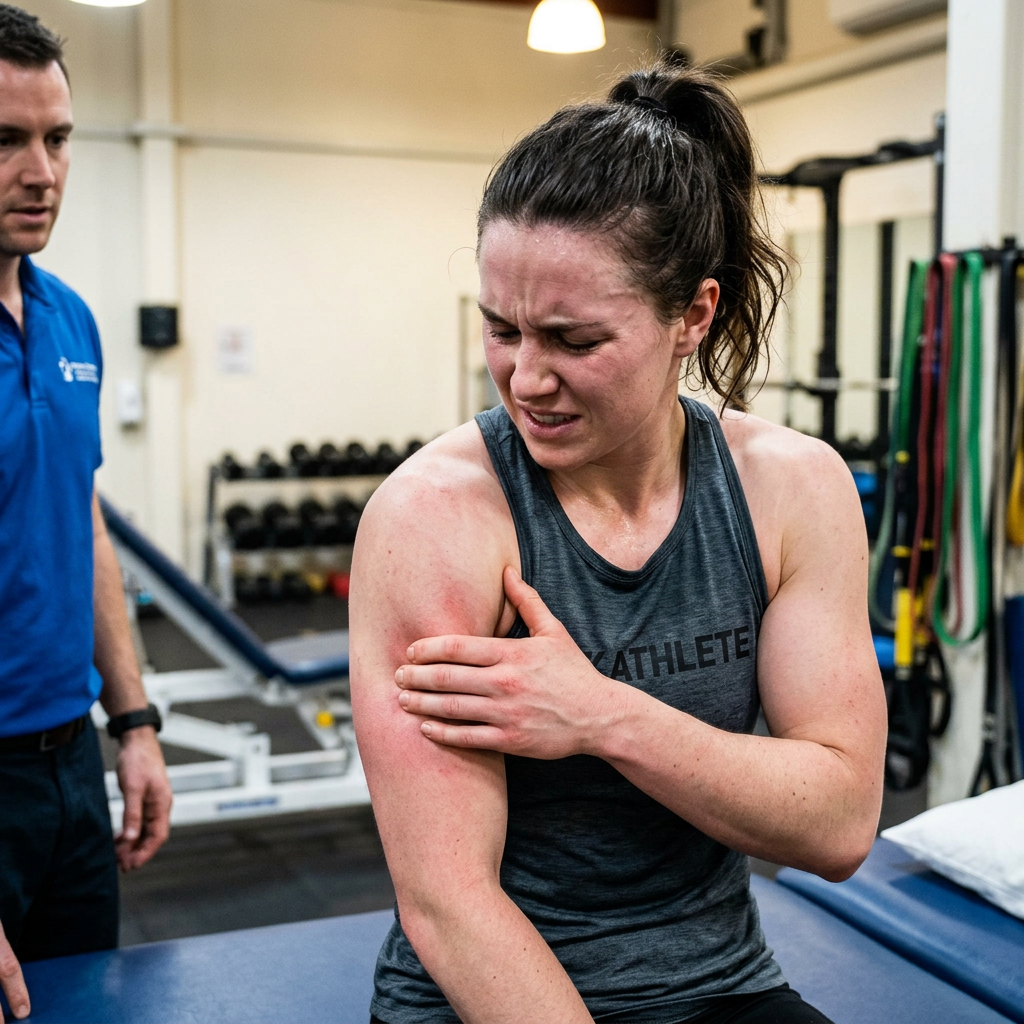
Bicep Tendinitis at the Shoulder: 5 Tools and a Return-to-Pressing Plan (2026)

Key Findings
Bicep tendinitis at the shoulder is almost always long-head biceps tendinopathy (LHBT) pain in the front of the shoulder, not the muscle belly. Roughly 75% of cases resolve without surgery when managed correctly (UT Southwestern Medical Center). The catch: “correctly” no longer means six weeks of rest. Current evidence supports progressive tendon loading, heavy slow resistance and eccentric work at gradually increasing loads over passive rest. This guide pairs a 3-test self-triage with a 4-week return-to-pressing protocol and the 5-tool home stack clinical guides never name.
What is “bicep tendinitis at the shoulder,” really?
When lifters say “I have biceps tendinitis,” they almost never mean the muscle belly or the elbow attachment. They mean the long head of the biceps tendon (LHBT) the rope of tissue that runs from the top of the biceps, through the bicipital groove of the humerus, and attaches inside the shoulder joint at the superior glenoid. According to AAOS OrthoInfo, biceps tendinitis is inflammation or irritation of the upper biceps tendon, the long head and is typically seen in young athletes who participate in throwing sports, and in middle-aged people from years of wear and tear.
The short head of the biceps and the distal (elbow) attachment are rarely the symptomatic structures. Cleveland Clinic notes the proximal long-head tendon is the tendon most commonly affected by tendinitis because it travels through a narrow bony groove and is exposed to compressive load during pressing, overhead, and decelerating motions. That single anatomical detail is why bench press, overhead press, and dips become the symptomatic lifts long before curling or rowing does.
Risk factor data is consistent across clinical guidance. UCSF Health lists repetitive overhead motion, untreated rotator cuff disease, and shoulder impingement as the three structural drivers. A 2024 scoping review in Brazilian Journal of Physical Therapy (PubMed 38219522) reinforces that isolated LHBT pathology is rare, it almost always co-exists with rotator cuff dysfunction or scapular control deficits, which is why pure rest fails as a long-term fix.
Decision Tree: 3-test home self-triage
Test 1: Localize the pain. Point with one finger to the most painful spot. If it sits at the front of the shoulder, in the groove just lateral to the deltoid, that is the bicipital groove (long head). If it sits in the inner elbow crease, that is the distal tendon. If it sits on the top or side of the shoulder, suspect rotator cuff (see our rotator cuff recovery guide).
Test 2: Yergason’s maneuver. Bend the elbow to 90 degrees, palm down. Resist as you try to rotate the palm up against your other hand. Pain in the front of the shoulder = positive Yergason’s. Per a peer-reviewed comparison in Arthroscopy (PubMed 15007311), Yergason’s runs roughly 43% sensitivity / 79% specificity for LHBT pathology, a positive result is meaningful, a negative one doesn’t rule it out.
Test 3: Speed’s test. Straighten the arm in front of you with the palm up. Have someone push the arm down at the wrist while you resist. Pain at the front of the shoulder = positive. Same study reports Speed’s at roughly 32% sensitivity / 75% specificity.
The contrarian beat: rest doesn’t fix it, load does
The classic recipe is rest, ice, NSAIDs, and a steroid injection. That sequence still appears at the top of most clinical pages. The problem is what happens after the pain quiets: the tendon is structurally weaker than before the injury, and any return to bench press re-triggers the cycle. The International Delphi Study on biceps tendinopathy management (PMC 9159730) reached consensus that progressive loading exercise is a primary intervention — not a bridge from rest to surgery, but the actual fix.
This is not theoretical. A 2022 review titled Putting Heavy into Heavy Slow Resistance (PMC 9124646) summarizes the broader tendinopathy literature: tendons adapt to load at roughly 70% of one-rep max (about 7RM intensity) through both eccentric and concentric phases, and the historical eccentric-only prescription is no longer required for tendon remodeling. The clinical implication for the shoulder is straightforward, biceps curls and pressing variants should return to your program in graded fashion, not be exiled.
NSAIDs deserve a separate note. Short courses are fine for sleep and acute flare-ups; chronic use blunts the tendon’s adaptive response, which is exactly the response you need for recovery. UT Southwestern Medical Center notes that around 75% of bicep tendonitis cases resolve without surgery when conservative care is done right. Right here means load progression alongside symptom management, not in place of it.
5-tool comparison at a glance
| Tool | Stage of recovery | What it does | Typical price |
|---|---|---|---|
| TheraICE Shoulder Ice Pack Wrap | Phase 1 (Days 1-7) | Cold + compression to the bicipital groove | $40-50 |
| TheraBand Shoulder Pulley | Phase 1-2 (Weeks 1-3) | Pain-free passive ROM into flexion | $10-15 |
| TheraBand Professional Resistance Bands | Phase 2-4 (Weeks 2-8) | Graded eccentric biceps + scap-stabilizer loading | $25-35 |
| Kieba Lacrosse Balls | Phase 2-3 (Weeks 2-6) | Pec minor / lat / posterior shoulder self-release (never on the tendon itself) | $10-14 |
| RENPHO R3 Active Massage Gun | Phase 3-4 (Weeks 3-8) | Biceps + triceps + trap muscle belly recovery between sessions | $70-80 |
The 5 picks (with why each one earns its slot)
1. TheraICE Shoulder Ice Pack Wrap PRO for Phase 1 cold + compression

The TheraICE Rx Pro is a contoured gel sleeve with FocusZone Technology the gel concentrates at the front and lateral shoulder, which is exactly where the bicipital groove sits. That precision matters: a flat ice pack rests on the deltoid and leaves the actual symptomatic tendon under-cooled. The Pro version delivers 20-minute cycles, which aligns with the AAOS cold-therapy guidance of 20 minutes at a time, several times a day.
Best use: 20 minutes after any pressing-adjacent session, and as needed for night pain in Days 1-10. Stop using it as a primary intervention by Week 3 by then you are loading the tendon, not just cooling it.
Pros: Anatomically targets the bicipital groove; reusable; compression element supports the joint capsule; reversible left/right.
Cons: Single-cycle freezer time means you need a backup wrap for repeated sessions; freeze duration 2 hours minimum.
2. TheraBand Over-the-Door Shoulder Pulley, for pain-free ROM in Phase 1-2

A shoulder pulley is the cheapest tool in the rehab world that actually moves the needle. The TheraBand version uses a divided-section rope with black reference marks, which makes are we making progress answerable in 30 seconds. The Phase 1 goal is not strength, it is preventing the loss of overhead range during the inflammatory phase. Per UCSF Health, stiffness is a documented complication if the joint is immobilized through symptom resolution.
Best use: 2 sets of 10 slow assisted flexion reps, twice daily, into the first pain-free 80% of range. Do not push into pain. If you have not regained baseline flexion by Week 3, that is the cue to escalate to in-person evaluation.
Pros: Inexpensive; doctor-prescribed in standard shoulder protocols; measurable rope marks; fits any door over the door-stop.
Cons: Requires a door with consistent clearance; does not load the tendon, pair with bands by Week 2.
3. TheraBand Professional Resistance Bands, for graded eccentric loading in Phase 2-4

This is the workhorse. The eight-color progressive system (yellow → red → green → blue → black → silver → gold) lets you start at a stimulus the tendon can actually tolerate and step up in roughly 20-30% increments. That is the load-progression rate the Delphi consensus (PMC 9159730) and the heavy-slow-resistance literature both support. Eccentric biceps curls, supine straight-arm pull-overs, and external rotation with the elbow at the side all map cleanly onto band resistance.
Best use: Start at yellow or red for eccentric curls 3-second lowering, 1-second lift, 3 sets of 10, every other day. Progress one color every 7-10 days as long as symptoms are stable. The stable check is no worse the next morning.
Pros: Eight progressive resistance levels mapped to a clinical reference standard; portable; the same bands carry into long-term shoulder maintenance.
Cons: Latex (silicone option exists for allergies); anchoring requires a door-mounted attachment or rack.
4. Kieba Massage Lacrosse Balls for pec minor, lat, and posterior shoulder release

The biceps tendon does not exist in isolation, when the pec minor shortens (chronic desk posture, heavy benching), the coracoid pulls forward, the humeral head migrates anteriorly, and the bicipital groove narrows. That is mechanical compression on the tendon every time the arm elevates. Self-release of the pec minor and the posterior cuff restores the head’s centered position and reduces the impingement component of LHBT.
Read this twice: never roll directly on the symptomatic tendon itself. The Kieba ball is a tool for the surrounding tissue. Pec minor, against a doorframe, just below the clavicle. Latissimus, against a foam roller or floor, in side-lying. Posterior cuff, against a wall, arm crossed in front. Each spot, 60-90 seconds of sustained pressure.
Pros: Cheapest tool in the stack; firmer than a tennis ball, smaller than a foam roller, hits depth standard rollers miss; durable solid rubber.
Cons: Firmness has a learning curve, beginners should use against a wall before going to the floor.
5. RENPHO R3 Active Massage Gun, for muscle-belly recovery in Phase 3-4

The R3 Active is RollRestore’s recommended sub-$80 percussive device because it hits the spec thresholds that matter 10 mm amplitude, up to 3,200 percussions per minute, 90+ minute battery life, without the price overhead of the Theragun or Hypervolt families. For LHBT recovery the gun is a muscle-belly tool: biceps belly (mid-arm), triceps belly, upper trap, and posterior deltoid. Cleveland Clinic’s percussion massage guidance notes the tool is appropriate for muscle soreness recovery, not for directly treating tendons.
The non-negotiable rule: do not run the gun over the bicipital groove, the front of the shoulder, or any spot that hurts on Speed’s test. Percussive force on an inflamed tendon is documented across the 2024 biceps-tendinopathy scoping review (PubMed 38219522) as a contraindication. The gun supports recovery between sessions; it does not substitute for the loading protocol.
Pros: Strong spec-to-price ratio; quiet motor (under 50 dB on speed 1); compact case; long battery.
Cons: Tendon-contraindication discipline required; not the strongest stall force in its class.
Contraindication note. If your shoulder has visible bruising, a Popeye-shaped lump in the biceps, or sudden loss of strength with a snapping sensation, stop the at-home protocol. Those signs are consistent with a biceps tendon rupture, which AAOS describes as needing prompt evaluation, not self-management.
The 4-week return-to-pressing protocol
This protocol assumes a clean self-triage (Section 2), no rupture signs, and pain at 6/10 or lower at rest. Heavier presentations should start with a physical therapist.
Phase 1 — Days 1-7: Calm
- TheraICE Pro: 20 minutes, 2-3 times daily, on the bicipital groove.
- Shoulder pulley: 2 × 10 assisted flexion, twice daily, into the first 80% of pain-free range.
- Bench press / overhead press / dips: paused. Lat pull-down, row, leg work, isometric grip work all stay in.
- NSAID use: short course only if sleep is disrupted. Do not extend past Day 7.
Phase 2 — Days 8-14: Wake the tendon up
- Eccentric biceps curl with yellow or red TheraBand: 3 × 10, 3-second lowering, every other day.
- Banded external rotation at the side: 3 × 12, daily — rebuilds the posterior cuff support of the humeral head.
- Pec minor + posterior cuff release with Kieba balls: 60 seconds each, twice daily.
- Continue cold therapy after the loading sessions only if symptoms flare.
Phase 3 — Weeks 3-4: Reintroduce pressing — modified
- Bench press variants that block bottom-range tendon strain: floor press, pin press at chest-touch height, or board press. Start at 50% of pre-injury working weight, 3 × 8, twice weekly. Per Stronger By Science’s biceps-tendinopathy guide, the bottom of the press is the bottleneck — bypassing the bottom 2-4 inches removes the worst compressive load while training stays in.
- Band progression: green for eccentric curls, blue for external rotation.
- Continue lacrosse-ball release and gun-on-muscle-belly recovery.
Phase 4 — Weeks 5-8: Restore full range
- Add 1 inch of bottom range every 7-10 days as long as symptoms are stable the next morning.
- Progress band loading every 7-10 days (green → blue → black).
- By Week 8, target 75-80% of pre-injury bench working weight at full range. Most lifters reach full pre-injury load between Week 8 and Week 12 that range is consistent with the recovery timelines published by Cleveland Clinic and UT Southwestern.
If symptoms increase by more than 2 points on a 10-point scale between sessions and stay elevated the next morning, drop back one phase for a week before progressing again. Internal links to companion protocols: workout injury prevention and post-workout recovery routine.
Buying guide: what actually matters in each tool
1. For the cold-therapy wrap, prioritize anatomical contour over capacity
A larger ice pack is not better here. The bicipital groove is a one-inch zone, a contoured sleeve that concentrates the gel over the front of the shoulder beats a generic 10-inch flat pack every time. Compression is the silent benefit: gentle joint-capsule compression reduces effusion and matches the principles in standard UCSF shoulder rehab guidance.
2. For the band stack, prioritize an 8-level progression, not just light to heavy
The reason eight levels matter is the heavy-slow-resistance progression rate (PMC 9124646): roughly 20-30% step-ups between loading sessions. Three-band kits force jumps that are too aggressive for a tendon coming off inflammation. The eight-color TheraBand system maps almost perfectly onto a four-to-six-week progression. See also our resistance bands buying guide.
3. For the massage gun, prioritize amplitude and noise, not stall force
Stall force matters for deep-tissue users without tendon symptoms. For LHBT recovery the gun lives on the biceps and triceps muscle bellies, where 10-12 mm amplitude and quiet operation (under 55 dB) matter more than peak force. The R3 Active hits both. RollRestore’s broader massage gun comparison covers heavier-duty options if you have other recovery needs.
Frequently Asked Questions
How long does bicep tendinitis at the shoulder take to heal?
Per Cleveland Clinic and UT Southwestern Medical Center, mild cases typically improve in 2-4 weeks with appropriate management. Full return to pre-injury pressing load usually takes 6-12 weeks. The pace depends on how strictly the load-progression rules are followed.
Can I still lift if I have biceps tendinitis?
Yes and current evidence suggests you should keep training with modifications. Stop the specific symptomatic lifts (bench, overhead press, dips) for 7-10 days, then reintroduce via floor press or pin press at sub-maximal loads. Lower-body, lat pull-down, and row movements stay in throughout. The Delphi consensus on biceps tendinopathy (PMC 9159730) favors progressive loading over rest.
Is bicep tendinitis the same as a torn biceps tendon?
No. Tendinitis is inflammation/irritation; a tear is a structural disruption. The AAOS biceps tendon tear page describes rupture as a sudden snap with a visible Popeye bulge in the upper arm and a sharp loss of strength. If those signs appear, stop self-management and seek evaluation.
Should I use heat or ice for biceps tendinitis?
Ice during the first 7-10 days when inflammation dominates; heat from Week 2 onward to support pre-loading tissue prep. Our companion guide on heat vs. ice timing covers the hour-by-hour rules for related tissue states.
Will a cortisone injection fix biceps tendinitis?
Injections relieve short-term pain. AAOS OrthoInfo notes that effects are typically temporary and that repeated injections may weaken the tendon, increasing rupture risk. Treat an injection as a pain-management bridge to the loading protocol not a substitute for it.
Editorial Verdict
Bicep tendinitis at the shoulder is fixable at home for the majority of lifters but only with discipline about load progression, not load avoidance. The 5-tool stack covers every phase: TheraICE Shoulder Wrap for the calming phase, the TheraBand Shoulder Pulley for early ROM, TheraBand Professional Resistance Bands for graded eccentric loading, Kieba lacrosse balls for the surrounding tissue, and the RENPHO R3 Active for between-session recovery on the muscle belly only. If only one item gets bought today, make it the bands, that is the tool the recovery actually runs on.
What this means for your training next week
Monday: pause bench press, overhead press, and dips. Pull, leg, and lat work stay in. Twice that day, run a 20-minute cold cycle on the bicipital groove and 2 × 10 assisted flexion on a shoulder pulley. Wednesday: add yellow-band eccentric biceps curls 3 × 10 with a 3-second lowering. Friday: reassess pain with Yergason’s test. If the test is less painful than Monday, you are on track. If it is the same, hold Phase 1 another week before adding load. The single most important behavior change is committing to the band progression for six weeks, not six days.
Sources
- American Academy of Orthopaedic Surgeons. Biceps Tendinitis. OrthoInfo, reviewed 2024. https://orthoinfo.aaos.org/en/diseases–conditions/biceps-tendinitis/
- American Academy of Orthopaedic Surgeons. Biceps Tendon Tear at the Shoulder. OrthoInfo, reviewed 2024. https://orthoinfo.aaos.org/en/diseases–conditions/biceps-tendon-tear-at-the-shoulder/
- Cleveland Clinic. Bicep Tendonitis: Symptoms, Causes & Treatment. Reviewed 2024. https://my.clevelandclinic.org/health/diseases/bicep-tendonitis
- UCSF Health. Biceps Tendinitis. 2024. https://www.ucsfhealth.org/conditions/biceps-tendinitis
- UT Southwestern Medical Center. Heal biceps tendonitis without surgery. MedBlog, 2024. https://utswmed.org/medblog/biceps-tendonitis-no-surgery/
- Holtby R., Razmjou H. Accuracy of the Speed’s and Yergason’s tests in detecting biceps pathology and SLAP lesions. Arthroscopy, 2004. https://pubmed.ncbi.nlm.nih.gov/15007311/
- de Oliveira F. et al. Physical therapy interventions used to treat individuals with biceps tendinopathy: a scoping review. Brazilian Journal of Physical Therapy, 2024. https://pubmed.ncbi.nlm.nih.gov/38219522/
- McDevitt A.W. et al. Physical Therapy Interventions for the Management of Biceps Tendinopathy: An International Delphi Study. International Journal of Sports Physical Therapy, 2022. https://pmc.ncbi.nlm.nih.gov/articles/PMC9159730/
- Steele J., Fisher J. et al. Putting Heavy into Heavy Slow Resistance. Sports Medicine, 2022. https://pmc.ncbi.nlm.nih.gov/articles/PMC9124646/
- Cleveland Clinic. Percussion Massage Therapy: Benefits and How To Use It. Reviewed 2024. https://my.clevelandclinic.org/health/treatments/percussion-massage
Leave a Reply