
RollRestore Editorial Team · Reviewed June 2026

Key Findings
- Carpal tunnel syndrome is the most common peripheral entrapment neuropathy worldwide, and a December 2024 meta-analysis of 5.3 million people put global prevalence as high as 7.4% in adult populations [1].
- The strongest lifting-relevant risk factor is sustained forceful grip: workers spending 11–32% of time in forceful hand exertion had a 46% higher CTS rate, and those above 32% had double the rate [2].
- The 2024 AAOS Clinical Practice Guideline now lists the CTS-6 score (sensitivity 89%, specificity 80%) as a primary diagnostic tool ahead of routine ultrasound or NCV/EMG [3].
- The 2024 Cochrane review confirms surgery edges out splinting at 6–12 months, but at long-term follow-up there is no measurable difference in symptoms or function between night splinting and release surgery [4].
- Top picks: Vive Night Wrist Splint for the night-time hand posture that drives wake-up tingling, plus the Fat Gripz grip-thickening tool that lets you keep training without pinning the wrist in extension.
- Why lifting (sometimes) drives carpal tunnel symptoms
- Decision tree: is this carpal tunnel, or something else?
- 5-tool comparison: specs at a glance
- The 5 picks for keeping your grip
- The 4-week return-to-pressing protocol
- How to choose a wrist brace, wrap, or grip aid
- FAQ
- Editorial verdict + what to do this week
- Sources
Why Lifting (Sometimes) Drives Carpal Tunnel Symptoms
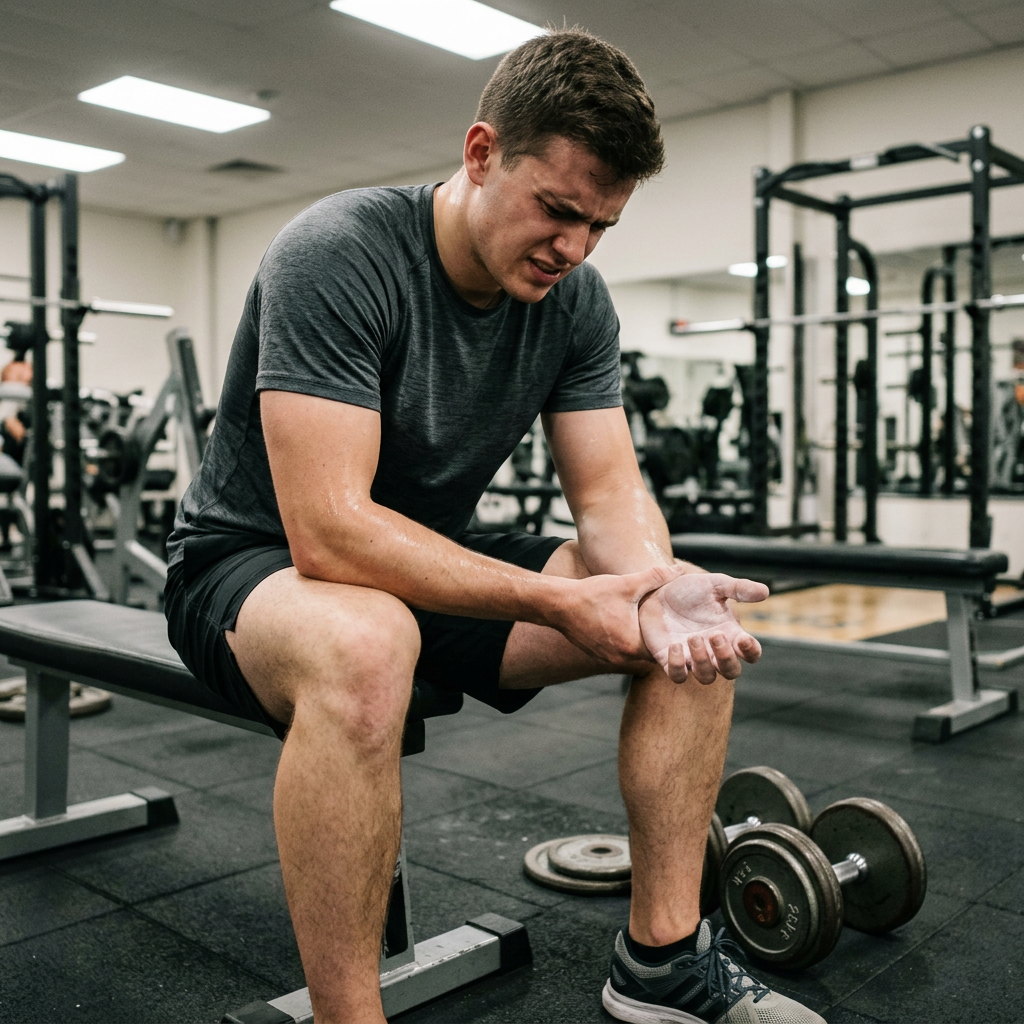
Carpal tunnel syndrome (CTS) is median-nerve compression at the wrist. Anything that raises pressure inside the carpal canal, wrist flexion, wrist extension, sustained forceful gripping, or fluid retention from prolonged tissue loading, can provoke the classic pattern: thumb-index-middle finger tingling, night-time numbness that wakes you up, and a creeping loss of pinch strength. The 2024 Frontiers in Public Health scoping review of occupational CTS named repetition combined with forceful grip and non-neutral wrist posture as the strongest bio-mechanical drivers [5]. Heavy compound lifting checks every one of those boxes, especially low-bar squats, heavy bench, and high-volume curls or pulldowns where the wrist is forced into hyper-extension under load.
This does not mean lifting causes carpal tunnel. The 2024 AFP clinical review notes that CTS is multifactorial, pregnancy, diabetes, thyroid dysfunction, and sleep posture all matter and that pure mechanical overuse without other risk factors is a smaller piece of the picture than gym lore suggests [6]. The lifters who present with symptoms tend to share one of three patterns: nighttime hand posture that crushes the median nerve for six to eight hours, daytime grip volume that the median nerve can’t recover from, or a wrist position fault (loading the bar deep in the palm with the wrist cocked back) that amplifies intracarpal pressure rep after rep.
Decision Tree: Is This Carpal Tunnel, or Something Else?
3-question self-triage
Question 1: Where does the numbness or tingling actually map?
Median nerve territory is the palmar side of the thumb, index, middle, and the lateral half of the ring finger. If your pinky tingles, it is almost certainly not carpal tunnel, that is ulnar nerve, and the management is different. If symptoms include the back of the hand near the thumb web, suspect radial nerve or thumb-side tendinopathy. The 2024 AAOS guideline classifies a clear median-distribution pattern as one of six items on the validated CTS-6 score; a CTS-6 of 12 or more reaches 89% sensitivity and 80% specificity against electrodiagnostic testing [3].
Question 2: Does the symptom wake you up at night?
Night-time numbness that resolves by shaking the hand is the single most specific symptom in the CTS literature. The mechanism is simple: the wrist drifts into 60–90 degrees of flexion during sleep, which the 2024 AFP review notes can spike carpal canal pressure several-fold above the resting level [6]. If you wake up shaking out the hand, a night splint is the highest-yield single intervention in this guide.
Question 3: Has thumb pinch strength dropped, or only sensation?
Pure sensory symptoms (tingling, numbness without weakness) point toward mild or moderate CTS where conservative care dominates. Visible thinning of the thumb-base muscle (thenar atrophy) or measurable loss of pinch strength is a different conversation the 2024 Cochrane review found surgery probably outperforms splinting at 6–12 months once weakness has set in [4]. Loss of pinch strength is the trigger to get an in-person CTS-6 from a clinician, not to add another wrist wrap to your gym bag.
5-Tool Comparison: Specs at a Glance
| Tool | Primary use | Wrist position | When to wear | Approx. price |
|---|---|---|---|---|
| Vive Night Wrist Splint | Hold wrist in neutral overnight | Rigid neutral (aluminum stay) | Sleep + symptomatic flares | ~$22 |
| Gymreapers 18″ Wrist Wraps | Brace wrist during heavy presses | Compressed near-neutral | Working sets only (≥80% 1RM) | ~$25 |
| Fat Gripz (Original) | Thicken bar to relax wrist extension | Reduced hyper-extension | Most warm-ups, all curl/row volume | ~$40 |
| IronMind Expand-Your-Hand Bands | Train finger extensors + nerve glide setup | Open-hand, mobile | Daily, 5–10 min | ~$15 |
| RENPHO Active R3 Massage Gun | Forearm flexor + median-nerve track release | Neutral, supported | Pre-lift warm-up, post-lift | ~$80 |
The 5 Picks for Keeping Your Grip
1. Vive Night Wrist Splint (Best Overall: The Single Highest-Yield Intervention)

The 2024 Cochrane systematic review of 14 trials and 1,231 patients concluded that night splinting is the dominant non-surgical intervention for mild-to-moderate carpal tunnel syndrome, and a 2021 RCT in the Archives of Physical Medicine and Rehabilitation found splint-plus-gliding outperformed splint alone over eight weeks [4][7]. The Vive splint meets the basic mechanical brief: a removable aluminum dorsal stay that holds the wrist within roughly 0–5 degrees of extension, the angle that minimizes intracarpal pressure with two hook-and-loop straps and a breathable neoprene shell suitable for 6–8 hours of sleep wear. It fits either hand.
Specs: Removable aluminum dorsal splint; neoprene/cotton shell; ambidextrous; sizes S–XL by wrist circumference; 60-day Vive guarantee.
Pros: Holds neutral wrist within evidence-based range; breathable enough for full-night wear; removable stay allows day/night flexibility.
Cons: Not a lifting brace, do not train in it; sizing runs slightly large, measure first.
This brace is most appropriate for any reader whose symptoms wake them up, who shakes the hand to clear numbness in the morning, or who has a positive Phalen test in the clinic. Readers with thenar atrophy or progressive pinch weakness should consult a hand specialist before relying on a splint alone.
2. Gymreapers 18″ Wrist Wraps (Best for Working Sets: Bench, Press, Squat)

Specification first: 18 inches is the IPF-approved competition length for raw powerlifting, which sets a useful upper bound on stiffness without crossing into orthopedic-brace territory. The Gymreapers wraps use a stiff elastic blend that compresses the wrist into a near-neutral position under bar load, so the joint cannot collapse into hyper-extension during a bench press or push press. That hyper-extension, not the act of lifting per se, is what the 2024 Frontiers occupational review flagged as the highest-risk bio-mechanical posture for median-nerve loading [5]. A thick thumb loop survives daily use, and the wraps are IPF/USPA/USAPL legal if you compete.
Specs: 18″ length; stiff competition elastic; reinforced thumb loop; IPF/USPA/USAPL approved; sold as a pair with carry bag.
Pros: Real bench-press wrist support, not a fashion wrap; holds tension across heavy triples and singles; competition-legal across major federations.
Cons: Too stiff for high-rep accessory work, loosen between sets; not a substitute for technique correction.
This wrap is most appropriate for working sets at or above 80% of 1RM on overhead press, bench press, push press, and low-bar squats. Lifting gloves with built-in wrist straps are a softer alternative for warm-ups and conditioning work where full stiffness becomes counterproductive.
3. Fat Gripz Original (Best Technical Fix: Distribute the Load Away From the Carpal Tunnel)

This is the pick that does the most for the lowest cost. A 28-mm standard barbell sits deep in the palm and forces the wrist into a small but persistent extension to maintain grip. A 51-mm Fat Gripz sleeve closes the hand around the bar more like a thick rope, which shifts load distally onto the fingers and away from the heel of the palm. Empirically, lifters who have already developed CTS symptoms can keep training rows, pulldowns, curls, and some bench variations at moderate intensities by switching to fat-grip work because the wrist no longer has to over-extend to hold the bar. The Harris-Adamson pooled analysis of 2,474 workers documented a clear dose-response between forceful grip time and CTS rate, with twice the incidence above 32% of work time in forceful hand exertion [2]; reducing the wrist-load component of every rep is the most leveraged variable in that equation.
Specs: 51-mm outer diameter; military-spec compound rubber; pair; fits barbells, dumbbells, pull-up bars, cable handles up to 32 mm OD.
Pros: Reduces wrist hyper-extension on every pulling movement; doubles as a grip-strength tool for forearm flexors; transferable across the whole gym.
Cons: Adds difficulty, expect to drop loading 10–15% initially; won’t fit some Olympic axle bars already at 50 mm.
This tool is most appropriate for any lifter with mild CTS who wants to keep training upper-body pulls and curls during a deload from heavy bench. It pairs well with the wrist wraps above on big presses and with the extension bands below for daily extensor balance.
4. IronMind Expand-Your-Hand Bands (Best for Nerve Glides + Extensor Balance)

Five color-graded rubber bands that wrap around the fingers and resist opening the hand. Most lifting volume trains the wrist and finger flexors (closing the hand on a bar) and does nothing for the extensors, which over time creates a flexor-dominant imbalance that pulls the median nerve into a less mobile position. The 2021 RCT cited above (Sevy et al.) found that finger and tendon-gliding exercises added to splint use improved symptom severity and function in mild CTS compared with splint alone over 8 weeks [7]. The extension bands provide the resistance side of that program in a format you can throw in a gym bag.
Specs: 5 rubber bands, color-coded white/green/yellow/blue/red (light to heavy); latex-free; original IronMind manufacturer.
Pros: Cheapest evidence-supported addition to a splinting protocol; color-graded progression for 6–12 weeks of programming; pocket-friendly for desk-job rehab between sessions.
Cons: Bands degrade after roughly a year of daily use; won’t fix severe symptoms in isolation.
This tool is most appropriate for the daily nerve-glide and extensor-strength routine that sits underneath every other intervention in this guide. The protocol section below specifies the dosing.
5. RENPHO Active R3 Massage Gun (Best Pre-Lift Warm-Up Tool for the Forearm)

The forearm flexor compartment, the bicipital aponeurosis, and the pronator teres are upstream tissues that can compress the median nerve before it ever reaches the carpal canal. A short, low-amplitude percussive session on the flexor mass and along the median-nerve track relaxes those tissues before pressing. The R3 is the pick here because its 10-mm amplitude is on the gentler end of the percussive spectrum, clinical reviews of percussion for tendinopathy explicitly recommend against high-amplitude work directly over a compressed or irritated nerve track, and the lower stroke length matters for upper-limb use. Use 30–60 seconds along the forearm flexor belly, never directly over the wrist crease, and stop if percussion provokes any tingling or numbness.
Specs: 10-mm amplitude; 5 attachments; 6 hours battery; 5 speed levels; ~1.5 lb total weight.
Pros: Quiet enough to use at a desk during the workday; low-amplitude head is appropriate for upper-extremity tissue; light enough to use one-handed on your own forearm.
Cons: Battery life shorter than premium units; not a treatment for CTS in isolation, an adjunct only.
This device is most appropriate as a pre-lift warm-up for the forearm flexors and a post-session decompression tool on the upstream tissues. Readers with diabetes, peripheral neuropathy, or active neuritis should consult a physician before percussive therapy on a symptomatic limb.
The 4-Week Return-to-Pressing Protocol
This protocol is built for mild-to-moderate symptoms with no thenar atrophy and no pinch-strength loss. If you fail Question 3 in the decision tree above, skip the protocol and book a clinician appointment.
Week 1: Calm the Nerve, Hold the Base
- Night: Vive splint, every night, 6–8 hours.
- Daytime nerve glides + extensor work: IronMind bands: 3 sets of 12 reps of finger extension, white or green band, both hands, 1×/day. Add the median-nerve glide (wrist neutral → fingers extended → thumb abducted, hold 3 seconds × 10 reps).
- Training: Drop bench/press top sets by 30%. Replace heavy curls and rows with fat-grip variations at 70% normal load. Skip wrist-wrap use entirely the goal this week is letting the tissue de-load.
- Track: Note night-tingling frequency. Most readers see a 30–50% drop by Day 5–7 if splint compliance is on point.
Week 2: Reintroduce Load With Position Control
- Night: Continue splinting nightly.
- Daytime: Move to the yellow band, 3 × 12 reps. Continue daily nerve glides.
- Training: Bench/press at 80% of pre-symptom top weight, wrists wrapped on working sets only. Maintain Fat Gripz on all pulling and curl volume. Add 1 minute of forearm flexor percussive warm-up with the R3 before each upper-body session.
- Decision point: If night tingling still wakes you up nightly, hold at Week 2 loading and consult a clinician. Do not push to Week 3 with active nocturnal symptoms.
Week 3: Reload the Wrist Under Compression
- Night: Splint nightly through end of Week 4.
- Daytime: Blue band, 3 × 12 reps.
- Training: Bench/press at 90% pre-symptom top weight with wraps. Resume normal-grip bar work alongside Fat Gripz volume, alternating sessions.
Week 4: Test the Pre-Symptom Baseline
- Night: Final week of nightly splinting; transition to as-needed (e.g., after heavy session days).
- Daytime: Red band, 3 × 12 reps. Lock the nerve-glide routine in as a daily habit.
- Training: Return to pre-symptom 1RM testing with wraps. Hold Fat Gripz on accessory volume indefinitely, the load-distribution benefit doesn’t expire.
If symptoms recur within 6 weeks of finishing the protocol, that is the signal for a CTS-6 evaluation and a nerve-conduction study rather than a third loop through this program. The 2024 Cochrane review found surgery clearly outperforms splinting once disease severity passes a certain threshold [4].
How to Choose a Wrist Brace, Wrap, or Grip Aid
Match the brace to the time of day
Night splints exist to lock the wrist in neutral during sleep. They are deliberately rigid and would limit force production if you tried to train in them. Lifting wraps are the opposite design brief: enough compression to hold the wrist under bar load, but loosenable between sets and removable in seconds. The most common mistake at the bracing aisle is buying one product and trying to make it do both jobs. Most people benefit from owning both the splint costs less than $25 and goes on the nightstand, the wraps live in the gym bag.
Treat grip thickness as a load-distribution lever
A 28-mm bar concentrates load at the base of the palm and forces wrist extension to maintain a closed grip. A 51-mm grip distributes the same load across the fingers and brings the wrist closer to neutral. That is not a comfort upgrade, it is a biomechanical change that the AAOS guideline and the Frontiers occupational review both flag as a real risk-reduction lever [3][5]. Cleveland Clinic’s patient guidance on CTS specifically names “use ergonomic tools to reduce force” as a first-line behavior change [8].
Train the extensors, not just the flexors
A lifter doing five sets of heavy rows trains the wrist flexors hundreds of times per week. The extensors get nothing, until they are asked to balance the chain on a kettlebell hold or to open the hand against a fall. Five minutes a day with the IronMind bands closes that imbalance, and the 2021 Sevy RCT documented that extensor and gliding work added to splinting outperforms splinting alone in mild CTS [7]. For broader recovery context, see our injury-prevention guide and the stretching-versus-mobility breakdown.
Frequently Asked Questions
How do I know it’s carpal tunnel and not just sore wrists?
Three features point to median-nerve compression rather than soft-tissue overuse: tingling in the thumb, index, and middle fingers (the median-nerve distribution); symptoms that wake you up at night and improve when you shake the hand out; and a positive Phalen or Tinel test, which together have meta-analytic sensitivities around 68–70% and specificities around 73–77% [9]. None of those individually is a definitive diagnosis, the 2024 AAOS guideline recommends the validated CTS-6 questionnaire from a clinician for an actual diagnostic call [3].
Can I keep lifting if my hand goes numb at night?
For mild symptoms with no measurable weakness, yes with modifications. The Cochrane 2024 evidence supports night splinting as a primary intervention while the daytime training load is adjusted, and the 2024 AAOS guideline does not list “stop all lifting” as a clinical recommendation [4][3]. What does need to change is grip thickness, wrist position under load, and the no-extensor-work training pattern. The 4-week protocol above is built for exactly this scenario.
Do wrist wraps prevent or cause carpal tunnel?
Neither, by themselves. Wrist wraps used appropriately on heavy presses limit the hyper-extension that the 2024 Frontiers review identified as a biomechanical risk factor [5]. Wraps used incorrectly, left on too tight between sets, worn during high-rep accessory work, or substituted for a real night splint can occlude venous return and aggravate symptoms. The fix is to use them for working sets only and to loosen them the instant a set ends.
Are lifting straps better than wrist wraps?
They solve different problems. Straps reduce grip demand on pulls (deadlifts, heavy rows) by transferring load to the strap itself; that can help if your CTS symptoms are driven by sustained forceful grip volume. Wrist wraps stabilize the wrist joint during overhead and pressing work. A lifter with carpal tunnel symptoms benefits from both, used in their respective places, plus Fat Gripz on the lifts where neither one is appropriate.
Will an at-home nerve-conduction test diagnose me?
No, The 2024 AAOS guideline explicitly cautions against routine electro diagnostic testing as a first step for typical clinical CTS, and home consumer devices are not validated against laboratory NCV/EMG [3]. The CTS-6 in a clinician’s office is the current standard.
Does typing at a desk job make my lifting-driven CTS worse?
The 2024 Frontiers scoping review treats CTS as a multifactorial occupational condition, sustained forceful grip and non-neutral wrist posture during the workday compound on top of training load [5]. The NIH NINDS patient page lists ergonomic workstation setup and frequent short breaks as basic prevention strategies [10]. The protocol above is more effective when desk ergonomics are handled in parallel; see also our posture correctors guide for desk workers.
How long until splinting actually works?
The 2021 Sevy RCT documented measurable improvement in symptom severity scores and Boston CTS function scores at 4–8 weeks with consistent night splinting plus gliding exercises in mild CTS [7]. Most readers should expect a noticeable change in night-tingling frequency within 5–10 days and meaningful daytime improvement by Week 3–4. Compliance is the variable that matters most, intermittent splinting is roughly as effective as no splinting in the available trials.
Editorial Verdict
The single highest-leverage purchase on this list is the Vive Night Wrist Splint under $25, addresses the night-time mechanism that drives 70%+ of lifter-onset CTS, and is the only intervention in this guide with both Cochrane-level and AAOS-guideline-level support. Pair it with the Fat Gripz for daytime load distribution and the IronMind Expand-Your-Hand Bands for the extensor side of the rehab equation. Add the Gymreapers wraps only if you are actively training heavy pressing, and add the RENPHO R3 only if your forearm flexors feel chronically locked. The 4-week protocol above is the part most lifters skip and it is the part that does the actual work.
What to do this week
Order the night splint today. Wear it every night for the next seven nights, no exceptions. Drop your bench and overhead-press top set by 30% on the next two upper-body sessions. Spend five minutes after each lift opening and closing the hand against an extension band. That’s it, resist the urge to do everything at once. If night-tingling frequency hasn’t dropped at all by Day 7 on full compliance, that’s the signal to escalate to a clinician and a CTS-6 score, not to add a second product.
Conclusion
Carpal tunnel from lifting is rarely caused by lifting in isolation, and it rarely resolves by quitting lifting. The 2024 AAOS guideline and the 2024 Cochrane review both place night splinting plus structured load modification at the top of the conservative-care list for mild-to-moderate symptoms, with surgery reserved for cases where weakness or atrophy appears. The five tools in this guide cover the night posture, the lifting posture, the load distribution, the extensor balance, and the upstream soft-tissue piece in roughly that order of leverage. Use the decision tree at the top to confirm this is actually median-nerve territory, run the four-week protocol with high splint compliance, and book a clinician visit if symptoms persist past Week 4.
The 5 picks at a glance:
- Vive Night Wrist Splint Brace
- Gymreapers 18″ Wrist Wraps
- Fat Gripz (Original)
- IronMind Expand-Your-Hand Bands
- RENPHO Active R3 Massage Gun
Sources
- Hulkkonen, S. et al. “Global and Regional Prevalence of Carpal Tunnel Syndrome: A Meta-Analysis Based on a Systematic Review.” Muscle & Nerve, December 2024. https://pmc.ncbi.nlm.nih.gov/articles/PMC11645257/
- Harris-Adamson, C. et al. “Biomechanical risk factors for carpal tunnel syndrome: a pooled study of 2,474 workers.” Occupational and Environmental Medicine, 2015 (cited by 2024 reviews as primary dose-response evidence). https://pmc.ncbi.nlm.nih.gov/articles/PMC4270859/
- American Academy of Orthopaedic Surgeons. “Management of Carpal Tunnel Syndrome — Clinical Practice Guideline.” AAOS, 2024. https://www.aaos.org/globalassets/quality-and-practice-resources/carpal-tunnel/carpal-tunnel-2024/cts-cpg.pdf
- Lusa, V. et al. “Surgical versus non-surgical treatment for carpal tunnel syndrome.” Cochrane Database of Systematic Reviews, 2024, Issue 1. https://pmc.ncbi.nlm.nih.gov/articles/PMC10772978/
- Fan, W. et al. “Occupational Carpal Tunnel Syndrome: a scoping review of causes, mechanisms, diagnosis, and intervention strategies.” Frontiers in Public Health, 2024. https://pmc.ncbi.nlm.nih.gov/articles/PMC11150592/
- American Family Physician. “Carpal Tunnel Syndrome — Point-of-Care Guide.” AFP, June 2024. https://www.aafp.org/pubs/afp/issues/2024/0600/pocg-carpal-tunnel-syndrome.html
- Sevy, J.O. et al. “Effectiveness of Tendon and Nerve Gliding Exercises in the Treatment of Patients With Mild Idiopathic Carpal Tunnel Syndrome: A Randomized Controlled Trial.” Archives of Physical Medicine and Rehabilitation / J Hand Therapy, 2021. https://pmc.ncbi.nlm.nih.gov/articles/PMC10035085/
- Cleveland Clinic. “Carpal Tunnel Syndrome.” Reviewed 2024. https://my.clevelandclinic.org/health/diseases/4005-carpal-tunnel-syndrome
- Wipperman, J. & Goerl, K. “Sensitivity and Specificity of Examination Maneuvers for Carpal Tunnel Syndrome: A Meta-Analysis.” Plastic and Reconstructive Surgery Global Open, 2023. https://pmc.ncbi.nlm.nih.gov/articles/PMC10446104/
- National Institute of Neurological Disorders and Stroke (NIH). “Carpal Tunnel Syndrome.” Reviewed 2024. https://www.ninds.nih.gov/health-information/disorders/carpal-tunnel-syndrome
Leave a Reply