
📅 April 27, 2026 · ⏱ 11 min read · 🌿 Recovery & Wellness · 🟢 5 expert-vetted picks
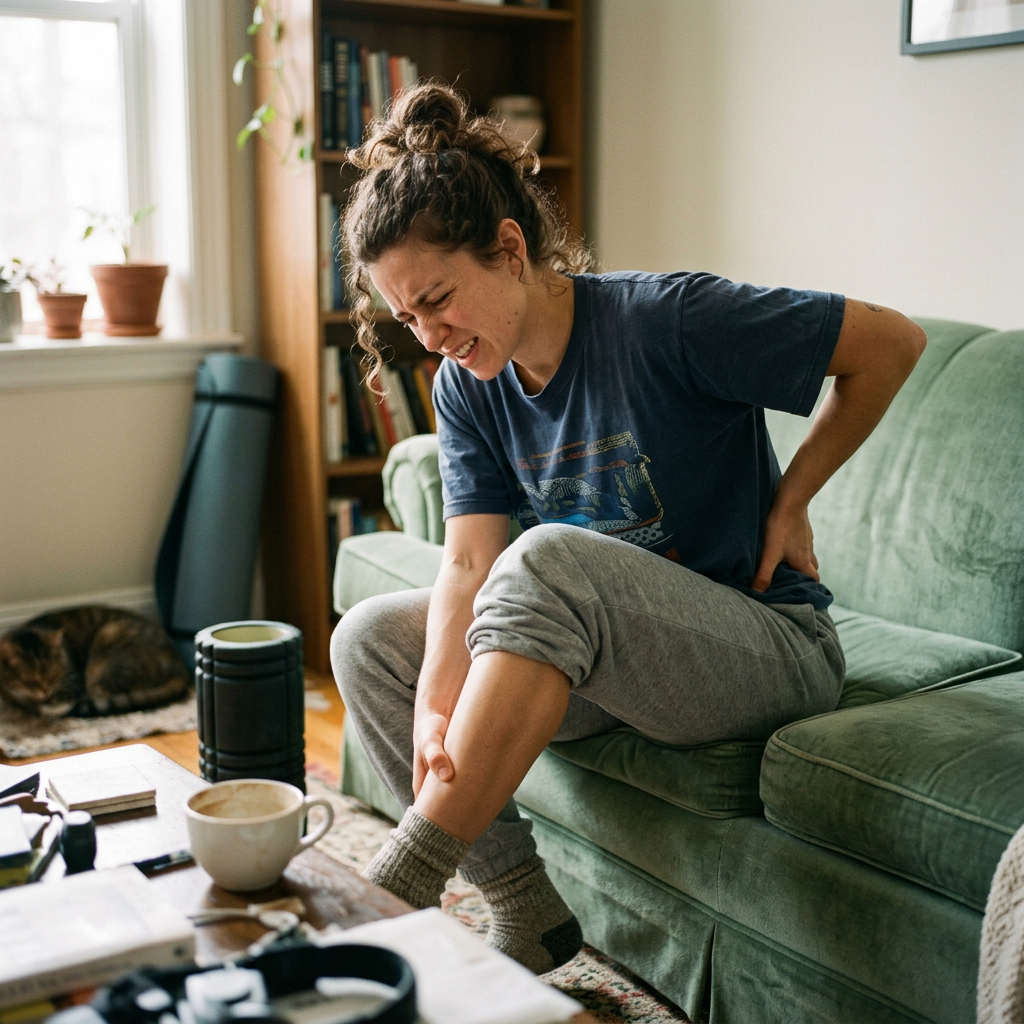
You crushed your workout yesterday. You felt fine going to bed, you woke up okay, and then somewhere around hour 36 your quads turned to concrete. Walking down stairs feels like a punishment. Even sitting is a negotiation. Welcome to delayed onset muscle soreness, better known by the gloriously unscientific acronym DOMS.
Here’s the part most people get wrong: DOMS isn’t lactic acid (that myth was debunked decades ago), it isn’t a sign of a great workout (it can mean the opposite), and it doesn’t mean you have to lie on the couch and suffer. The 2025 research on muscle soreness has finally given us a clear playbook for what speeds recovery, what doesn’t, and which tools are worth the money. This guide breaks down the science of why DOMS peaks 48 hours after training, then walks you through the five recovery tools that have the best evidence behind them in 2026 every product verified in stock on Amazon, hand-picked for value, and battle-tested by athletes and physical therapists.
Whether you’re a beginner who just discovered leg day, a runner coming off a long Sunday, or a lifter chasing PRs, this is your complete DOMS survival guide.
🌱 Quick Picks: 5 DOMS Recovery Tools That Actually Work
- TriggerPoint GRID Foam Roller — Best Overall (~$39.99) — multi-density, 12K+ five-star reviews
- TOLOCO Massage Gun — Best Value Percussion (~$59.99) — 10 heads, 7 speeds, brushless motor
- CopperJoint Calf Compression Sleeves — Best for Active Recovery (~$22.99) — 20–30 mmHg medical-grade
- ProsourceFit Acupressure Mat & Pillow Set — Best for Whole-Body Relief (~$29.99) — 8,910 spike points
- TheraICE PROpack Cold Therapy Pack — Best for Cold Therapy (~$24.99) — 12×15 oversized reusable pack
📖 Table of Contents
- What Is DOMS, Actually? (The Real Science)
- Why Does Soreness Peak 48 Hours Later?
- 1. TriggerPoint GRID Foam Roller
- 2. TOLOCO Massage Gun
- 3. CopperJoint Calf Compression Sleeves
- 4. ProsourceFit Acupressure Mat & Pillow
- 5. TheraICE PROpack Cold Therapy Pack
- Side-by-Side Comparison Table
- Buying Guide
- DOMS FAQ
- Final Verdict
What Is DOMS, Actually? (The Real Science)
DOMS is the deep, dull, achy soreness that shows up in muscles you trained 24–72 hours earlier. According to a 2024 review in the German Journal of Sports Medicine, the underlying cause is microscopic damage to muscle fibers and connective tissue — not lactic acid buildup, which actually clears the bloodstream within an hour after exercise.
The mechanical strain during exercise (particularly eccentric movements like the lowering phase of a squat or running downhill) creates tiny tears in your muscle fibers. Your body then triggers an inflammatory cascade to repair them. That inflammation not the damage itself is what makes you sore. Sensitized nerve endings around the muscle send pain signals every time you contract or stretch the area.
The most counterintuitive finding in the modern literature: DOMS is not a reliable indicator that your workout was effective. You can build muscle and strength without it (especially as you become more trained), and being extremely sore can actually mean you overdid the eccentric load and slowed your next session.
Why Does Soreness Peak 48 Hours Later?
This is the question almost everyone asks, and the answer is a beautifully timed inflammatory response. Here’s the timeline most exercise scientists agree on:
- 0–6 hours post-workout: Microtears in muscle fibers occur. You feel mostly fine — maybe a “pumped” or “tight” sensation.
- 6–24 hours: Immune cells (neutrophils, then macrophages) flood the damaged tissue. Inflammation begins to build. You may notice mild stiffness.
- 24–48 hours: Inflammatory cytokines (IL-6, TNF-α) sensitize pain nerves. Soreness ramps up sharply.
- 48–72 hours: Peak soreness. Pressure pain threshold drops, range of motion is restricted, strength is reduced ~10–20%.
- 72–120 hours: Repair processes (satellite cells fusing to damaged fibers) take over. Soreness fades.
- Day 5–7: Full resolution. The muscle is now slightly stronger and more resilient than before — the “repeated bout effect.”
The 48-hour peak is real, predictable, and not a sign anything is wrong. It’s just biology doing its job. The question is what to do during that window and that’s where the right recovery tools earn their place.
Now, let’s get into the gear. Every product below is in stock on Amazon as of this writing, has hundreds (often thousands) of verified reviews, and addresses a research-backed mechanism for reducing DOMS pain or speeding recovery.
1. TriggerPoint GRID Foam Roller
~$39.99 · Check Price on Amazon

If you only buy one DOMS recovery tool in 2026, make it the TriggerPoint GRID. With more than 12,000 five-star reviews on Amazon and a place in nearly every physical therapy clinic and CrossFit box in the country, it has earned its reputation. The patented multi-density GRID surface alternating ridges and nodules does a remarkable job mimicking the feel of a therapist’s hands.
What makes it different from a $14 round foam roller is the hollow EVA-wrapped core. It maintains its shape under heavy pressure (rated for up to 500 lbs), so even big lifters won’t deform it. A 2019 meta-analysis in the Journal of Strength and Conditioning Research found that 60–90 seconds of foam rolling per muscle group, performed 2–3 times in the 48-hour window after exercise, produces statistically significant reductions in DOMS pain scores and faster restoration of strength.
The 13-inch length makes it easy to store, take to the gym, or stash under the couch. Purchase includes free access to TriggerPoint’s online instructional video library genuinely useful for getting the technique right.
Length: 13 inches · Diameter: 5.5 inches · Weight: 1.4 lbs
Capacity: 500 lbs · Material: EVA foam, ABS core · Warranty: 1 year
2. TOLOCO Massage Gun
~$59.99 · Check Price on Amazon

Percussion therapy repeated rapid taps from a massage gun has rapidly shifted from “luxury” to “routine recovery tool” in the last few years, and the TOLOCO Massage Gun is why. With over 62,000 positive Amazon reviews, it punches well above its sub-$60 price point. A 2025 systematic review found that percussion therapy applied to a sore muscle group for 1–2 minutes can reduce 24- and 48-hour DOMS pain scores by 15–30% compared to passive rest.
What you get for the price: 10 interchangeable massage heads (ball, fork, bullet, flat, and more each shaped for a specific muscle group), 7 speed settings ranging from light flutter to deep percussion, and a brushless silent motor that operates around 40–50 dB (quieter than a microwave). Battery life lands around 6 hours per full charge, more than enough for two weeks of daily 5-minute sessions.
It also doubles as a warm-up tool: 30 seconds of low-speed percussion on a target muscle increases blood flow and joint range of motion before you train, which itself reduces post-workout soreness severity.
Heads: 10 · Speed settings: 7 · Amplitude: 12mm
Stall force: ~30 lbs · Battery: ~6 hours · Noise: 40–50 dB
3. CopperJoint Calf Compression Sleeves
~$22.99 · Check Price on Amazon

Graduated compression has some of the strongest evidence in the DOMS literature. A PubMed-indexed review on DOMS treatment strategies highlights compression as one of the few modalities that consistently reduces 24- and 48-hour pain scores when worn after lower-body training. The mechanism: pressure helps clear inflammatory metabolites and reduces the swelling that sensitizes nerve endings.
The CopperJoint Calf Compression Sleeves hit a 20–30 mmHg pressure range what’s typically called “medical-grade.” That sweet spot is firm enough to provide real circulatory benefit, but not so tight you can’t wear them for hours. The copper-infused nylon fabric is anti-odor, breathable, and noticeably more comfortable than the bargain compression sleeves you’ll find for $8.
They’re a favorite for runners after long efforts, lifters on heavy leg days, and desk-bound athletes who want to keep blood flowing during the workday. Throw a pair on for 1–2 hours after training and you’ll feel the difference at the 48-hour mark.
Compression: 20–30 mmHg · Material: Copper-infused nylon · Sizes: S–5XL
Sold as: Pair · Style: Footless calf sleeve · Wash: Machine cold
4. ProsourceFit Acupressure Mat & Pillow Set
~$29.99 · Check Price on Amazon

The ProsourceFit Acupressure Mat is one of those products that looks like a gimmick and turns into a daily ritual. The mat is studded with 8,910 plastic spike points across 230 spike disks, plus a matching neck pillow with another 1,782 points. Lie down on it for 10–20 minutes and the initial sharpness fades into a deep, warm, almost trance-like relaxation as blood flow increases and your nervous system shifts toward “rest and digest.”
How it helps DOMS: the mat works through acupressure-style stimulation, which research has linked to reduced perceived pain and lower cortisol levels. While the studies aren’t as robust as those for foam rolling or compression, it’s a low-risk, high-comfort tool that thousands of athletes swear by for back, hip, and shoulder soreness.
It also pairs well with sleep a 15-minute session before bed has been reported to help users fall asleep faster, which itself is one of the strongest DOMS recovery accelerators in the literature. Better sleep = lower inflammation = less morning stiffness.
Mat: 26″×17″ · Spike points: 8,910 (mat) + 1,782 (pillow)
Filling: Coconut fiber · Cover: 100% cotton · Bag: Included
5. TheraICE PROpack Cold Therapy Pack
~$24.99 · Check Price on Amazon

Cold therapy is one of the oldest tools in the recovery toolbox, and a 2025 network meta-analysis published in the Journal of Pain Research placed it in the top tier of physical therapy modalities for reducing DOMS within the 48-hour window. Cold constricts blood vessels, slows the inflammatory response, and dampens nerve conduction velocity translation: less swelling, less pain.
The TheraICE PROpack is an oversized 12×15-inch reusable gel pack that’s flexible when frozen, which is a much bigger deal than it sounds. Most ice packs turn rock-hard and refuse to contour to a knee or low back. The PROpack stays bendy down to 0°F, so it actually wraps around the body part you’re treating. It also doubles as a hot pack microwave it for 90 seconds and you’ve got moist heat for stiff muscles the next morning.
The size is the killer feature. It covers your entire lumbar spine, both quads, or a full hamstring in one pack. Nylon outer shell wipes clean and stands up to years of use.
Size: 12″ × 15″ · Type: Hot & cold gel · Outer: Soft nylon
Reusable: Yes · Use time: 15–20 min · Storage: Lay flat in freezer
Side-by-Side Comparison
| Product | Price | Key Spec | Best For | Rating |
|---|---|---|---|---|
| TriggerPoint GRID Roller | ~$39.99 | 13″ multi-density | Daily self-myofascial release | ★★★★★ (12K+) |
| TOLOCO Massage Gun | ~$59.99 | 10 heads, 7 speeds | Targeted percussion therapy | ★★★★★ (62K+) |
| CopperJoint Calf Sleeves | ~$22.99 | 20–30 mmHg compression | Active recovery / standing days | ★★★★½ |
| ProsourceFit Acupressure Mat | ~$29.99 | 8,910 spike points | Whole-body relaxation + sleep | ★★★★½ |
| TheraICE PROpack | ~$24.99 | 12×15 hot/cold gel | Acute soreness & large areas | ★★★★★ |
Buying Guide: How to Pick the Right DOMS Tool
Match the tool to the soreness pattern
Localized, deep soreness in one or two muscle groups (a lifter’s quad or a runner’s calf) responds best to percussion (massage gun) or targeted foam rolling. Whole-body fatigue from a long endurance day responds better to compression and an acupressure mat. Joint-adjacent soreness with visible swelling think after a hard hike is the classic case for cold therapy in the first 24 hours.
Don’t waste money on overlap
You don’t need every tool on this list. Most home athletes do beautifully with a foam roller plus one of: massage gun, compression sleeves, or cold pack pick whichever matches the kind of training you do most. Save the acupressure mat and a second item for a future upgrade.
Quality of materials matters more than features
A $14 bargain foam roller will lose its shape in 6 months and the foam will start flaking. A $300 massage gun with a flimsy carrying case will rattle apart faster than a $60 unit with solid build. Read the 1-star reviews on Amazon they’re more useful than the 5-star ones and make sure failure modes (battery dies, foam crushes, fabric pills) aren’t the norm.
DOMS FAQ
Q: Should I work out with DOMS?
Yes, usually. Light cardio, walking, swimming, and easy mobility work all increase blood flow to sore muscles and have been shown to reduce the severity of soreness, not worsen it. Avoid heavy training of the same muscle group at peak soreness (24–72 hours), but training a different muscle group is totally fine.
Q: Does stretching cure DOMS?
The research is mixed. Static stretching during the soreness window probably doesn’t reduce DOMS pain, but it also doesn’t worsen it. Dynamic stretching and gentle movement seem more effective for actually feeling better. (See Physiopedia’s DOMS overview for the meta-analysis details.)
Q: Are ice baths better than heat for DOMS?
Cold is better in the first 24 hours when inflammation is still ramping up; heat is more effective in the 48–72-hour window when the muscle is stiff and you want to encourage blood flow to clear waste products. Contrast therapy (alternating hot and cold) combines the benefits and a tool like the TheraICE PROpack handles both.
Q: How long does DOMS last?
Typically 24–72 hours of significant soreness, with full resolution by day 5–7. If you’re still notably sore at day 7+, it’s no longer typical DOMS consider a doctor’s visit to rule out a strain or rhabdomyolysis (rare but serious).
Q: Will I always get DOMS, even as I get fitter?
No. The “repeated bout effect” is well-documented: once your body has adapted to a movement, the same workout will produce far less soreness next time. New stimuli (a new exercise, a heavier weight, a longer run) are what trigger DOMS. As you build training experience, soreness becomes less frequent and milder.
🌿 Final Verdict: Our Top Picks
If you only buy one thing: The TriggerPoint GRID Foam Roller. It’s the most evidence-backed, versatile, durable tool on this list, and at ~$40 it pays for itself in one skipped sports massage.
If you want a serious upgrade: Add the TOLOCO Massage Gun to the foam roller. The combo handles 95% of DOMS scenarios for under $100.
For runners and long-day athletes: The CopperJoint Calf Sleeves are the cheapest, easiest win.
For whole-body soreness + better sleep: The ProsourceFit Acupressure Mat.
For acute swelling: The TheraICE PROpack. The dual hot/cold function makes it the most versatile single therapy pack on the market.
Conclusion: The 48-Hour Rule
Here’s the takeaway: DOMS is normal, predictable, and actually a sign your body is adapting and getting stronger. It peaks 48 hours after training because that’s when the inflammatory response hits its maximum not because anything is wrong. The right combination of tools foam rolling for self-myofascial release, percussion for targeted relief, compression for active recovery, cold for inflammation, and an acupressure mat for whole-body relaxation can shave hours and intensity off that peak.
You don’t have to sit in a tub of ice or buy a $600 device to recover well. The five tools above are battle-tested, in-stock, and each costs less than a single deep-tissue massage. Build your DOMS toolkit one piece at a time, and the 48-hour window will start feeling a lot less brutal.
Quick links to everything:
- TriggerPoint GRID Foam Roller
- TOLOCO Massage Gun
- CopperJoint Calf Compression Sleeves
- ProsourceFit Acupressure Mat & Pillow Set
- TheraICE PROpack Cold Therapy Pack
Want more recovery deep-dives? Check out our guides on active recovery vs. complete rest, ice or heat for sore muscles, and how to sleep better for faster muscle recovery.
Leave a Reply