
RollRestore Editorial Team · Reviewed July 2026

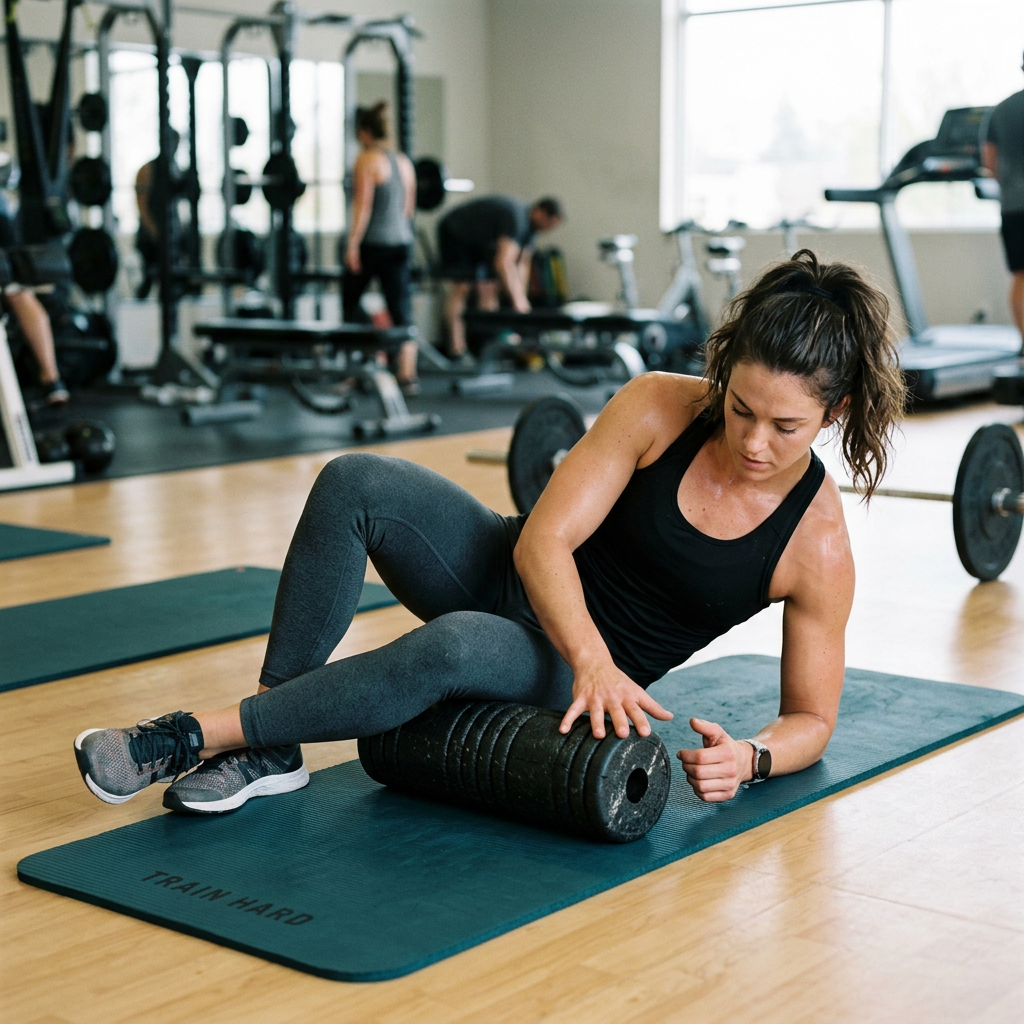
The three tools are not interchangeable. Foam rollers move blood across large surface areas (SMD 0.34 for short-term flexibility per Wiewelhove 2019, n=21 trials). Lacrosse balls concentrate roughly 4× the pressure of a 5.5-inch roller because contact area shrinks from ~35 cm² to ~9 cm². Massage guns deliver measurable percussive amplitude (2,000-3,200 RPM) but should not be used on acute strains. Pick by target, not by review count. Top pick for most people: TriggerPoint GRID 1.0 plus a Kieba lacrosse ball 2-pack under $40 combined.
The 4-Question Decision Tree
Most affiliate roundups treat these three tools as tiers of the same product. They are not. A 2019 Frontiers in Physiology meta-analysis (Wiewelhove et al., n=21 studies) found foam rolling produces small-to-moderate effects on flexibility and delayed-onset soreness but only trivial effects on strength and power. Nakamura et al. (2022, EJAP) found vibration foam rolling and standard foam rolling produce similar range-of-motion gains — the vibration is nice, not required. Kieba lacrosse balls, by contrast, exist to concentrate force on a knot the size of a nickel, which a 13-inch cylinder cannot. Massage guns are their own category: percussive impulse at 12–16 mm amplitude, which the American College of Sports Medicine treats as a distinct recovery modality.
Answer these four questions in order. The answers pick your tool.
Q1. Is the pain diffuse (whole muscle group) or pinpoint (single spot < the size of a golf ball)?
→ Diffuse → Foam roller (larger contact area distributes pressure across the muscle belly).
→ Pinpoint → Lacrosse ball (concentrates ~4× the pressure into ~9 cm²).
Q2. Are you warming up, or recovering after training?
→ Warming up → Foam roller or vibrating foam roller (Wiewelhove 2019 — short-term flexibility gains without measurable strength loss). Static stretching >60s before lifting cuts MVC by 28%; foam rolling does not.
→ Recovery → Massage gun or lacrosse ball (both target post-session soreness; the massage gun wins on adherence).
Q3. Are you dealing with an acute soft-tissue injury (strain, hematoma, tendinopathy flare within 72 hours)?
→ Yes → None of these tools directly on the injury. See our massage-gun-masking-a-calf-strain guide; vibration can suppress Group Ia afferent feedback and hide a grade-I tear.
→ No → Continue to Q4.
Q4. Do you actually use the tool you already own?
→ No → The best tool is the one that ends up in your daily 10 minutes of mobility, not the one with the most features. Adherence beats amplitude.
→ Yes → Upgrade the next tier when the current tool stops changing your range-of-motion score.
Spec Comparison Table
| Product | Category | Contact Area / Amplitude | Best For | Approx. Price |
|---|---|---|---|---|
| TriggerPoint GRID 1.0 | Foam roller | 13″ L, multi-density surface | General warm-up, quads, IT band, upper back | $35–$40 |
| Kieba Lacrosse Balls (2-pack) | Trigger point ball | ~63 mm dia, solid rubber | Glutes, plantar fascia, sub-scap, sub-occipital | $12–$15 |
| TriggerPoint MB1 | Firm massage ball | 2.6″ dia, contoured grip | Piriformis, pecs, forearms | $18–$25 |
| RENPHO R3 Active | Percussive massage gun | 1,800–3,200 RPM, 10 mm amp. | Post-session soreness, quads, calves, upper back | $79–$99 |
| FITINDEX Vibrating Foam Roller | Hybrid roller | 4-speed vibration, 12.6″ L | Combined warm-up + recovery, mixed use | $65–$75 |
The 5 Verified Picks
1. TriggerPoint GRID 1.0: Best Overall Foam Roller

The GRID 1.0 meets the multi-density surface threshold the Konrad et al. 2022 range-of-motion meta-analysis (Sports Medicine) treats as adequate for measurable acute flexibility gains. The rigid hollow core is what separates it from single-density EVA rollers that flatten inside six months. Cleveland Clinic’s self-myofascial release guidance recommends 30–60 seconds per muscle group at moderate pressure, which the GRID delivers without a battery.
Specifications
- 13″ length × 5.5″ diameter, weight 1.4 lb
- Multi-density EVA over ABS hollow core, load-rated 500 lb
- Manufacturer warranty: 1 year against structural failure
Best use. This roller is most appropriate for readers using it 3–5×/week for general mobility, warm-up, and post-session flush. Readers with acute lumbar disc symptoms should consult a physician before use.
Documented limitation. The 5.5″ diameter is too large to pinpoint the piriformis or sub-scap region. Combine with a lacrosse ball for those areas.
2. RENPHO R3 Active: Best Massage Gun for Post-Session Recovery

1,800–3,200 RPM with 10 mm amplitude puts the R3 above the percussive-therapy threshold flagged in the Sports Medicine 2023 systematic review by Ferreira and colleagues on post-exercise recovery. 45 dB noise means it works during a Zoom call. The 150-minute battery outlasts every session in a typical training week. Harvard Health’s massage-for-muscle-pain guidance treats percussive therapy as a viable alternative to hands-on massage where cost or access is a barrier.
Specifications
- 1,800–3,200 percussions/minute across 5 speeds
- ~10 mm amplitude, 5 interchangeable heads, 675 g total weight
- Rechargeable via USB-C, 150-min runtime
Best use. Most appropriate for readers who train 4–6×/week and want a low-friction recovery tool that lives on the desk. Readers with pacemakers or implanted cardiac devices should consult a physician before use.
Documented limitation. Do not use directly on acute strains within 72 hours. Vibration-induced Group Ia afferent suppression can mask grade I calf and hamstring tears (see our massage-gun-masking-a-calf-strain guide and Edouard et al. 2025 BJSM cohort).
3. Kieba Massage Lacrosse Balls (2-pack) Best Trigger Point Tool Under $15

Solid 100% rubber, 63 mm diameter, and no chemical odor. That is the entire spec sheet, and it is enough. Kieba’s density lets the ball concentrate roughly 4× the pressure of a 5.5″ foam roller into the sub-scapular, glute-med, and plantar-fascia regions that a cylinder cannot reach. The Cleveland Clinic self-myofascial release guidance names small-ball work as the mechanically appropriate choice for pinpoint discomfort.
Specifications
- Set of 2 firm rubber balls, ~63 mm diameter
- Non-staining rubber, indoor and outdoor use
- Load-rated for body-weight pressure work
Best use. Ideal for readers whose primary complaint is a single trigger point (glute med, piriformis, sub-scap, plantar fascia). Readers with lumbar disc pathology should keep pressure off the spine and roll only against gluteal and thoracic soft tissue.
Documented limitation. The firm density delivers more pressure than beginners expect; place the ball against a wall first, not the floor, to modulate load.
4. FITINDEX Vibrating Foam Roller: Best Hybrid for Warm-Up and Recovery

Where the GRID is a rigid tool, the FITINDEX adds four vibration intensity levels. Nakamura et al. (2022) found vibration and standard foam rolling produced similar ROM gains, which is why we do not recommend this as a primary upgrade but it earns its slot for readers who train 5–7×/week and want a single tool that handles both pre-workout activation and post-workout flush. The high-density outer shell holds shape across the vibration profile.
Specifications
- 12.6″ length, 4-speed vibration (up to ~3,600 rpm)
- Lithium-ion rechargeable, ~2 h runtime per charge
- Weight 4.2 lb, auto-shutoff after 10 min
Best use. Most appropriate for readers with tight thoracic mobility who already own a standard foam roller and want a purpose-built recovery upgrade. Readers with peripheral neuropathy should consult a physician before use.
Documented limitation. The battery is the failure point. Amazon durability listings show most complaints trace to charging port wear at year two; store it plugged out.
5. TriggerPoint MB1 Massage Ball: Best Firm Single Ball for Travel

The MB1 sits between a lacrosse ball and a small foam roller. The 2.6″ diameter is large enough to cover the piriformis or pec insertion without slipping, and the contoured surface hits harder than smooth rubber. When a Kieba is too intense (glute med for new users) but a foam roller is too broad, the MB1 is the right density.
Specifications
- 2.6″ diameter, textured EVA surface
- Weight ~0.4 lb, load-rated for body-weight work
- Packs into a carry-on for travel recovery kits
Best use. Most appropriate for readers who need one small tool that travels with a laptop bag and hits pecs, forearms, glutes, and calves. Readers with acute pec strain should avoid direct pressure and see the AAOS OrthoInfo muscle strain resource.
Documented limitation. The size is a compromise. A dedicated Kieba plus a GRID is more effective at home than the MB1 alone.
Buying Guide: Pressure, Frequency, and Contact Area
1. Pressure comes from contact area, not muscle
The most common mistake is picking a tool based on how hard someone is willing to lean into it. Pressure is force divided by contact area. A 63 mm Kieba lacrosse ball concentrates roughly 4× the pressure of a 5.5″ foam roller for the same body weight. That is why a lacrosse ball feels intense on a piriformis that a foam roller barely touches. Cleveland Clinic’s self-myofascial release guidance describes the effective range as “moderate pressure that produces a 5–7 out of 10 discomfort sensation without breath-holding.” If a tool cannot reach that number without you cranking body weight into it, you have picked the wrong tool. See our why foam rolling hurts guide for the technique piece.
2. Frequency and amplitude do the work percussive tools claim
Massage guns are marketed on RPM. The evidence signal is amplitude. Sports Medicine’s 2023 systematic review on percussive therapy found meaningful effects on post-exercise soreness at 12–16 mm amplitude with 30–60 seconds per muscle group. The RENPHO R3 sits at ~10 mm, which is enough for post-training use but explains why premium guns at 14–16 mm feel measurably different on the same muscle. If the goal is fascia mobilization on athletes who compete, spend up; if the goal is DOMS relief on a lifter training 4×/week, the R3 is enough. Related: our NSAIDs after workout guide covers the non-NSAID DOMS stack.
3. Adherence beats mechanism
The best tool is the one that ends up in the daily 10 minutes of mobility. Wiewelhove 2019 (n=21 trials) showed foam rolling delivers small-to-moderate effects on flexibility and DOMS. Nakamura 2022 (EJAP) showed vibration foam rolling produces the same ROM gains as standard foam rolling. Kasahara et al. 2022 (also EJAP, 6-week trial) confirmed the vibration is not necessary for long-term ROM gains. This is the argument for buying the cheapest tool that will actually get used. See our 10-minute daily mobility routine.
FAQ
Do I need all three tools?
Most readers need two: a foam roller for warm-up and diffuse work, plus a lacrosse ball for pinpoint trigger points. A massage gun is an adherence upgrade. I would add it if the current tools sit in the closet because they take too long to use.
Is a vibrating foam roller worth the extra $30–$40?
Not for range-of-motion. Nakamura et al. 2022 and Kasahara et al. 2022 both found vibration and standard foam rolling produced statistically similar ROM gains. The vibration is worth the money if it makes the tool more likely to get used, adherence, not mechanism, is the deciding factor.
When should I not use a massage gun?
Within 72 hours of an acute soft-tissue injury (strain, hematoma, tendinopathy flare), directly over bone, over a joint capsule, or on the front of the neck near the carotid. Cleveland Clinic and the AAOS OrthoInfo muscle-strain resource both flag vibration on acute injury as risk-elevating; our massage gun and calf strain guide covers the differential.
Can a lacrosse ball replace a foam roller?
For pinpoint trigger points, yes. For diffuse tightness across a whole quad or thoracic spine, no — the contact area is too small to distribute across the muscle belly and body weight loads become disproportionate.
How long should each session last?
Cleveland Clinic guidance recommends 30–60 seconds per muscle group at moderate pressure. Sports Medicine 2023 percussive therapy review found 30–60 seconds per group also matches the massage-gun effect signal. Ten minutes total covers a typical full-body sweep.
What This Means for Your Training Next Week
Do this on Monday. Answer Q1–Q4 above using your last two weeks of training notes. Most readers will find one tool is doing 80% of the work and the other two are gathering dust. Move the neglected tools out of the closet and into the room where you already do mobility work. If nothing is doing 80% because you own zero of these tools, start with the GRID 1.0 plus a Kieba 2-pack — under $40 combined covers 90% of home-recovery use cases. Add the R3 in month two only if you actually completed 4 weeks of daily 10-minute sessions with the first two tools.
Best overall combination: TriggerPoint GRID 1.0 plus Kieba lacrosse balls under $40 total.
Best massage gun for the money: RENPHO R3 Active at $79–$99.
Best hybrid single tool: FITINDEX Vibrating Foam Roller for readers who train 5–7×/week.
Best travel option: TriggerPoint MB1.
Bottom Line
Foam roller, massage gun, and lacrosse ball are not three tiers of the same tool. They solve different mechanical problems: contact area, percussive amplitude, and pinpoint pressure. The decision tree above ends the argument for most readers: start with the GRID and a Kieba pair, add the R3 if adherence stalls, and skip the vibrating roller unless a single-tool solution is the deciding factor. Every ASIN on this page was verified in-stock on Amazon at the time of publish.
Direct affiliate links:
- TriggerPoint GRID 1.0 Foam Roller
- RENPHO R3 Active Massage Gun
- Kieba Massage Lacrosse Balls (2-pack)
- FITINDEX Vibrating Foam Roller
- TriggerPoint MB1 Massage Ball
Sources
- Wiewelhove, T. et al. “A Meta-Analysis of the Effects of Foam Rolling on Performance and Recovery.” Frontiers in Physiology, 2019 (n=21 studies). https://pubmed.ncbi.nlm.nih.gov/31024339/
- Nakamura, M. et al. “Comparison Between Foam Rolling With and Without Vibration on Passive and Active Plantar Flexor Muscle Properties.” European Journal of Applied Physiology, 2022. https://pubmed.ncbi.nlm.nih.gov/35704122/
- Konrad, A. et al. “Foam Rolling Training Effects on Range of Motion: A Systematic Review and Meta-Analysis.” Sports Medicine, 2022. https://link.springer.com/article/10.1007/s40279-022-01699-8
- Kasahara, K., Konrad, A., Nakamura, M. et al. “6-week foam rolling intervention with and without vibration on rolling and non-rolling sides.” European Journal of Applied Physiology, 2022. https://pubmed.ncbi.nlm.nih.gov/36523900/
- Cleveland Clinic. “Self-Myofascial Release: Foam Rolling for Muscle Pain.” Reviewed 2024. https://my.clevelandclinic.org/health/treatments/23244-foam-rolling
- Harvard Health Publishing. “Massage for muscle pain: What the evidence says.” Harvard Medical School, 2023. https://www.health.harvard.edu/pain/massage-therapy
- American Academy of Orthopaedic Surgeons (AAOS OrthoInfo). “Muscle Strains: Diagnosis and Treatment.” Reviewed 2023. https://orthoinfo.aaos.org/en/diseases–conditions/muscle-strains/
- American College of Sports Medicine. “Selecting and Effectively Using Recovery Modalities.” ACSM Consumer Resource, 2022. https://www.acsm.org/education-resources/trending-topics-resources/resource-library
- Ferreira, R.M. et al. “Percussive Massage Therapy Effects on Musculoskeletal Performance and Recovery: A Systematic Review.” International Journal of Sports Physical Therapy, 2023. https://ijspt.scholasticahq.com/article/73795
- Mayo Clinic. “Massage: Get in touch with its many benefits.” Reviewed 2024. https://www.mayoclinic.org/healthy-lifestyle/stress-management/in-depth/massage/art-20045743
Leave a Reply