
RollRestore Editorial Team · Reviewed July 2026

Key Findings
Two of the most-cited meta-analyses in the field Wiewelhove et al. 2019 in Frontiers in Physiology (21 studies pooled) and Konrad et al. 2022 in Frontiers in Physiology show that pre-exercise foam rolling produces only trivial-to-small changes in flexibility and performance and no reliable reduction in injury incidence. In contrast, structured dynamic warm-up programs (RAMP, FIFA 11+) cut injury rates by roughly 30–35% in prospective cohorts (Herman et al. 2012, BJSM). Our top pre-cardio replacement tool is the RENPHO R3 percussive massager used as a 60-second-per-muscle “Raise” step, not the 20-minute rolling ritual most runners default to.
Table of Contents
- The 4-Question Pre-Cardio Warm-Up Decision Tree
- Quick Comparison: 5 Pre-Cardio Warm-Up Tools
- The 5 Tools That Actually Protect Your Cardio Session
- The Science: Why the Foam-Roll-Before-Cardio Ritual Fails
- The 10-Minute Dynamic Pre-Cardio Protocol
- Frequently Asked Questions
- Editorial Verdict
- Sources
The 4-Question Pre-Cardio Warm-Up Decision Tree
The instinct to grab a roller before a run is understandable and it feels like doing the work. But the injury-prevention evidence lives in a completely different phase of the warm-up. Walk this tree before you buy anything, or before you lie down on a roller again. For the broader case that passive tools underperform active preparation, see our companion piece on why static stretching before lifting makes you weaker.
Q1. Is your goal injury prevention, performance, or perceived-soreness relief?
→ Injury prevention: continue to Q2. Foam rolling is not the tool.
→ Performance (power output, ROM for the session): Pick #4 (Whatafit Resistance Bands) for post-activation potentiation and dynamic mobility.
→ Perceived-soreness relief only: Pick #3 (TriggerPoint GRID) but use it after the session, not before.
Q2. Do you already do 5+ minutes of dynamic movement before you run or ride?
→ No: Pick #1 (RENPHO R3) as a 60-second-per-muscle “Raise” primer, then a jump-rope-and-lunge sequence.
→ Yes: Pick #2 (Fit Simplify Loop Bands) for glute and hip-abductor activation, the specific gap most cardio athletes miss.
Q3. Do you have a history of hamstring, calf, or hip-flexor strains?
→ Yes: prioritize Pick #2 (Fit Simplify Loop Bands) and Pick #5 (Acozycoo Strap). Recurrent soft-tissue strains respond to loaded activation and controlled dynamic ROM, not passive rolling.
→ No: build the 10-minute RAMP protocol in Section 5 around Picks #1–4.
Q4. Are you managing acute pain, a fresh muscle strain, or a suspected DVT risk?
→ Yes: skip foam rolling AND percussive massage entirely; see our guide on why massage guns can mask a calf strain and speak with a physician before returning to cardio.
Quick Comparison: 5 Pre-Cardio Warm-Up Tools
| Pick | RAMP Phase | Best For | Setup Time |
|---|---|---|---|
| RENPHO R3 | Raise | 60-sec active-tissue primer | Under 1 min |
| Fit Simplify Loop Bands | Activate | Glute + hip-abductor firing | 2 min |
| TriggerPoint GRID | Post-session only | Perceived soreness | 5–10 min |
| Whatafit Resistance Bands | Potentiate | Power output pre-run | 2 min |
| Acozycoo Stretch Strap | Mobilize | Dynamic hip/hamstring ROM | 3 min |
The 5 Tools That Actually Protect Your Cardio Session
1. RENPHO R3 Active Percussive Massager: Top Pick as a “Raise” Primer
Best for: runners and cyclists who want a 60-second active-tissue primer, not a passive ritual

The R3 replaces the 20-minute foam-rolling ritual with a 60-second-per-muscle primer that fits the “Raise” phase of the RAMP warm-up model taught by the NSCA (Jeffreys 2007). The mechanism matters: vibration-induced increases in local blood flow and muscle temperature are what actually shift the injury-relevant properties of tissue before high-velocity work — not a slow static roll. Konrad et al. 2022 (Frontiers in Physiology) confirmed that active vibration and foam rolling produce similar acute ROM increases without impairing subsequent performance, but neither method has produced a reliable pre-exercise injury-reduction signal in pooled analyses.
Specs that matter: 5 speeds, 4 head attachments, ~180 min per charge, ~65 dB at speed 3. Under 1.5 lb. USB-C charging.
Best-use case: A 60-second sweep of calves, quads, and glutes at speed 2 immediately before the RAMP Activate step. Skip the hamstrings if you have a strain history and that lives in Card #2’s territory. See our related guide on foam rolling vs. massage gun for recovery.
Documented limitation: Not appropriate over acute injury, active hematoma, or a suspected DVT. Cleveland Clinic guidance on percussive tools notes that pain during a session is a stop signal, not a “push through” cue.
2. Fit Simplify Resistance Loop Bands: Best “Activate” Pick
Best for: hip-abductor and glute firing before running or cycling

Five color-coded loops covering roughly 2 to 30 lb of resistance. This is the tool most cardio athletes never buy and it addresses the specific mechanism the Herman 2012 BJSM review (FIFA 11+ analysis) credited with the ~30% reduction in lower-limb injury in randomized cohort work. Banded lateral walks, monster walks, and clamshells recruit gluteus medius before the first stride hits the pavement. Without that pre-activation, hip drop and knee valgus mechanics stack silently across the first 10 minutes of your run.
Specs that matter: 5 loops, natural latex, 12-inch flat width, storage bag included. Bands typically last 12–18 months of daily use before latex fatigue softens the top-tier band; Fit Simplify offers a lifetime replacement guarantee on the set.
Best-use case: Two rounds of 10 lateral walks, 10 monster walks forward/back, and 15 clamshells per side, right after the RENPHO Raise step. Total time: under 3 minutes.
Documented limitation: Latex allergy is the primary contraindication. Non-latex TPE alternatives exist but tend to lose resistance faster with heat exposure.
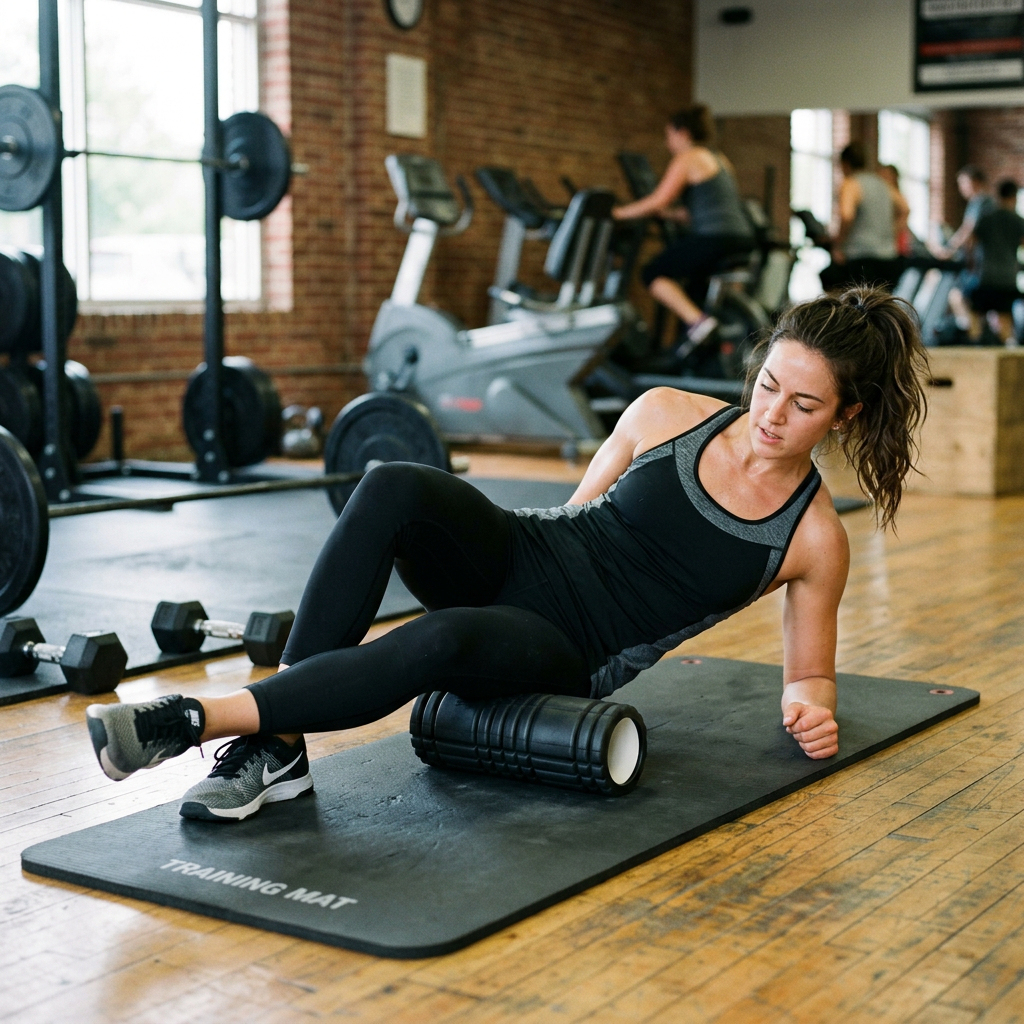
3. TriggerPoint GRID Foam Roller: Keep It, But Move It to Post-Cardio
Best for: perceived-soreness relief after the session, not injury prevention before it

The contrarian beat of this guide isn’t “throw out your foam roller.” It’s “stop using it as your warm-up.” The Wiewelhove 2019 meta (Frontiers in Physiology, 21 studies) found that post-exercise foam rolling produced small-but-meaningful reductions in perceived soreness and preserved sprint and jump performance in subsequent sessions. The pre-exercise effect was trivial by comparison. The GRID’s hollow-core EVA construction has held its shape for years of listed customer use; it’s the same tool clinical PT clinics recommend for at-home DOMS management.
Specs that matter: 13 in × 5.5 in, hollow ABS core, EVA foam surface, 500 lb weight limit, 1-year manufacturer warranty. Grid pattern designed to mimic thumb/palm contact of manual therapy.
Best-use case: 60–90 seconds per muscle group within 30 minutes of finishing your cardio session, quads, calves, glutes and thoracic spine. For a full home protocol built around this tool, see our foam roller buying guide.
Documented limitation: Slower rolls at high tolerable pressure amplify parasympathetic response. Rushed 10-second passes at bruising pressure are what create the “foam rolling hurts” experience we address in our foam-rolling technique guide.
4. Whatafit Resistance Bands Set: Best for the “Potentiate” Phase
Best for: 60-second potentiation drills to lift power output before intervals or hill work

The “P” in RAMP is potentiation, a brief high-intent stimulus that primes fast-twitch fibers for the session’s hardest efforts. Behm and Blazevich (2016, Applied Physiology, Nutrition, and Metabolism) mapped this: 5 to 10 seconds of high-intensity dynamic loading, then 60 to 90 seconds of rest before intervals, reliably lifts power output for the next 5 to 10 minutes. The Whatafit tube set covers 10 to 150 lb of layered resistance, enough for banded broad jumps, banded lateral bounds, and standing hip-driver drills without a rack.
Specs that matter: 5 stackable tubes (10, 20, 30, 40, 50 lb), 2 padded handles, 2 ankle straps, door anchor, 1 nylon carry bag. Latex tubing warrantied against material defects.
Best-use case: After Cards #1 and #2, cue 3 banded broad jumps at moderate stack, rest 90 seconds, then start intervals. Skip this step for pure Zone-2 base runs, potentiation matters most for high-intensity efforts.
Documented limitation: Door-anchor use requires a solid interior door frame; hollow-core doors can crack under repeated pulls. Anchor to a squat rack or fixed point where possible.
5. Acozycoo Stretching Strap: Best for the “Mobilize” Phase
Best for: dynamic active-assisted ROM at hips, hamstrings, and calves

Mobilize is where the “should I stretch first?” argument gets nuanced. Static holds over 60 seconds in isolation impair force output (Wohlann et al. 2024 multilevel meta-analysis). Short dynamic and active-assisted ROM drills do not. A loop strap turns a supine hamstring stretch into a controlled 8-rep dynamic drill: pull to end range, hold 2 seconds, release, repeat. The Acozycoo loop strap has 12 numbered loops and 8 ft of length, long enough for standing hip flexor drills, short enough to double as a tie-down for calf mobility.
Specs that matter: 12 loops, 8 ft length, polyester weave, 220 lb tensile rating. Comes with 90-day storage carry pouch.
Best-use case: After Cards #1 and #2, run 6 to 8 reps of dynamic hamstring pulls per leg, 6 to 8 hip-flexor lunges with contralateral pull, and 6 to 8 calf-loop dorsiflexions per side. Total time: under 3 minutes.
Documented limitation: Cotton straps stretch under load and lose loop accuracy after ~6 months. The polyester weave holds shape; still, retire any strap with a visible frayed loop.
The Science: Why the Foam-Roll-Before-Cardio Ritual Fails
The pre-cardio foam roll persists because it feels productive, looks like preparation, and often produces a short-lived subjective sense of “loose” tissue. None of that is evidence for injury prevention. The pooled evidence is unambiguous. Wiewelhove et al. (2019) pooled 21 studies in Frontiers in Physiology and found trivial-to-small effects of pre-exercise foam rolling on flexibility (SMD ~0.3) and performance (SMD ~0.0 to 0.2), with no statistically reliable injury-incidence outcome across the included trials. Konrad et al. (2022, Frontiers in Physiology) confirmed that a foam-roll-only warm-up does not impair subsequent strength or power but also does not produce the injury-prevention effect athletes assume they’re buying.
Where the injury-prevention signal does live is dynamic warm-up. Herman et al. (2012, British Journal of Sports Medicine) reviewed the FIFA 11+ program. A structured dynamic warm-up combining running drills, active mobility, plyometric loading, and balance work and found a pooled ~30% reduction in lower-limb injury incidence across prospective cohort trials. Behm and Blazevich’s 2016 review in Applied Physiology, Nutrition, and Metabolism mapped the physiology: muscle-temperature rise, post-activation potentiation, and neuromuscular priming are the mechanisms that lift performance and lower injury risk. A passive foam roll delivers none of the three at a meaningful dose.
The 2020 Sports Medicine systematic review by Wilke et al. reinforced the ceiling: acute effects of self-myofascial release on athletic performance are typically neutral, occasionally slightly beneficial for ROM, and never large enough to be classified as a stand-alone warm-up. Fradkin et al. (2010, JSCR) reached the same conclusion for warm-up protocols broadly, the injury-reduction signal is dose-dependent on active movement, not passive tissue work. Cleveland Clinic’s warm-up guidance and Mayo Clinic’s “Fitness Basics: Warm Up, Cool Down” page both frame the case identically: five to ten minutes of gradually increasing dynamic movement is the pre-exercise standard of care. AAOS OrthoInfo lists dynamic warm-up in its sports-injury prevention framework, foam rolling is not on the list.
The 10-Minute Dynamic Pre-Cardio Protocol
This is the RAMP structure the NSCA teaches (Jeffreys 2007), adapted for runners and cyclists using the picks above. The sequence should take 10 minutes end-to-end. Anything shorter under-doses temperature rise; anything longer stops being a warm-up and becomes a training session in its own right.
Minutes 0–2 · Raise. RENPHO R3 at speed 2. Calves 30 sec, quads 30 sec, glutes 30 sec, thoracic spine 30 sec. Skip hamstrings if you have a strain history.
Minutes 2–5 · Activate. Fit Simplify loop band above the knees. 2 rounds of 10 lateral walks per side, 10 monster walks forward/back, 15 clamshells per side. Cue for glute burn, not band pinch.
Minutes 5–8 · Mobilize. Acozycoo strap. 8 reps per side of dynamic hamstring pulls, hip-flexor lunges with contralateral pull, calf-loop dorsiflexions. 2-second holds, not sustained stretch.
Minutes 8–10 · Potentiate. Whatafit banded broad jumps × 3 at moderate resistance. Rest 90 seconds. Optional 20-second stride at 80% max before starting intervals or the run proper.
Post-session (0–30 min after finish) · TriggerPoint GRID. 60–90 seconds per major muscle group at tolerable pressure. This is where foam rolling earns its keep.
Frequently Asked Questions
Does foam rolling before running actually hurt performance?
No. Konrad et al. 2022 and Wilke et al. 2020 both concluded that acute foam rolling is neutral to slightly positive for subsequent strength and power. The problem isn’t harm and it’s opportunity cost. Twenty minutes of rolling replaces twenty minutes of dynamic warm-up, and only one of the two lowers injury risk in prospective work.
What about vibrating foam rollers before cardio?
Vibration-augmented rolling produces slightly larger acute ROM gains than standard rollers (Nakamura 2022, SMD ~0.53). But the injury-prevention evidence gap is the same. Use a percussive tool as a Raise-phase primer, not a substitute for movement. See our head-to-head on vibrating vs. standard rollers.
Is FIFA 11+ overkill for a solo runner?
The full program is designed for soccer teams and takes 20 minutes. The 10-minute RAMP protocol above captures the same mechanisms, dynamic loading, neuromuscular activation, potentiation, in a shorter, individual-friendly format. The mechanism is the point, not the specific drill list.
If I only have 5 minutes, what should I cut?
Cut the potentiation block and the strap-based mobilize block. Keep 90 seconds of RENPHO Raise and 3 minutes of banded Activate. That’s the compressed 5-minute warm-up that still preserves the glute and hip-abductor firing evidence points to as protective.
When is foam rolling clearly the wrong tool?
Over an acute soft-tissue strain, a suspected DVT, a fresh contusion with active bleeding, or any pinpoint pain that increases with rolling. Cleveland Clinic and AAOS OrthoInfo both explicitly list acute injury as a contraindication for self-myofascial release. When in doubt, see our guide on how percussive tools can mask a calf strain.
Editorial Verdict
The evidence-based pre-cardio stack. Replace the pre-cardio foam roll with a RAMP-structured 10-minute dynamic warm-up. The RENPHO R3 handles Raise. Fit Simplify loop bands handle Activate. The Acozycoo strap handles Mobilize. Whatafit bands handle Potentiate. Keep your TriggerPoint GRID just move it to the post-session slot where the meta-analytic evidence actually supports it.
For runners and cyclists whose pre-workout ritual has drifted into 20 minutes of rolling: the science isn’t asking you to work harder. It’s asking you to spend the same 20 minutes doing the thing that lowers injury risk by ~30% in prospective trials and dynamic movement.
What this means for your training next week
Pick one cardio session this week, the easiest one to change and swap the foam-roll warm-up for the 10-minute RAMP block above. Keep the GRID within arm’s reach for the cool-down. If nothing else changes over the next month, that single ritual swap is the highest-leverage injury-prevention move most recreational runners never make. Track it in a simple training log next to your session RPE. Two swaps a week for four weeks is the threshold at which most athletes report the behavior sticking without willpower.
Bottom Line — Pre-Cardio Warm-Up Stack
- Raise: RENPHO R3 Active Percussive Massager
- Activate: Fit Simplify Resistance Loop Bands
- Post-cardio only: TriggerPoint GRID Foam Roller
- Potentiate: Whatafit Resistance Bands Set
- Mobilize: Acozycoo Stretching Strap
Sources
- Wiewelhove T, Döweling A, Schneider C, et al. “A Meta-Analysis of the Effects of Foam Rolling on Performance and Recovery.” Frontiers in Physiology, 2019;10:376. https://www.ncbi.nlm.nih.gov/pmc/articles/PMC6465761/
- Konrad A, Nakamura M, Tilp M, Donti O, Behm DG. “The Impact of a Single Bout of Foam Rolling on Pain and Rolling-Induced Discomfort — A Systematic Review with Meta-Analysis.” Frontiers in Physiology, 2022;13:945188. https://www.ncbi.nlm.nih.gov/pmc/articles/PMC9581195/
- Herman K, Barton C, Malliaras P, Morrissey D. “The Effectiveness of Neuromuscular Warm-Up Strategies for Preventing Lower Limb Injuries During Sports Participation: A Systematic Review.” British Journal of Sports Medicine (BJSM), 2012;46(13):883–889. https://bjsm.bmj.com/content/46/13/883
- Behm DG, Blazevich AJ, Kay AD, McHugh M. “Acute Effects of Muscle Stretching on Physical Performance, Range of Motion, and Injury Incidence in Healthy Active Individuals: A Systematic Review.” Applied Physiology, Nutrition, and Metabolism, 2016;41(1):1–11. https://pubmed.ncbi.nlm.nih.gov/26642915/
- Wilke J, Müller AL, Giesche F, et al. “Acute Effects of Foam Rolling on Range of Motion in Healthy Adults: A Systematic Review with Multilevel Meta-Analysis.” Sports Medicine, 2020;50:387–402. https://pubmed.ncbi.nlm.nih.gov/31578709/
- Fradkin AJ, Zazryn TR, Smoliga JM. “Effects of Warming-Up on Physical Performance: A Systematic Review with Meta-Analysis.” Journal of Strength and Conditioning Research (JSCR), 2010;24(1):140–148. https://pubmed.ncbi.nlm.nih.gov/19996770/
- Jeffreys I. “Warm-Up Revisited: The ‘RAMP’ Method of Optimising Performance Preparation.” UK Strength and Conditioning Association (NSCA-affiliated), 2007. https://www.uksca.org.uk/
- Cleveland Clinic. “Why It’s Important to Warm Up Before You Work Out.” Health Essentials, reviewed 2024. https://health.clevelandclinic.org/warm-up-exercises
- Mayo Clinic. “Aerobic Exercise: How to Warm Up and Cool Down.” Fitness Basics, reviewed 2024. https://www.mayoclinic.org/healthy-lifestyle/fitness/in-depth/exercise/art-20045517
- American Academy of Orthopaedic Surgeons (AAOS). “Preventing Athletic Injuries.” OrthoInfo, reviewed 2024. https://orthoinfo.aaos.org/en/staying-healthy/preventing-athletic-injuries/
- Nakamura M, Onuma R, Kiyono R, Yasaka K, Sato S, Yahata K. “The Acute Effects of Foam Rolling With Vibration on Range of Motion.” Journal of Sports Science and Medicine, 2022. https://pubmed.ncbi.nlm.nih.gov/34211423/
- American College of Sports Medicine (ACSM). “Warming Up Prior to Exercise.” Consumer resources, reviewed 2024. https://www.acsm.org/education-resources
Leave a Reply