
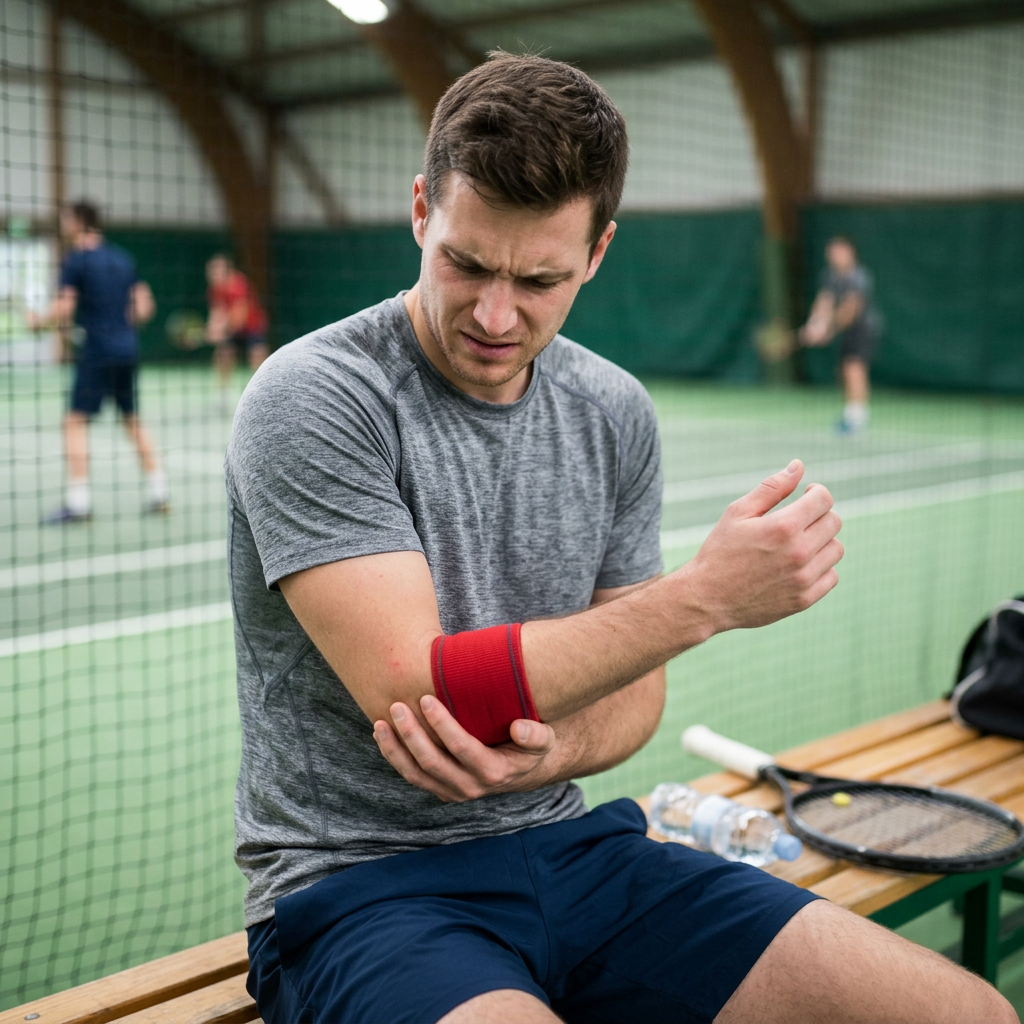
Golfer’s Elbow Deep Dive: Why It Won’t Heal & the Isometric-First Home Protocol
RollRestore Editorial Team · Reviewed September 2026

Key Findings
Medial epicondylitis (golfer’s elbow) is a load-management problem, not an inflammation problem. Rest alone does not resolve it because the underlying tendon degeneration requires controlled mechanical loading to remodel. The most-cited home protocol pairs pain-relieving isometric holds in Weeks 1–2 with the Reverse Tyler Twist eccentric exercise from Weeks 3–8; a 2013 case series of 20 patients (18 competitive athletes, 70% golfers) all previously unresponsive to medication, injection, and PT reported significant pain and strength improvement using a resistance bar for three sets of 15 reverse eccentrics with 60 seconds rest. Top pick: THERABAND FlexBar 2-Pack (Green 15 lb + Blue 25 lb). Budget alternative: THERABAND FlexBar Red 10 lb single bar for Phase 1 only.
Quick Picks
- Best overall (main rehab tool): THERABAND FlexBar 2-Pack — Green 15 lb + Blue 25 lb
- Best for Phase 1 pain/swelling: REVIX Elbow Ice Pack Wrap (detachable gel + spring supports)
- Best for grip & forearm endurance: Prohands Gripmaster Set of 3 (Blue/Red/Black)
- Best all-day support: CAMBIVO 2-Pack Elbow Compression Sleeves
- Best upstream mobility tool: TriggerPoint GRID Foam Roller
Table of Contents
- Why golfer’s elbow won’t heal on rest alone
- The four-phase, 12-week home protocol
- The five tools that make the protocol work
- Comparison table
- Buying guide: what actually matters
- FAQ
- Verdict & next steps
Why Golfer’s Elbow Won’t Heal on Rest Alone
Medial epicondylitis is the technical term for what most people call golfer’s elbow. Despite the “-itis” suffix, current pathology research has largely reframed the condition as a tendinopathy: a degenerative failure of the common flexor-pronator tendon origin rather than an active inflammatory process. StatPearls describes the histology as angiofibroblastic hyperplasia — disorganized collagen, immature vasculature, and a notable absence of inflammatory cells in the chronic phase.1
That distinction matters. Because the tissue is degenerative, not inflamed, rest does not resolve it. Rest simply removes the pain trigger while the tendon remains structurally weak. Return to the same load and the pain returns. This is why so many cases become chronic — and why “just take time off” fails as a strategy.
The AAOS OrthoInfo guidance names the flexor carpi radialis and pronator teres as the two muscles most commonly implicated, with the pathology localized at the medial epicondyle of the humerus.2 Cleveland Clinic notes that golfer’s elbow is caused by repeated wrist flexion, pronation, or grip loading meaning golfers, throwing athletes, climbers, plumbers, and desk workers with poor wrist positioning are all at risk.3
The clinical consensus that has emerged over the last decade points in one direction: controlled mechanical loading is required to remodel the tendon. A 2025 systematic review in Journal of Bodywork and Movement Therapies evaluated eccentric exercise therapy across the medial epicondylitis literature and concluded that structured eccentric loading produces consistent clinical improvement.4 A phased protocol that starts with isometric holds for pain modulation and progresses to eccentric loading is the current best-supported home approach.
The Four-Phase, 12-Week Home Protocol
This structure follows the phased-loading model described in current clinical rehabilitation literature. Move to the next phase only when you meet the exit criteria for the current phase. Skipping ahead is the single most common reason home protocols fail.
Phase 1 — Weeks 1–2: Pain Isometrics & Load Deload
Goal: reduce daily pain, protect the tendon, and begin analgesic isometric loading.
- Ice wrap 15–20 minutes twice daily after aggravating activity (not before).
- Wrist-flexor isometric hold: elbow at 90°, forearm supinated, resist gentle wrist flexion against the palm of the opposite hand. Hold 45 seconds × 5 reps, 2×/day. Pain during the hold up to a self-rated 3/10 is acceptable; sharper pain means reduce force.
- Modify daily loading: lighter grips, thicker handles, avoid repetitive wrist flexion and pronation under load.
Exit criteria: resting pain ≤ 2/10 and the 45-second isometric hold is tolerable at moderate effort.
Phase 2 — Weeks 3–5: Reverse Tyler Twist Eccentrics
Goal: introduce the primary eccentric loading stimulus.
- Reverse Tyler Twist with a resistance bar: 3 sets of 15 reverse eccentrics, 60 seconds rest between sets, once daily. Twist the bar with both hands, then slowly untwist with the injured side over 4 seconds under load.5
- Continue Phase 1 isometrics before or after the eccentric session.
- Load progression: start with the lightest color bar that produces meaningful resistance without a pain spike above 4/10. Progress bar color only when 3×15 is completed for two consecutive days at ≤ 3/10 pain.
Exit criteria: completing 3×15 at the current bar color at ≤ 3/10 pain for five consecutive sessions.
Phase 3 — Weeks 6–8: Grip Endurance & Progressive Load
Goal: rebuild grip endurance and add pronation/supination volume.
- Continue Reverse Tyler Twist, progressing bar color when tolerated.
- Add finger-piston grip work 4×/week: 3 sets of 10–15 reps per finger at a resistance where the last 2 reps are challenging but painless. Grip endurance is the missing link between pain-free rehab and pain-free return to sport.
- Add pronation/supination with a light dumbbell or hammer held at the very end: 2 sets of 12 slow reps each direction, elbow supported on a bench at 90°.
Exit criteria: painless grip fatigue at ≥ moderate load and no next-day flare after the combined session.
Phase 4 — Weeks 9–12: Return-to-Load Gate & Sport-Specific Reintroduction
Goal: return to the activity that provoked the injury without recurrence.
Reintroduce sport or work loading only after clearing all five of the following criteria:
- Resting pain 0/10 for 14 consecutive days.
- Full pain-free grip strength on the affected side (comparable to unaffected side by hand-dynamometer or equivalent everyday test — e.g., carrying two full grocery bags without provocation).
- Painless completion of 3×15 Reverse Tyler Twist at Blue (25 lb) or higher bar color.
- Painless pronation/supination at ≥ 5 lb dumbbell load for 2×12 each side.
- No morning stiffness lasting more than five minutes on waking.
Layer upstream mobility work throughout Phase 4: pec minor, thoracic spine, and scapular positioning all influence load distribution across the forearm. A firm foam roller against the pec minor and thoracic spine for 60 seconds pre-activity is sufficient.
The Five Tools That Make the Protocol Work
1. THERABAND FlexBar 2-Pack — Green 15 lb + Blue 25 lb TOP PICK

The FlexBar is the mechanical vehicle for the Reverse Tyler Twist — the eccentric exercise around which the entire published home protocol for medial epicondylitis is built. The Green (15 lb) and Blue (25 lb) two-pack covers the resistance range needed for the middle-to-late phases of the protocol, allowing the classic progression from lighter to heavier eccentric load without buying multiple single bars.
Manufacturer documentation lists the bar as latex-free, textured for grip retention when hands are wet, and rated at the stated torque values across the color-coded resistance system (Yellow 6 lb, Red 10 lb, Green 15 lb, Blue 25 lb, Black 35 lb).5
Specs: two-pack, Green (15 lb) + Blue (25 lb), textured EVA, latex-free.
Best for: anyone entering Phase 2 of the protocol. Readers who have never done tendon rehab may want to start with a single lighter bar and add the pack later.
Documented limitation: the bar is a single-plane loading tool. It handles the primary eccentric stimulus but does not replace grip-endurance work or upstream mobility. Manufacturer instructions specify hand positioning matters; performing the exercise with reversed hand orientation targets tennis elbow instead of golfer’s elbow.5
2. REVIX Elbow Ice Pack Wrap (Detachable Gel + Spring Supports)

Specification first: the REVIX wrap has a detachable gel pack for freeze/reheat cycling and includes two spring supports that maintain elbow positioning during application. The advertised 45-minute cold-therapy window matches the manufacturer specification for gel volume and neoprene insulation thickness.
Cold therapy after aggravating loads is a symptomatic tool, not a curative one. Cleveland Clinic guidance on golfer’s elbow lists ice application among initial conservative measures alongside activity modification, precisely because it addresses post-load discomfort without expecting to reverse the underlying tendinopathy.3 Using it after the daily eccentric session not before — is the correct sequencing.
Specs: detachable gel pack, neoprene exterior, ice-silk lining, two spring supports, 45-minute cold window (manufacturer figure), sized to wrap the elbow fully.
Best for: Phase 1 post-load application and any Phase 2–3 session that produces a next-day flare. Readers with Raynaud’s or cold-sensitivity conditions should consult a physician before use.
Documented limitation: gel-pack cold therapy is a symptom-management tool. Independent guidance from the AAOS is that pain reduction is not a proxy for tendon healing.2
3. Prohands Gripmaster (Set of 3 Blue/Red/Black)

Most rehab plans stop at eccentric loading and leave grip endurance untouched. That is the gap where recurrence lives. The Prohands Gripmaster uses a spring-loaded finger-piston system so each finger can be loaded independently — which matches the anatomy of the flexor-pronator origin more precisely than crush-style grippers that fire only the strong middle fingers.
Manufacturer specifications list tension levels from 5 lb through 9 lb per finger across the Blue (medium 7 lb), Red (heavy 9 lb), and Black (extra-heavy 9+ lb) trio; that range covers the Phase 3 grip-endurance progression without requiring accessory purchases.
Specs: set of three Prohands Gripmasters, isolated finger pistons, ABS plastic body, stainless-steel springs, santoprene grip.
Best for: Phase 3 grip endurance and the return-to-sport bridge between rehab and sport-specific loading. Musicians, climbers, and racket-sport athletes get particular benefit because the loading is isolated.
Documented limitation: designed for endurance rather than one-rep-max grip strength. If maximum crush strength is the goal, a hand gripper is a better complementary tool — not a replacement.
4. CAMBIVO 2-Pack Elbow Compression Sleeves

This is the tool most often oversold and most often useful. Compression sleeves do not heal a tendinopathy. What they do is provide proprioceptive feedback and mild circumferential support during the everyday movements that trigger flares between rehab sessions — carrying grocery bags, typing, opening jars, driving. The CAMBIVO 3D-knit construction is designed for all-day wear without the pressure points that adhesive counterforce straps create over long shifts.
The manufacturer lists moisture-wicking fabric and a seamless knit that avoids the velcro-strap fatigue common in workday use. Compression garment guidance from AAOS OrthoInfo and general orthopedic sources treats sleeves as an adjunct to loading rehab, not a substitute for it.2
Specs: two sleeves per pack, seamless 3D knit, no velcro, sized S–XL.
Best for: readers who need to keep working through Weeks 1–8 of the protocol and want daytime symptom reduction that does not interfere with function.
Documented limitation: compression provides symptom relief and proprioception, not tissue remodeling. Cleveland Clinic guidance emphasizes that supportive garments are one component of a multi-modal approach.3
5. TriggerPoint GRID Foam Roller (Upstream Mobility)

Compared with the other four tools, the GRID is the one addressing the chain rather than the site. Restricted pec minor and thoracic extension load the medial elbow disproportionately by biasing the entire kinetic chain into flexion and internal rotation. Freeing that upstream restriction is why Phase 4 exists as its own phase in the protocol.
The GRID’s multi-density foam construction has been the industry reference for a decade. The hollow-core design maintains firmness under repeated load without the density collapse common in single-density EVA rollers, which matters if the same roller will still be usable in Year Two of home training.
Specs: 13-inch length, multi-density EVA over hollow ABS core, 500 lb weight capacity, manufacturer warranty 1 year against structural failure.
Best for: Phase 4 pre-activity mobility work on pec minor, lats, and thoracic spine. Also usable long term for full-body recovery, which extends the value beyond this single protocol.
Documented limitation: foam rolling does not directly rehabilitate the elbow. It addresses the upstream mechanics that keep loading the elbow. Trials on foam rolling generally show acute range-of-motion effects without a documented lasting tissue change.
Comparison Table
| Tool | Phase Used | Primary Role | Skip If… |
|---|---|---|---|
| THERABAND FlexBar 2-Pack | Phases 1–4 | Isometric holds + Reverse Tyler Twist eccentrics | You already own Green + Blue bars |
| REVIX Elbow Ice Wrap | Phase 1 daily; PRN thereafter | Post-load symptom management | Cold-sensitive; using CBD/topicals |
| Prohands Gripmaster Set | Phase 3–4 | Isolated finger & grip endurance | Already own a hand-strength system |
| CAMBIVO Sleeves 2-Pack | Phases 1–3 daytime | All-day proprioceptive support | Desk-only workday; low sleeve tolerance |
| TriggerPoint GRID | Phase 4 pre-activity | Upstream pec & thoracic mobility | Already own a firm high-density roller |
Buying Guide: What Actually Matters
1. Resistance Bar Color Selection
The single most common mistake is buying the wrong FlexBar color. Yellow (6 lb) is generally too light to produce a meaningful eccentric stimulus after Week 2 unless the deconditioned state is severe. Red (10 lb) is a reasonable starting point for a completely deconditioned adult but many will out-grow it inside three weeks. Green (15 lb) is the working color for most Phase 2–3 sessions. Blue (25 lb) is the target color for the return-to-load gate. Purchasing the Green + Blue two-pack covers the whole progression without a second order.
2. Compression Sleeve vs. Counterforce Strap
Full-length compression sleeves and adhesive counterforce straps address different problems. Sleeves distribute mild pressure across the forearm and improve proprioception during workday use. Counterforce straps apply focal pressure just distal to the epicondyle to reduce tendon-origin loading during a specific activity, and are generally most useful during return-to-sport and less useful for all-day wear. For a home protocol focused on the eight weeks between diagnosis and return, a sleeve is the higher-utility choice.
3. Grip-Trainer Selection
Two categories exist. Crush-style grippers (Captains of Crush, IronMind) train maximum grip strength. Finger-piston trainers (Prohands, Gripmaster) train isolated finger endurance. For medial epicondylitis rehabilitation the isolated-finger approach is the better match because the flexor-pronator group involves multiple digit-specific tendons feeding into a shared origin. A crush gripper is a useful complement but not a substitute in Phase 3.
Frequently Asked Questions
Should I stop training entirely while doing this protocol?
No. Modify, don’t stop. Continue lower-body work, cardio, and any upper-body movement that does not provoke medial elbow pain. Rowing, gripping heavy dumbbells, and pull-ups typically flare golfer’s elbow; pushing movements (bench press, overhead press) are often tolerated at moderate load. Cleveland Clinic guidance emphasizes activity modification rather than cessation.3
How long until the pain is fully gone?
The 20-patient case series that established the Reverse Tyler Twist reported significant pain reduction across a seven-week structured protocol; individual timelines vary substantially with duration and severity of pre-existing symptoms.5 Chronic cases (six months or more of pain before starting rehab) typically require the full 12 weeks and sometimes longer to reach the five-criterion return gate.
Is it okay if the exercise hurts a little?
Pain up to 3/10 during loading and returning to baseline within 24 hours is generally considered acceptable in tendinopathy rehabilitation. Pain above 4/10 during loading, or pain that increases the following day, means the load is too high. Reduce the bar color or the number of reps and re-test.
Do I need a cortisone injection first?
Not for a home protocol decision. Cortisone can produce short-term symptom relief but the long-term evidence for medial epicondylitis is mixed and some series suggest higher recurrence at 12 months compared with loading-based rehab. AAOS OrthoInfo lists corticosteroid injection as one of several options that a clinician may consider, not as first-line self-management.2 Discuss with a physician if pain is not responding to structured loading after 6–8 weeks.
What if this is actually tennis elbow, not golfer’s elbow?
The same FlexBar is used, but the exercise is reversed. The Tyler Twist (not the Reverse) targets the lateral epicondyle (tennis elbow) via wrist-extensor eccentrics; the Reverse Tyler Twist targets the medial epicondyle (golfer’s elbow) via wrist-flexor eccentrics. If pain is on the outside of the elbow it is likely lateral epicondylitis — see RollRestore’s dedicated tennis-elbow guide for the correct hand positioning.
Verdict & Next Steps
The single most impactful purchase for golfer’s elbow rehabilitation at home is the resistance bar. Everything else in this stack is either symptom management (the ice wrap, the compression sleeves) or extension of the loading principle (the grip trainer, the foam roller for upstream mechanics). If the budget only permits one item, buy the THERABAND FlexBar Green + Blue two-pack and begin the Phase 1 isometric holds today, adding the eccentric Reverse Tyler Twist in Week 3.
For the full protocol as designed, add the REVIX Elbow Ice Wrap for Phase 1, the Prohands Gripmaster set at Week 6, the CAMBIVO sleeves for daytime function through Week 8, and the TriggerPoint GRID before Phase 4 return-to-load work.
Related RollRestore Reading
- Tennis Elbow vs. Golfer’s Elbow: How to Tell the Difference and Fix Both
- Elbow Tendinopathy Beyond Tennis and Golfer’s: Distal Bicep and Triceps Pain
- How to Train Around an Injury Without Losing Progress
Sources
- Kiel J, Kaiser K. “Medial Epicondylitis.” StatPearls, NCBI Bookshelf, Updated 2024. https://www.ncbi.nlm.nih.gov/books/NBK519000/
- American Academy of Orthopaedic Surgeons. “Golfer’s Elbow (Medial Epicondylitis).” OrthoInfo, AAOS. https://orthoinfo.aaos.org/en/diseases–conditions/
- Cleveland Clinic. “Golfer’s Elbow (Medial Epicondylitis): Symptoms & Treatment.” Reviewed 2024. https://my.clevelandclinic.org/health/diseases/21711-golfers-elbow-medial-epicondylitis
- “Eccentric exercise therapy for medial epicondylitis: A systematic review of clinical outcomes.” Journal of Bodywork and Movement Therapies, 2025. https://www.sciencedirect.com/science/article/pii/S0965229926000476
- Tyler TF, Nahow RC, Nicholas SJ, McHugh MP. “Reverse Tyler Twist with the Thera-Band FlexBar for Golfer’s Elbow.” International Journal of Sports Physical Therapy, published summary via Performance Health Academy. https://www.performancehealthacademy.com/reverse-tyler-twist-with-the-thera-band-flexbar-for-golfers-elbow.html
- Tyler TF, Thomas GC, Nicholas SJ, McHugh MP. “Addition of isolated wrist extensor eccentric exercise to standard treatment for chronic lateral epicondylitis: a prospective randomized trial.” Journal of Shoulder and Elbow Surgery, 2010. https://pubmed.ncbi.nlm.nih.gov/20579907/
Leave a Reply