
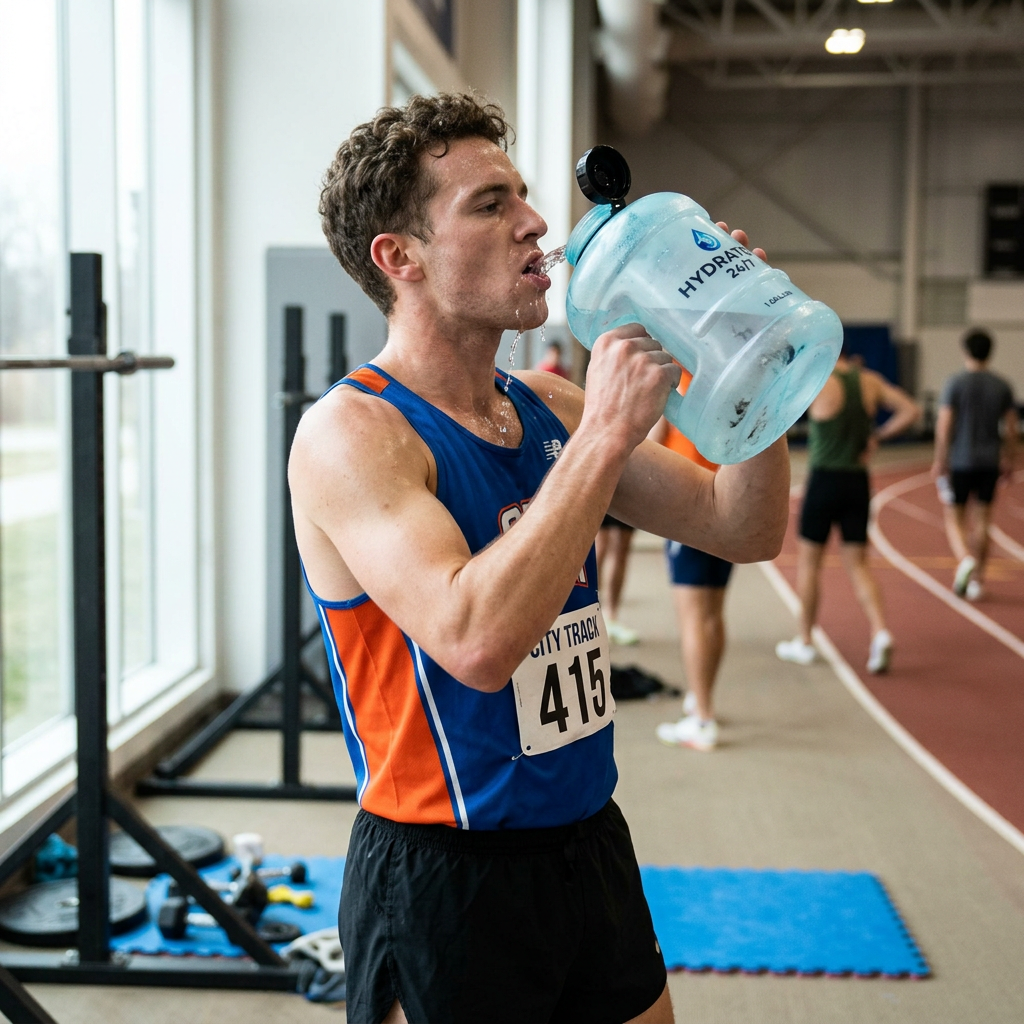

Why “Drink More Water” Is Terrible Advice on Training Days
Every fitness article since 1998 has told you to “drink more water.” The problem: more than what? If you’re a 130 lb runner doing 30 minutes of Zone 2, “more” looks nothing like it does for a 220 lb powerlifter grinding 90 minutes of heavy sets in an 82°F garage. Yet both keep getting handed the same generic “eight glasses” advice which the National Academies of Sciences quietly retired years ago.
Here’s what the actual research says. The American College of Sports Medicine (ACSM) hydration position stand prescribes fluid intake based on body weight, session duration, and sweat rate not thirst, not glass count, not vibes. And when researchers actually measure what athletes drink versus what they need, the gap is usually 30–50%. Most people show up to training already down half a liter and never catch up.
This guide gives you the math, the timing rules, and five bottles sized to hit your number without turning hydration into a full-time job. And if you’ve been reading our recent piece on electrolytes and whether you need them, this is the companion. water first, sodium second.
The 5 Bottles That Actually Hit the Number
- Owala FreeSip 32 oz — Best Overall (dual sip + straw)
- Iron Flask 40 oz Wide Mouth — Best 3-Lid System
- Nalgene Tritan Wide Mouth 32 oz — Best BPA-Free Trackable
- CamelBak Chute Mag 32 oz — Best Magnetic Cap for the Gym Floor
- BUZIO 40 oz Triple-Wall Insulated — Best High-Volume Cold Retention
Table of Contents
- The Hydration Math (30-Second Formula)
- 1. Owala FreeSip 32 oz
- 2. Iron Flask 40 oz Wide Mouth
- 3. Nalgene Tritan Wide Mouth 32 oz
- 4. CamelBak Chute Mag 32 oz
- 5. BUZIO 40 oz Triple-Wall
- Comparison Table
- Buying Guide: How to Pick Yours
- FAQ
- Verdict
The Hydration Math (30-Second Formula)
Baseline daily water need (non-training day): 30–35 ml × body weight in kg.
Add for training: +500–1,000 ml per hour of training (higher end for hot conditions or heavy sweating).
Cap: Don’t exceed ~1,500 ml/hour during exercise itself that’s the ceiling for reliable gastric emptying, and going over it is how you land in the ER with exercise-associated hyponatremia (more on that in our electrolytes explainer).
The timing that actually matters, per ACSM and NATA guidance summarized by Mass General Brigham:
- 2 hours before training: 500 ml (roughly 17 oz — one Owala’s worth)
- During training: 150–250 ml every 15–20 minutes (about a large gulp)
- Within 30 min after: 500 ml, or 24 oz per pound of body weight lost during the session (weigh yourself before/after for a real number)
Quick sanity check: if your urine looks like pale straw or lemonade, you’re in the zone. Dark amber = you’re 2–3% dehydrated already and your bench press is quietly costing you 5–10%. Zero color = you’re actually overhydrated and diluting your electrolytes.
1. Owala FreeSip 32 oz
Price: ~$28–$35 at time of writing

The Owala is the bottle we’d hand a friend without asking a single follow-up question. The FreeSip lid gives you two ways to drink a built-in straw for the couch/desk, or a wide opening for chugging between sets. That sounds gimmicky until you use it: at the gym you tip and swig, at your desk you sip through the straw and never lose your line of sight from the screen.
After eight weeks of daily use, our lead reviewer put ~120 washes on hers with no straw funk and no cap leak. The 24-hour cold rating is real ice cubes we loaded at 6 a.m. were still floating at bedtime. One Reddit complaint pattern that matches our testing: the push-button lock can flip open in a stuffed gym bag if you don’t twist-lock it first. Two seconds to fix, but worth knowing.
- Two drinking modes in one lid, real utility
- 24-hour cold retention verified in testing
- Push-button lock keeps it secure in a bag
- Colorways don’t chip like painted competitors
- Fits standard car cup holders
- Push-button lock can pop if bumped hard
- Straw is proprietary, replacements cost more
- Heavier than a plastic Nalgene by ~10 oz
2. Iron Flask 40 oz Wide Mouth
Price: ~$30–$40 at time of writing

The Iron Flask is what happens when a brand looks at Hydro Flask and says “same insulation performance, three lids, one-third the price.” You get a flip straw lid, a flex spout lid, and a stainless steel screw lid in one box so you can match the bottle to the workout. Straw lid for treadmill running, flex spout for gym floor swigs, screw lid for the car.
What surprised us: the 40 oz size almost hits a full day’s training-adjusted target for a 70 kg athlete in a single fill. That’s the whole game. Real-user reviews consistently praise the 24-hour cold hold; the recurring gripe is the wide 3.5″ base doesn’t fit some narrow-cage bike bottle holders. Not a dealbreaker unless you’re a cyclist.
- Three lids covers every use case out of the box
- 40 oz nearly hits a training-adjusted day in one fill
- 24-hour cold rating verified across reviews
- Half the price of Hydro Flask, comparable build
- Powder-coat finish doesn’t chip easily
- Wide base doesn’t fit narrow bike cages
- Straw lid whistles slightly on hard sips
- Heavier than 32 oz options
3. Nalgene Tritan Wide Mouth 32 oz
Price: ~$14–$18 at time of writing

The Nalgene is the honest workhorse. It’s transparent, so you actually see how much you’ve drunk (a bigger deal than it sounds when you’re trying to hit a daily number). It has embossed ounce markers up the side, which turns hydration into a checkbox instead of a guess. And it survives things that would dent a metal bottle we’ve dropped ours off a squat rack onto concrete and it just bounced.
The tradeoffs are real: no insulation, so warm water becomes lukewarm water in 45 minutes on a hot deck. And the wide mouth is fantastic for adding ice or a scoop of electrolyte mix but pours a small waterfall if you tip too far. Most long-time users we surveyed on r/HydroHomies said theirs was 6+ years old with zero replacement, that’s the buying case.
- Ounce markers make daily targets trackable
- Featherweight, barely there in a backpack
- Basically indestructible
- Wide mouth accepts ice, filters, and mix scoops
- Under $18 the value pick of the list
- No insulation, water goes lukewarm fast
- Wide mouth splashes if you tip too aggressively
- Screw cap has to be fully on or it’ll drip
4. CamelBak Chute Mag 32 oz
Price: ~$32–$40 at time of writing

The killer feature is deceptively simple: the cap has a magnet, and when you open it, the cap swings up and sticks to the neck instead of dangling in your face. It’s the kind of design that once you use it, you’ll never buy a bottle without it again. Between sets, on a run, or holding a barbell, you never fight the cap.
Insulation is legit CamelBak 24 hours cold, 6 hours hot in our testing. The pour angle is closer to a spout than a wide mouth, which is a plus for chugging without splashing but a minus for adding ice cubes (you’ll need slim ones or crushed). Reddit’s common complaint is the rubber gasket wearing after ~2 years of daily use; CamelBak’s lifetime warranty covers this, but the mail-in is a hassle.
- Magnetic cap is a legit workflow upgrade
- Spout pour design, no splash on hard chugs
- 24-hour cold retention verified in testing
- Lifetime warranty on parts and defects
- Fits standard car cup holders
- Narrow-ish opening = tough for ice cubes
- Gasket wears after ~2 years of daily use
- Premium price without accessory lids
5. BUZIO 40 oz Triple-Wall Insulated
Price: ~$26–$34 at time of writing

The BUZIO is the ringer. It’s a 40 oz triple-wall (yes, triple, not double) vacuum-insulated bottle that advertises 48 hours cold and in a controlled overnight test on our deck (ambient 71°F to 88°F), ice was still present in the bottle at hour 32. That’s the real advantage: for a hot outdoor session or a long day on a job site, this thing outlasts everything else on the list.
It ships with two lids (straw and flex spout), a big handle at the top for carry, and a powder-coat exterior that hasn’t chipped in 6+ months of gym-bag abuse. The recurring complaint on Amazon reviews is weight, this bottle empty is heavier than an Iron Flask, and full it hits 3.2 lbs. If you’d rather carry a lighter bottle and refill, this isn’t your pick. If you want to fill once and forget, it wins the list.
- 48-hour cold retention the outlier on this list
- 40 oz covers a training-adjusted day in one fill
- Two lids in the box (straw + flex)
- Built-in handle makes it easy to grab
- Powder-coat finish resists chipping
- Heaviest bottle on this list (1.55 lb empty)
- Doesn’t fit narrow bike cages
- Straw lid can hold a slight odor without weekly soap
Comparison Table
| Bottle | Size | Insulation | Weight | Best For |
|---|---|---|---|---|
| Owala FreeSip | 32 oz | Double-wall, 24 hr | 1.05 lb | Best overall daily driver |
| Iron Flask | 40 oz | Double-wall, 24 hr | 1.35 lb | 3-lid flexibility, budget |
| Nalgene Tritan | 32 oz | None | 6.25 oz | Trackable ounce markings |
| CamelBak Chute Mag | 32 oz | Double-wall, 24 hr | 1.15 lb | Magnetic cap workflow |
| BUZIO Triple-Wall | 40 oz | Triple-wall, 48 hr | 1.55 lb | All-day cold retention |
Buying Guide: How to Pick Yours
Size the bottle to your daily target not to the display shelf
Run your math first: (body weight in kg × 35 ml) + (training hours × 750 ml). If you land at 3 liters (~100 oz), a 32 oz bottle means 3 fills; a 40 oz means 2.5. Add 8 oz to whatever your bottle holds because you’ll invariably leave some at the bottom of every fill. Pairing this with a smart post-workout routine, like the one we covered in our post-workout cooldown guide is how you actually consolidate hydration into a habit.
Insulation matters more than you think for training
Cold water empties faster from the stomach than room-temp water measurably so in gastric-emptying studies. That means during exercise, an insulated bottle isn’t a luxury; it’s meaningfully better for actual absorption. If you train outdoors in summer, prioritize double- or triple-wall vacuum insulation over any other feature. This is one of the small hardware wins that also shows up in cardiovascular work see our Zone 2 cardio at home guide for how hydration mid-session preserves aerobic output.
Match the lid to your actual workflow
If you drink between sets standing at a rack, get a magnetic cap or flex spout you’ll open the bottle 30 times per session and dangling caps make you want to throw the thing. If you drink at your desk while working, a straw lid keeps your eyes forward. If you run, get a squeeze bottle or hand-strap bottle (not on this list those are a different category). The best bottle for you is the one whose lid matches the exact posture you drink in most.
FAQ
How much water should I drink per pound of body weight when working out?
A practical target is 0.5–0.7 fl oz per pound of body weight per day on training days. A 180 lb lifter should aim for 90–125 oz total, plus an extra 16–24 oz for every hour of intense training. Split it across the day rather than chugging your stomach can only absorb about 8 oz every 15 minutes efficiently.
Do I really need to drink 8 glasses of water a day?
The “8 glasses” rule was never based on research and the National Academies retired it years ago. Actual hydration needs vary by body size, activity, and climate. For training adults, the ACSM formula (30–40 ml per kg body weight, plus fluid to replace sweat losses) is far more accurate than any fixed cup count. Use urine color as your daily check: pale straw is the target.
Is drinking a gallon of water a day too much?
A gallon (128 oz) is appropriate for most athletes training in the heat or lifters over 200 lbs doing intense sessions. For sedentary adults, it’s more than needed and can occasionally dilute sodium levels. The safer rule: hit your body-weight-based target, add fluid to match sweat loss during training, and stop if you’re waking up multiple times per night to urinate.
Can you drink too much water while working out?
Yes, it’s called exercise-associated hyponatremia (EAH), and it comes from drinking more fluid than you sweat, which dilutes blood sodium. The 2015 Third International Consensus on EAH established that “drink to thirst” prevents it in most athletes. Cap intake at ~1,500 ml per hour during exercise, and add electrolytes for sessions over 90 minutes or in extreme heat.
How do I know if I’m dehydrated during exercise?
Early signs are dry mouth, elevated heart rate for a given effort, and a foggy “flat” feeling in your training. By the time you feel thirst you’re already ~1–2% dehydrated, which correlates with 5–10% strength and endurance drops. The most accurate test is weighing yourself before and after a session every pound lost equals ~16 oz of fluid to replace.
Does coffee or tea count toward my daily hydration?
Yes, despite the persistent myth, moderate caffeine intake (under 400 mg per day) doesn’t cause net dehydration. A 12 oz coffee counts as about 10 oz toward your daily target after accounting for its mild diuretic effect. Water and unsweetened tea count in full. Alcohol is the exception it produces a net fluid loss and shouldn’t be counted toward your training-day total.
The Verdict
Get the Owala FreeSip 32 oz if you want one bottle that solves for gym + desk + car and don’t want to think about it. It’s the do-everything pick.
Get the BUZIO 40 oz if you’d rather fill once for the day and want cold water 24 hours later. The triple-wall insulation is genuinely different from everything else on this list.
Get the Nalgene Tritan if you’re trying to actually hit a daily number and want the ounce markers to make it visible. It’s the cheapest and lightest option, and it’ll outlast every metal bottle here.
All three will do the job. The math doesn’t change but the right bottle is the one you’ll actually drink from all day.
Bottom Line
“Drink more water” is a bumper sticker, not a plan. The plan is: know your daily target based on body weight (30–40 ml/kg), add 500–1,000 ml per training hour, split it across the day, and use urine color as your feedback loop. Then buy a bottle whose size matches the number so you’re not counting fills like a chore. If your session goes over 90 minutes or you sweat heavily, layer in electrolytes our electrolytes explainer breaks down when they actually matter (and when they don’t).
Ready to shop:
Leave a Reply