
Disclosure: This post contains affiliate links. If you purchase through our links, we may earn a small commission at no extra cost to you. We only recommend products we’ve researched and believe in.

Building a home gym on a budget is one of the smartest fitness decisions you can make in 2026. Between rising gym memberships, packed peak hours, and the commute that eats into your workout time, more people than ever are investing in home workout setups and for good reason. The truth is, you don’t need a spare room full of expensive machines to get strong, fit, and healthy. A well-chosen $150–$300 starter kit can give you 80% of what a commercial gym offers.
The key is knowing what to buy, in what order, and how to avoid the common trap of buying bulky equipment you never use. This guide walks you through exactly that: a practical, step-by-step approach to building a functional home gym from scratch no fluff, no filler, just what actually works.
Whether you’ve got a garage, a spare bedroom corner, or just a 6×6 foot patch of carpet, you can build a gym setup that gets real results. Let’s break it down.
📋 Table of Contents
- Why a Home Gym Makes Sense in 2026
- Step 1: Assess Your Space and Set a Budget
- Step 2: Build the Foundation First (The Non-Negotiables)
- Step 3: Add Resistance and Load
- The 3-Tier Budget Breakdown
- Space-Saving Tips for Small Homes
- 5 Mistakes to Avoid When Building a Budget Gym
- Frequently Asked Questions
Why a Home Gym Makes Sense in 2026
The average gym membership in the US now costs $40–$70 per month, and that’s before you factor in initiation fees, parking, and the time you lose driving. A modest home gym investment of $200–$400 can pay for itself within 3–6 months and deliver a return for years to come.
According to research cited by ACE Fitness, convenience is the #1 factor that determines long-term workout adherence. When your gym is 15 steps from your couch, excuses evaporate. You train more consistently, recover faster, and ultimately get better results — even with less equipment than a commercial facility.
💡 The Budget Home Gym Advantage
- No membership fees — your gear pays for itself in months
- Train any time, no wait for equipment
- Full privacy — no judgment, no crowds
- Customize your environment (temperature, music, lighting)
- Builds long-term workout consistency through sheer convenience
A 2023 study published in the journal PLOS ONE found that people who exercised at home maintained workout frequency at a rate comparable to gym members — and reported higher overall satisfaction with their fitness routines. Home training works. You just need to set it up right.
Step 1: Assess Your Space and Set a Budget
Before you buy a single piece of equipment, spend 10 minutes doing a real assessment of your available space. The biggest budget mistake people make is buying equipment that doesn’t fit their space then it collects dust in a corner.
Minimum Space Requirements
You need surprisingly little room to train effectively. A 6×6 ft corner is enough for bodyweight training, resistance bands, and a mat. 8×8 ft gives you room for dumbbells and lateral movements. A 10×12 ft space handles a full setup with pull-up bar and multi-directional workouts. If you have a full garage or basement, you’re working with unlimited options.
Setting a Realistic Budget
The key is prioritizing equipment with the highest versatility-to-cost ratio. Gear that lets you train multiple muscle groups, at multiple resistance levels, in a small space is worth its weight in gold. Bulky single-purpose machines (like a dedicated leg press or chest fly machine) are almost never worth the investment at home.
Step 2: Build the Foundation First (The Non-Negotiables)
Every effective home gym regardless of budget starts with the same three foundational items. These cover your floor, your body, and your basic resistance needs. Everything else is an upgrade.
1. A Quality Exercise Mat
Your mat is the literal foundation of your home gym. A good mat protects your joints during floor work, keeps you from sliding on hard floors, and defines your training space. Look for a mat that’s at least 6mm thick for cushioning and made from non-toxic TPE or natural rubber. See our top picks in the Best Yoga Mats for Home Workouts 2026 guide.
2. A Set of Resistance Bands
Pound for pound, resistance bands are the most versatile piece of home gym equipment you can own. A quality set typically including 5 different resistance levels lets you train your arms, legs, back, chest, and core, and perform warm-up and mobility work. According to ACE Fitness, resistance band training produces comparable muscle activation to free weights in most upper-body exercises. See our full guide: Best Resistance Bands for Beginners 2026.
3. A Doorframe Pull-Up Bar
A pull-up bar transforms your home gym’s upper-body capabilities overnight. With just this one piece of equipment, you can train your back, biceps, shoulders, and core through pull-ups, chin-ups, hanging leg raises, and body rows. Modern doorframe bars require no drilling, install in seconds, and support up to 300 lbs. Our full review: Best Pull-Up Bars for Doorframes 2026.
Step 3: Add Resistance and Load
Once you have your foundation in place, the next step is adding adjustable resistance to enable progressive overload the single most important driver of muscle growth and strength gains.
Adjustable Dumbbells vs. Fixed-Weight Sets
For home gyms, adjustable dumbbells are almost always the smarter buy. A single pair can replace an entire rack of fixed weights typically 5 to 52.5 lbs in one unit saving both money and enormous amounts of space. Garage Gym Reviews consistently rates adjustable dumbbell systems as the single highest-value upgrade for home gyms under $500. Full breakdown: Best Adjustable Dumbbells for Home Gym 2026.
The Case for Kettlebells
Kettlebells enable movement patterns that dumbbells can’t replicate as effectively: swings, Turkish get-ups, cleans, and snatches. These compound, ballistic movements burn more calories per minute than almost any other training modality, per research in the Journal of Strength and Conditioning Research. If you’re choosing between a single kettlebell and a single dumbbell, choose the kettlebell it’s more versatile. See: Best Kettlebells for Home Gym 2026.
Adding Dip Bars for Upper Body Strength
Dip bars let you train chest, triceps, and shoulders with bodyweight-only exercises that are genuinely challenging even for advanced athletes and they double as push-up stands. Our guide: Best Dip Bars for Home Gym 2026.
The 3-Tier Budget Breakdown
| Budget Tier | Equipment | Muscles Covered |
|---|---|---|
| Starter ~$50–$100 |
Exercise mat + Resistance band set | Full body (bodyweight + band resistance) |
| Solid ~$100–$200 |
Mat + Bands + Doorframe pull-up bar | Full body including serious back/arm pulling strength |
| Complete ~$200–$400 |
Mat + Bands + Pull-up bar + Adjustable dumbbells or kettlebell(s) | Full body with progressive overload for muscle growth |
| Advanced ~$400–$600 |
All above + Dip bars + Additional weight | Full body with advanced calisthenics capacity |
Space-Saving Tips for Small Homes
Store Vertically
Wall-mounted hooks for resistance bands, hanging storage bags, and under-bed storage for flat items like mats and sliders take your footprint to near zero when not in use. Your gym can literally disappear when training is done.
Use Multi-Function Equipment
Gymnastic rings hung from a pull-up bar can replace a cable machine for rows, dips, and push-ups. Think in terms of movement patterns, not individual pieces of equipment.
Invest in Rubber Flooring
If you’re dropping weights at all, invest in interlocking rubber floor tiles before you invest in heavier equipment. Floor protection prevents damage, reduces noise (critical for apartment dwellers), and protects your joints during heavy lifting.
5 Mistakes to Avoid When Building a Budget Home Gym
Mistake 1: Buying a Cheap Barbell Before You’re Ready
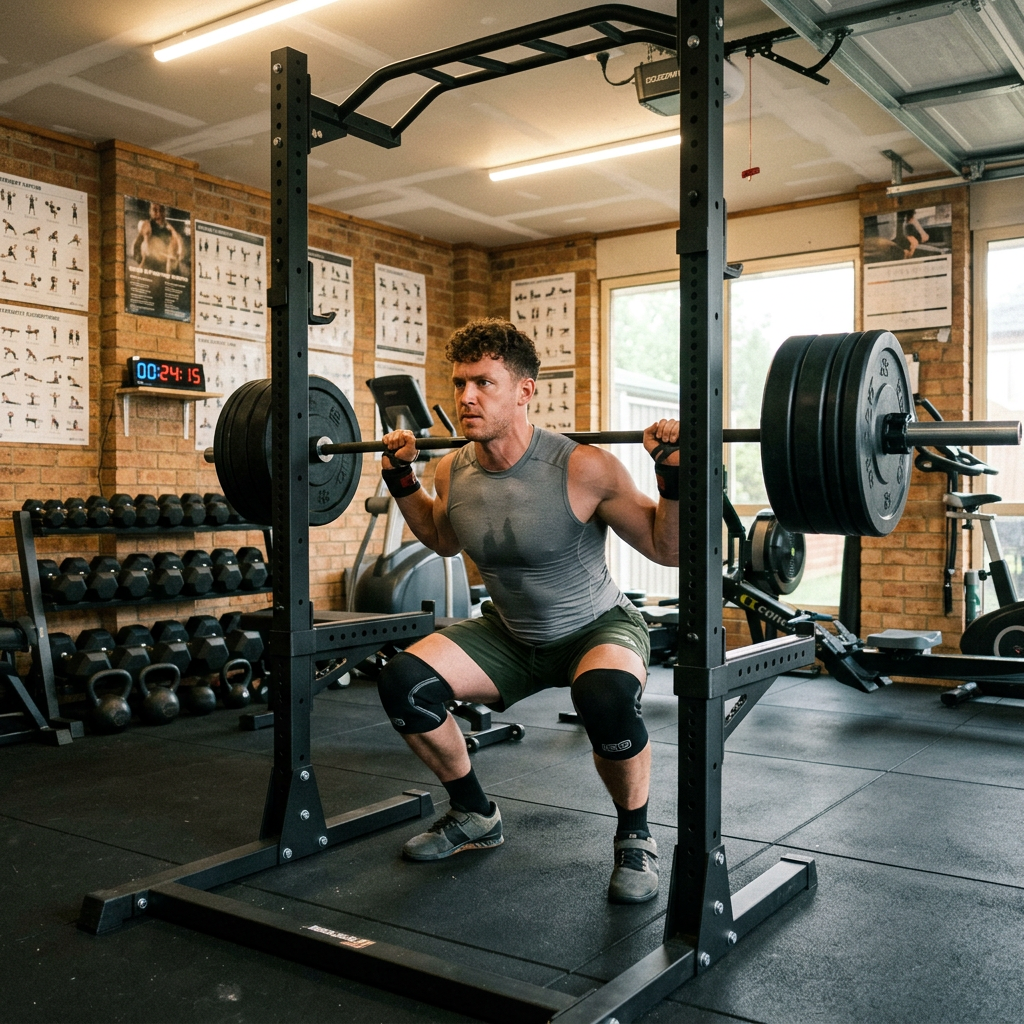
Barbells require weight plates, a rack or stand, and significant floor space. For beginners and intermediate trainees, adjustable dumbbells and kettlebells produce equivalent or better results in a fraction of the space and cost.
Mistake 2: Skipping the Mat
Training on a hard floor without a mat leads to joint discomfort, sliding, and avoidance of floor-based exercises altogether. The mat is the most foundational purchase don’t skip it to save $30.
Mistake 3: Buying a Full Fixed-Weight Set Instead of Adjustable
A rack of fixed-weight dumbbells takes up enormous space and costs significantly more than a single adjustable pair. Unless space and budget are unlimited, always go adjustable.
Mistake 4: Ignoring Recovery Equipment
Training at home means no pool, no sauna, no massage chair in the locker room. Your recovery tools matter more, not less. A foam roller, cold pack, and compression sleeve cost very little and meaningfully improve how you feel between sessions. See: Best Recovery Tools for Sore Muscles 2026.
Mistake 5: Not Having a Plan Before You Start Buying
Random equipment purchases lead to random results. Write down your training goals, the movements you want to train, and the space you have available then buy equipment that serves those goals in order of impact, not price.
🏆 The Bottom Line
Building a home gym on a budget isn’t about getting the most gear it’s about getting the right gear in the right order:
- Start with: Exercise mat + resistance band set
- Add next: Doorframe pull-up bar
- Then add: Adjustable dumbbells or 1–2 kettlebells
- Optional upgrade: Dip bars, suspension trainer, or additional weight
- Don’t forget: Rubber floor protection and basic recovery tools
Follow this sequence and you’ll have a genuinely effective home gym for $150–$400 that serves you for years.
Frequently Asked Questions
Sources & Further Reading
- 1. ACE Fitness — Resistance Bands vs. Weights: What’s Better for Building Muscle?
- 2. Garage Gym Reviews — Best Home Gym Equipment (Expert Tested)
- 3. Men’s Journal — How to Build a Home Gym on Any Budget
- 4. PubMed — Kettlebell Training and Metabolic Cost
- 5. Consumer Reports — Best Home Gym Equipment Tested and Rated
As an Amazon Associate we earn from qualifying purchases. We only recommend gear we’ve actually used.
The 5-band set we’d buy first
5 progressive resistance levels in one $30 set. Snap-free for 2+ years of daily use, fits in a drawer, replaces 80% of a commercial gym for full-body workouts.
No-drill doorframe pull-up bar
60-second install with no permanent damage. Supports 300 lbs. Adds back, biceps, and core training to any room with a doorframe — the highest ROI piece of equipment in any home gym.
One pair replaces an entire dumbbell rack
5 to 52.5 lbs per dumbbell with one twist of the dial. Saves 6 ft of floor space and ~$400 vs. a fixed-weight set. The single biggest upgrade you can make to a budget home gym.
Leave a Reply