
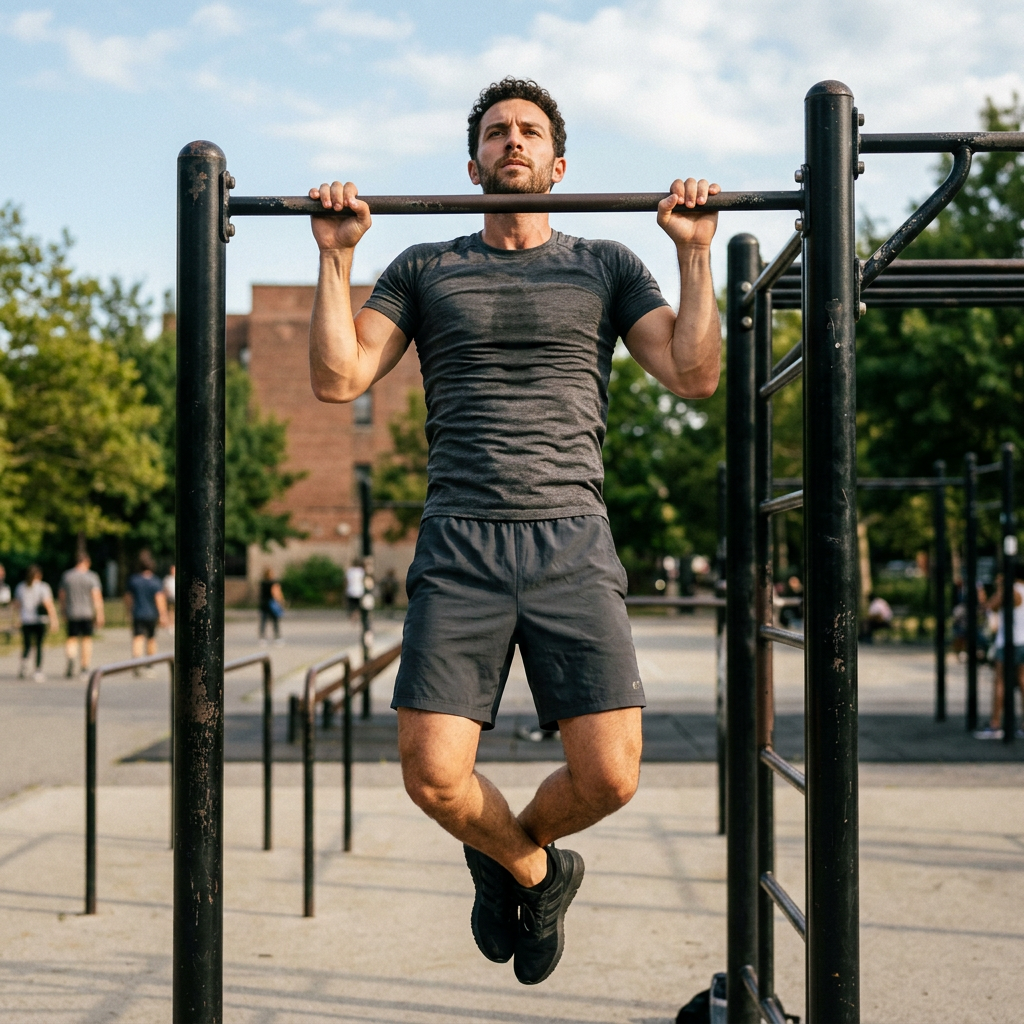
How to Do Your First Pull-Up: A Step-by-Step Training Plan
The problem isn’t effort it’s approach. Most people try to “just do more pull-ups” without building the foundational pulling strength and scapular control required to actually move their bodyweight. This guide lays out a methodical, step-by-step training plan built around progressions that actually work: dead hangs, scapular pulls, Australian rows, band-assisted reps, and negatives all structured into a weekly program you can run at home with a doorframe bar.
Whether you’re starting from zero or you’ve been stuck at a partial rep for months, this plan will fill in the gaps and get you to a clean, chin-over-bar pull-up. Let’s start from the top.
Table of Contents
- Why Pull-Ups Are Harder Than They Look
- Muscles Worked in a Pull-Up
- Phase 1: Build the Foundation (Weeks 1–2)
- Phase 2: Develop Pulling Strength (Weeks 3–4)
- Phase 3: Assisted Pull-Ups and Negatives (Weeks 5–8)
- Phase 4: Your First Unassisted Rep (Week 8+)
- Sample Weekly Training Schedule
- Gear That Helps
- FAQ
1. Why Pull-Ups Are Harder Than They Look
A pull-up requires you to lift your entire bodyweight using muscles most people barely use in daily life. Unlike a push-up, which builds on the chest and triceps you likely have some baseline strength in, pull-ups demand significant lat, rear delt, and bicep engagement alongside active scapular control a movement pattern most sedentary adults have essentially never trained.
According to ACE Fitness, the pull-up demands not just raw strength but neuromuscular coordination: your brain has to learn how to recruit the right muscles in the right sequence before the movement can happen cleanly. That’s why beginners often feel like they’re “all arms” when they try the lats and rear delts simply haven’t been taught their role yet.
Add to this the bodyweight component: if you’re carrying extra weight, every pound matters. A study published in the Journal of Strength and Conditioning Research found that relative body weight is one of the strongest predictors of pull-up performance, which is why getting lean while building pulling strength is a dual-track approach worth considering.
2. Muscles Worked in a Pull-Up
Understanding which muscles drive a pull-up helps you train them intentionally. The pull-up is a compound movement, meaning multiple muscle groups fire simultaneously:
Primary Movers
Latissimus dorsi (lats): The large, wing-shaped muscles of your back. These are the primary drivers of pulling your elbows down and back. Developing your lats is the single most important thing you can do to earn your first pull-up.
Biceps brachii: Your biceps assist with elbow flexion through the full range of motion. They’re important, but secondary — don’t make the mistake of training only biceps and wondering why your pull-up isn’t improving.
Rear deltoids and rhomboids: These muscles stabilize the shoulder joint and assist with scapular retraction — critical for the initial “set” of the movement before you pull.
Secondary and Stabilizers
Trapezius (lower fibers): Helps depress and stabilize the scapula. Teres major: Works alongside the lats to extend and adduct the shoulder. Core musculature: An engaged core prevents the body from swinging and keeps the movement efficient and injury-free.
3. Phase 1: Build the Foundation (Weeks 1–2)
Don’t touch the bar for a full pull-up attempt until you’ve completed Phase 1. The goal here is grip strength, shoulder health, and most importantly scapular activation. These two weeks lay the neuromuscular groundwork for everything that follows.
1. Dead Hangs — 3 sets × 20–30 seconds. Hang from the bar with arms fully extended. Don’t let your shoulders shrug up into your ears actively “pack” them down away from your head. This builds grip, shoulder stability, and decompresses the spine.
2. Scapular Pull-Ups — 3 sets × 8–10 reps. Hang from the bar with arms straight. Without bending your elbows, squeeze your shoulder blades together and down, lifting your body 1–2 inches. Pause, then lower slowly. This isolated movement teaches your scapulae to initiate the pull before the arms take over. It’s often the missing link for beginners.
3. Bar Holds at Top Position — 3 sets × 10–20 seconds. Use a box or jump to get your chin over the bar. Hold that position with your chin above the bar. This builds positional strength at the top of the rep.
4. Phase 2: Develop Pulling Strength (Weeks 3–4)
Phase 2 introduces horizontal pulling and inverted rows, which load the lats and rear delts through a full range of motion without requiring you to lift 100% of your bodyweight yet. This is the fastest-working phase for building real pulling strength in beginners.
1. Australian Rows (Inverted Rows) — 4 sets × 8–12 reps. Set a bar (or use a suspension trainer) at hip height. Lie under it, grab the bar with an overhand grip, and pull your chest to the bar while keeping your body straight. To increase difficulty, move your feet forward to increase the angle.
2. Negative Pull-Ups — 3 sets × 5 reps (5-second lowering). Jump or step to get your chin over the bar. Lower yourself as slowly as possible aim for a full 5-second descent before your arms are straight. You’re much stronger in the lowering (eccentric) phase than the lifting phase, so this builds strength faster than assisted reps alone.
3. Continue Dead Hangs + Scapular Pull-Ups in your warm-up. They maintain scapular activation and grip strength as the loads increase. 2 sets of each is plenty at this stage.
5. Phase 3: Assisted Pull-Ups and Negatives (Weeks 5–8)
This is where everything comes together. With your scapular control, grip, and horizontal pulling base built, you’re ready to move to the bar for real reps with assistance initially. Two tools shine here: resistance bands and a spotter (or foot assistance).
1. Band-Assisted Pull-Ups — 4 sets × 6–10 reps. Loop a resistance band around the pull-up bar. Place both knees (or one foot) in the band. The band’s elastic recoil offloads 20–50% of your bodyweight depending on band thickness, letting you complete full-range reps. Progress to a thinner band each week as you get stronger.
2. Negatives — 3 sets × 4–6 reps (3–5 second descent). Superset negatives with your band-assisted sets. Jump to the top, lower slowly, rest 60 seconds, and go again.
3. Flex Arm Hangs — 2 sets × max hold. Jump to chin-over-bar position and hold as long as you can, fighting gravity the whole way down. Track your time week-to-week when you can hold for 15+ seconds, an unassisted pull-up is very close.
For gear that makes Phase 3 training easier at home, check out our guide to the best resistance bands for beginners. A quality doorframe bar makes the whole progression accessible without a gym membership; see our roundup of the best pull-up bars for doorframes in 2026.
6. Phase 4: Your First Unassisted Rep (Week 8+)
By week 8, your lat strength, scapular control, and grip endurance should be sufficient for an attempt. Here’s how to set yourself up for success on your first unassisted rep:
1. Warm Up Thoroughly. Do 2 rounds of scapular pull-ups, dead hangs (30 seconds), and 5 Australian rows before any unassisted attempts.
2. Grip Overhand, Slightly Wider Than Shoulder-Width. Set your scapulae first: pull the shoulder blades down and together before bending your elbows.
3. Initiate With Your Back, Not Your Arms. Think “elbows to hips” rather than “hands to chin.” This mental cue shifts the focus to your lats and prevents you from muscling through with only your biceps.
4. Full Range of Motion Counts. A pull-up is only complete when your chin clears the bar and your arms return to full extension at the bottom.
7. Sample Weekly Training Schedule
| Phase | Day A | Day B | Day C |
|---|---|---|---|
| Phase 1 (Wk 1–2) | Dead hangs × 3, Scapular pull-ups × 3, Bar holds × 3 | Rest or active recovery | Repeat Day A |
| Phase 2 (Wk 3–4) | Scapular pull-ups × 2, Australian rows × 4, Negatives × 3 | Rest | Repeat Day A |
| Phase 3 (Wk 5–8) | Band pull-ups × 4, Negatives × 3, Flex arm hang × 2 | Rest | Repeat Day A (thinner band) |
| Phase 4 (Wk 8+) | Unassisted attempts × 3–5 singles, Band pull-ups × 3 | Rest | Repeat with progressive volume |
Rest between sets should be 90 seconds to 2 minutes for strength work. For negatives and bar holds, 2–3 minutes is appropriate.
8. Gear That Helps
You don’t need a full gym to train for your first pull-up. The three essential pieces of equipment are a doorframe bar, a set of loop resistance bands, and optionally, a set of gymnastic rings. See our roundups: Best Pull-Up Bars for Doorframes 2026, Best Resistance Bands for Beginners 2026, Best Gymnastic Rings for Home Training 2026, Best Suspension Trainers for Home Workouts 2026.
FAQ
Bottom Line: Your First Pull-Up Is Closer Than You Think
- Phase 1 (weeks 1–2): Master dead hangs and scapular pull-ups before attempting any full reps skipping this phase is why most progressions fail.
- Phase 2–3 (weeks 3–8): Australian rows and negatives are the fastest-working exercises for building real pull-up strength.
- Phase 4 (week 8+): When your flex arm hang hits 15 seconds, attempt your first unassisted rep. Use the “elbows to hips” cue to keep your lats engaged throughout.
Conclusion
Getting your first pull-up is one of the most satisfying milestones in bodyweight training — and it’s entirely within reach with the right approach. Stick to the 4-phase schedule, prioritize recovery, and track your flex arm hang time as your weekly progress marker. Before long, you won’t just have one rep — you’ll have a foundation for sets of 5, 10, and beyond.
As an Amazon Associate we earn from qualifying purchases. We only recommend gear we’ve actually used.
Doorframe pull-up bar (no drilling needed)
60-second install. Supports 300 lbs. The exact bar we recommend to every beginner working toward their first pull-up. Stays put in any standard doorframe.
Resistance band set (essential for the journey)
Loop a band over your bar to deload 20–60 lbs of bodyweight while you build pulling strength. Most beginners skip this step and stall for 6+ months — don’t make that mistake.
Power tower (when you outgrow the doorframe bar)
Once you can hit 5+ pull-ups, a power tower adds dips, knee raises, and weighted variations. The single best $200 upgrade for serious bodyweight training.
Leave a Reply