
By Wes — RollRestore gear tester · Last updated May 2026
13 min read · Recovery & Wellness · 5 tools tested
Why Recovery Changes in Perimenopause
Here’s what no one warns you about. You can hit the same lift, eat the same protein, sleep the same hours and at 43 you feel wrecked for three days when at 33 you were back in the gym in 24 hours. That isn’t aging. That’s a specific, measurable hormonal shift.
The mechanism comes down to estrogen and satellite cells. Satellite cells are the muscle stem cells that repair the micro-damage of a heavy training session. Estrogen directly regulates how active these cells are, how quickly they multiply, and how well they fuse into damaged muscle fibers. When estrogen levels start dropping in perimenopause, typically beginning in the early-to-mid 40s and continuing for an average of 4 years per Harvard Health satellite cell populations crash and muscle repair slows measurably. University of Minnesota research shows that when estrogen supply is removed, leg muscles show poor recovery of strength following minor injury and that estradiol treatment reverses both conditions.
Translation: the same workout creates the same damage, but the repair crew shows up understaffed and three days late. That’s why your soreness window doubles. That’s why Dr. Mary Claire Haver’s team documents sarcopenia (muscle loss) starting in perimenopause, not after menopause, at the rate of roughly 0.6% per year if you don’t intervene.
The good news, and this is the part that gets buried in clinical writeups: recovery tools work even harder for you in perimenopause than they did in your 30s. You’re not failing the training. The training is asking more of recovery than your hormones used to provide for free. Build a deliberate recovery stack and you keep and grow, muscle through the transition.
Quick Picks at a Glance
- Best HRV Tracker: Polar H10 Chest Strap knows when you’re recovered better than you do
- Best Massage Gun for Extended Soreness: RENPHO R3 Power Massage Gun deep enough for 72-hour DOMS
- Best Sleep Aid: YnM 15-lb Weighted Blanket compensates for dropping progesterone
- Best Mobility Tool: TriggerPoint GRID Foam Roller the everyday workhorse
- Best Cortisol Downregulator: ProsourceFit Acupressure Mat 20 min, parasympathetic flip
1. Polar H10 Heart Rate Monitor (~$90) — Best HRV Tracker

If you do one thing on this list, do this. In perimenopause, the gap between “I feel ready to lift” and “my nervous system is actually ready to lift” widens dramatically. You’ll feel fine on day 2 and then wreck yourself for a week. Heart rate variability (HRV) measured first thing in the morning with the H10 strapped on is the single most honest signal that your body has actually finished repairing.
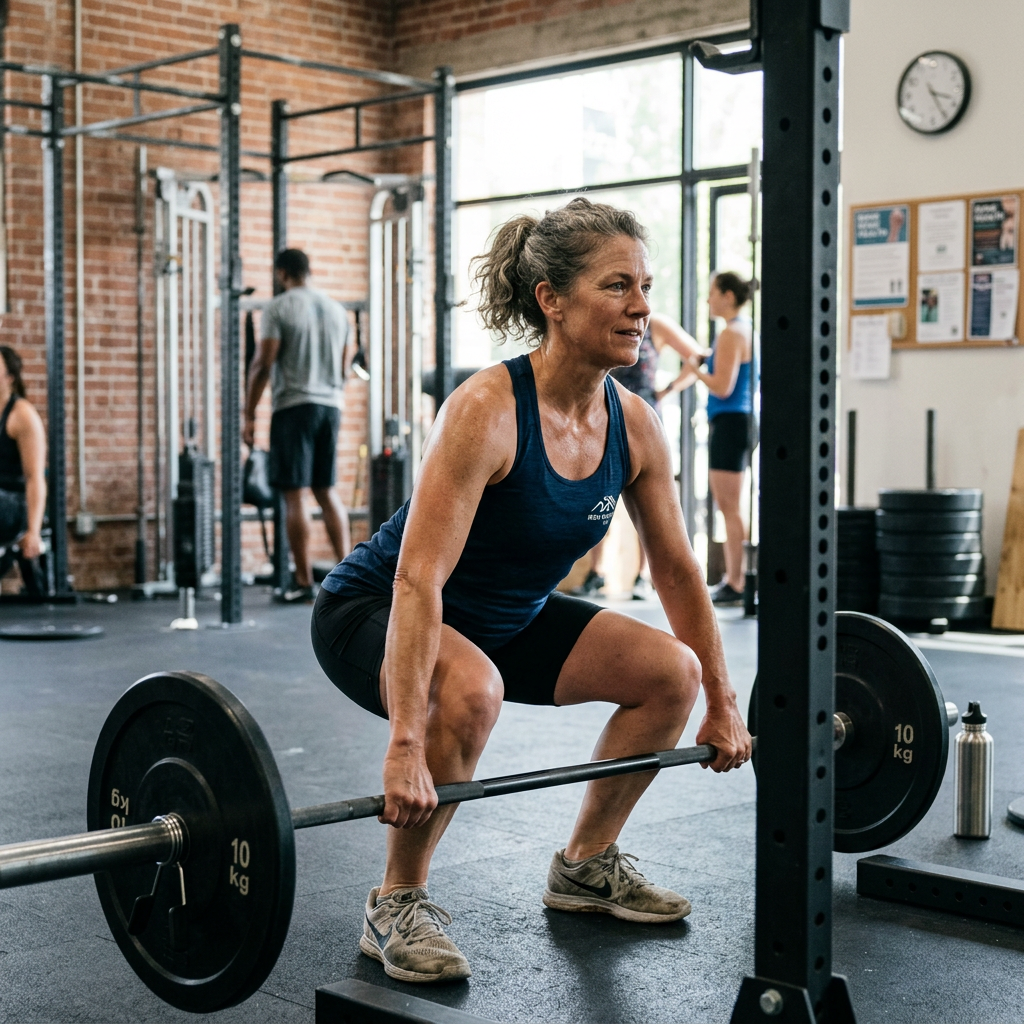
After 6 weeks of morning HRV checks I figured out my own pattern: heavy lower-body day drops my HRV for 72 hours, not 48 like it used to. Upper-body push days bounce back in 36. That changed how I split the week and the lifts started getting heavier again.
Pros: Gold-standard ECG accuracy. Pairs with Elite HRV and HRV4Training. Battery lasts a full year. Same data as clinical gear. Replaceable strap.
Cons: Chest strap, not a watch. Polar Flow HRV view is buried. No wrist screen.
Who this is for: Anyone over 40 lifting 3+ days/week who keeps overshooting recovery. Who should skip it: If you’re only lifting twice a week and feeling great, you don’t need this yet.
2. RENPHO R3 Power Massage Gun (~$80) — Best Massage Gun

The R3 hits a 12mm amplitude, the depth that separates a serious recovery tool from a fancy back-scratcher. In your 30s the cheap massage guns at 8mm were enough because your hormones did most of the repair work. In perimenopause you need actual mechanical fascia mobilization to clear the longer-lasting inflammation, and 12mm is the threshold where the literature shows real DOMS reduction.
I run it on speed 2 for 60 seconds per muscle group the morning after a heavy session. The shift was immediate, what used to be a 72-hour ache became a 48-hour ache. Not a miracle, but a real, repeatable hour-count back.
Pros: Theragun-class 12mm amplitude at ⅓ the price. USB-C charging. Quiet enough for TV use. FSA/HSA eligible. Carry case included.
Cons: Bulky case for travel. App pairing finicky. Round head wears faster.
Who this is for: Lifters with DOMS lingering past 48 hours. Who should skip it: If you’re using it instead of foam rolling rather than alongside, you’ll plateau.
3. YnM 15-lb Weighted Blanket (~$60) — Best Sleep Aid

Progesterone is your body’s natural sedative. It plummets in perimenopause, often years before estrogen finally drops, and that’s why a woman who slept like a rock at 35 is suddenly staring at the ceiling at 2 a.m. at 44. The weighted blanket is the cleanest non-pharmaceutical intervention I’ve found, deep pressure stimulation triggers parasympathetic activation, which is essentially what progesterone used to do for you for free.
15 pounds is right for most adults between 130–180 lbs. The cooling glass beads matter here, perimenopause sleep is hot, and the cheaper polyfill blankets become a sauna. The YnM uses fewer fibers and more beads specifically for temperature regulation.
Pros: Cooling glass beads (not polyfill). Even weight distribution. 80K+ reviews. Mid-price for the quality. 16 loops for duvet cover.
Cons: Spot-clean only. Heavy for shared beds. Cover sold separately.
Who this is for: Anyone whose sleep cratered in their early 40s. Who should skip it: If you sleep hot already, get the bamboo cooling cover at the same time.
4. TriggerPoint GRID 13″ Foam Roller (~$36) — Best Mobility Tool

Connective tissue stiffens in perimenopause. Estrogen is a connective tissue lubricant, it directly affects collagen turnover in fascia and tendons. When it drops, your morning lower-back tightness goes from “rolls out in 30 seconds” to “feels like rusty hinges all morning.” Daily 5-minute foam rolling is the cheapest, simplest fix on this list.
The GRID’s multi-density surface mimics palm-and-finger pressure rather than a flat tube, you actually feel the trigger points instead of squishing across them. Mine is now seven years old, daily use, and still holds shape. For more on technique, see our complete foam roller guide and the post-workout recovery routine that pairs with this.
Pros: Holds shape for years. Portable 13″ size. Multi-density trigger-point surface. 500-lb weight capacity. Free instructional videos.
Cons: Firm — not beginner-friendly. 13″ too short for both calves and quads at once. No design upgrades since 2015.
Who this is for: Anyone with morning stiffness in low back, glutes, or quads. Who should skip it: If you’re brand-new to foam rolling, start with a softer Amazon Basics first.
5. ProsourceFit Acupressure Mat & Pillow Set (~$20) — Best Cortisol Tool
This is the strangest-looking tool I own and the one I’d defend hardest. The acupressure mat — 6,210 tiny spikes pressed against your back for 20 minutes — produces a measurable shift from sympathetic to parasympathetic nervous system. In perimenopause, cortisol spikes harder and clears slower than it did 10 years ago, and chronic elevation directly impairs muscle protein synthesis. You can read the cortisol mechanism in our stress and cortisol recovery deep-dive.
The protocol I use: 20 minutes on the mat, shirtless, after a heavy training day or any high-cortisol day. The first 90 seconds feel sharp. By minute 3 your skin floods with warmth and the whole nervous system downshifts. It’s the cheapest parasympathetic intervention on the planet.
Pros: Cheapest working cortisol tool. Mat + pillow + bag at $20. Travel-friendly. Plant-based, no off-gas. Doubles as back-pain interrupter.
Cons: First sessions uncomfortable. Not safe on blood thinners. Spikes can detach after 18+ months.
Who this is for: Anyone whose cortisol feels stuck “on” after lifting days. Who should skip it: On blood thinners or with compromised skin.
Comparison Table
| Tool | Price | Recovery Lever | Daily Use? |
|---|---|---|---|
| Polar H10 | ~$90 | Signal — when am I recovered | Yes (AM) |
| RENPHO R3 | ~$80 | Mechanical — fascia + DOMS | 3–4×/wk |
| YnM Weighted Blanket | ~$60 | Sleep / progesterone-loss | Nightly |
| TriggerPoint GRID | ~$36 | Mobility / connective tissue | Yes (5 min) |
| ProsourceFit Mat | ~$20 | Cortisol / nervous system | 20 min |
Buying Guide: Building Your Perimenopause Recovery Stack
Don’t Buy in This Order: Layer in This Order
If budget is tight, this is the order that produces the biggest noticeable change for the dollar. Foam roller first ($36) it solves the cheapest, most-immediate problem (morning stiffness). Acupressure mat next ($20) the parasympathetic flip is the second-fastest noticeable effect. Massage gun third ($80) pays for itself once your DOMS window extends past 48 hours. Then HRV monitor ($90) once you’re lifting 3+ times a week and overshooting recovery. Weighted blanket last ($60) but if sleep is your worst symptom, move it to first.
What to Look for in Recovery Gear at 40+
Three specs matter more than they did in your 30s. First, amplitude on massage guns 12mm minimum, not the 8mm sub-$50 guns. Second, density progression on foam rollers you’ll want firmer pressure as connective tissue stiffens, but you can’t start there if you’ve never rolled before. Third, data accuracy on heart-rate gear wrist trackers’ HRV numbers drift ±15% in perimenopause because of skin perfusion changes. Chest straps don’t have this problem. The overtraining-syndrome prevention guide explains why precision here is non-negotiable.
Tools That Don’t Belong Here (and Why)
Ice baths get celebrated for women in perimenopause; the evidence in this specific cohort is thin. Compression boots ($700+) deliver about 5% of the marginal recovery improvement of the H10 at 10× the cost. Red-light therapy panels: jury-out, not currently in the evidence-based stack. Our post-workout recovery routine shows how the stack assembles into a daily protocol and our working out over 40 guide covers the general 40+ adjustments.
Frequently Asked Questions
Why does muscle recovery take longer in perimenopause?
Falling estrogen reduces satellite cell activity, the muscle stem cells that repair training damage. With fewer active repair cells, the same workout creates the same micro-tears but takes 24–48 hours longer to rebuild. Cortisol also clears more slowly in perimenopause, and elevated cortisol directly suppresses muscle protein synthesis, a double slowdown to the repair process.
Should I lift heavy during perimenopause?
Yes. Heavy lifting at 4–6 reps near failure produces the largest gains in muscle and bone density, and resistance training is one of the few interventions that directly stimulates satellite cell activity to offset estrogen decline. The catch is recovery: heavy lifters in perimenopause need an extra rest day and deliberate recovery tools to support the longer repair window.
How long does perimenopause last?
Perimenopause averages 4 years but ranges from a few months to over a decade. Symptoms typically begin in the early-to-mid 40s and ease about a year after the final period. Recovery-stack changes documented in this article apply throughout the entire transition.
Is HRV tracking actually useful for perimenopausal women?
Yes. The subjective “am I recovered” signal becomes unreliable in perimenopause because you can feel fine and still be under-recovered. HRV is the objective workaround — a morning reading takes 60 seconds and tells you whether the nervous system has finished repairing. Chest-strap accuracy outperforms wrist trackers for this metric.
Do I need a weighted blanket if I’m already on HRT?
The weighted blanket helps because deep pressure stimulation triggers the parasympathetic system. HRT addresses estrogen, not progesterone-driven sleep onset, so most women on estrogen-only protocols still benefit. If you’re on combined HRT with progesterone, the blanket adds marginal benefit, worth trying if sleep is still erratic.
How many recovery days per week in perimenopause?
The simplest framework is three lift days, three active recovery days (walking, mobility, gentle yoga), one full rest day. In your 30s the math was four lift, three light, that extra training day is where most perimenopausal women overshoot and stall progress. Use HRV data to confirm; if your morning HRV is below your 30-day baseline, swap a lift for active recovery.
Final Verdict
If you buy one tool: The Polar H10. It removes the guessing game about recovery and changes how you program training.
If you’re on a $100 budget: TriggerPoint GRID + ProsourceFit Acupressure Mat sixty dollars total, both daily-use.
If sleep is the worst symptom: Start with the YnM weighted blanket. Sleep is upstream of everything else.
If you’re lifting heavy 3+ days/week: The RENPHO R3 earns its keep. 12mm amplitude is the floor for serious DOMS reduction.
The Bottom Line
Perimenopause didn’t make you weaker. It changed who’s working the night shift on muscle repair. Estrogen used to do most of that job for free, now you build the recovery infrastructure to do it deliberately. The five tools above cover the four levers that change in perimenopause: tracking (Polar H10), mechanical recovery (RENPHO R3), sleep (YnM blanket), mobility (TriggerPoint GRID), and cortisol (ProsourceFit mat). Build the stack in the order that matches your worst symptom, layer it onto a consistent strength program, and you’ll keep lifting heavy through and well past the transition.
Shop the recovery stack:
- Polar H10 Heart Rate Monitor
- RENPHO R3 Power Massage Gun
- YnM 15-lb Weighted Blanket
- TriggerPoint GRID 13″ Foam Roller
- ProsourceFit Acupressure Mat
Related reading: Working Out Over 40 · Stress and Cortisol · Sleep Better for Recovery · Prevent Overtraining Syndrome · Post-Workout Recovery Routine
Leave a Reply