
RollRestore Recovery Team · Updated May 19, 2026 · 11 min read · Reviewed against AAOS, Cleveland Clinic, Mayo Clinic, and Johns Hopkins clinical guidelines

The 60-Second Version
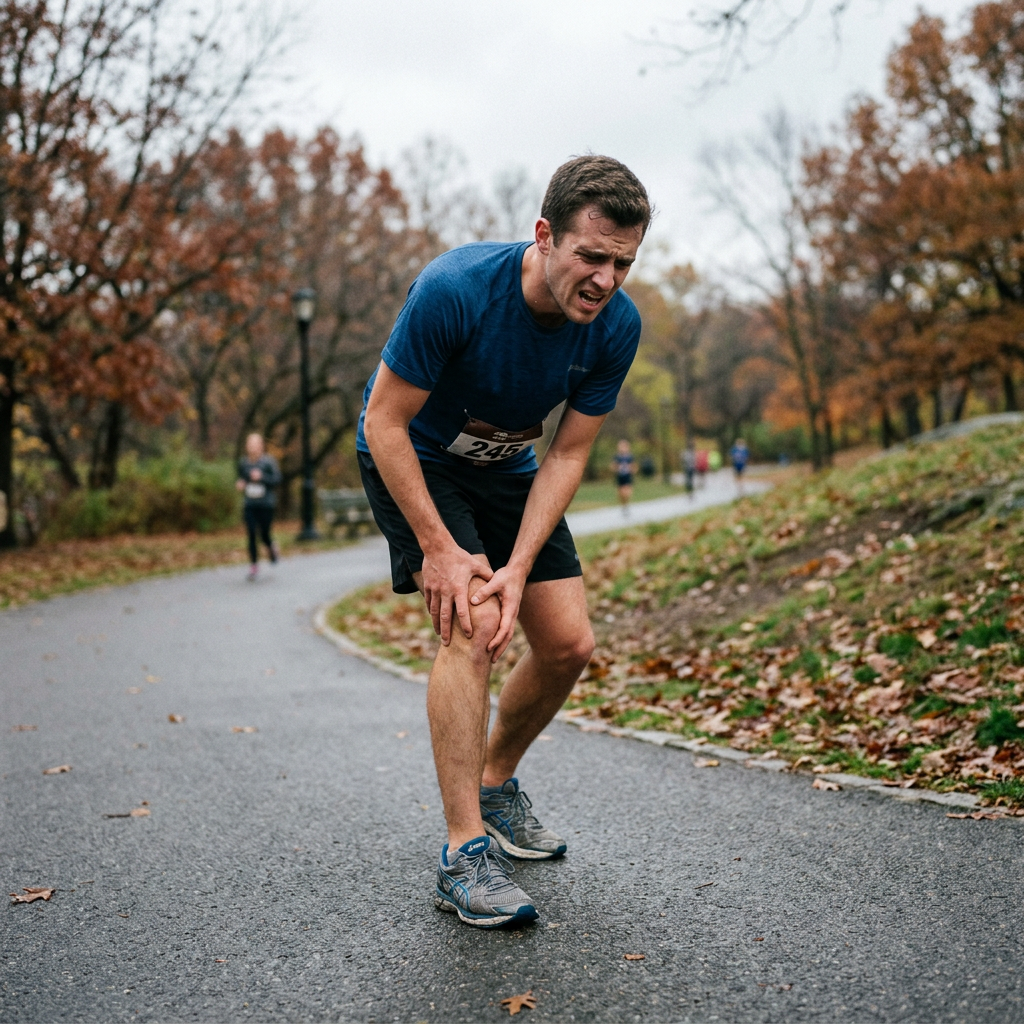
What it is: Runner’s knee, clinically called patellofemoral pain syndrome (PFPS) is dull aching pain under or around the kneecap, usually triggered by running downhill, sitting too long (“theater sign”), or going down stairs. It accounts for roughly 10% of all lower-extremity overuse complaints in runners.
The fix is not rest alone: Cleveland Clinic and the AAOS both emphasize that PFPS resolves through strengthening the hip abductors and VMO plus releasing the lateral quad/IT band, not by sitting on the couch until it “goes away.”
The 5-tool stack: patellar tendon strap to mechanically offload the kneecap during runs, knee compression sleeve for tracking support, foam roller for lateral chain release, fabric hip-strengthening bands for VMO + glute med work, and a percussion gun for stubborn vastus lateralis tightness.
Realistic timeline: Mild cases caught early 1 to 3 weeks. Pushed-through cases 2 to 3 months. The protocol below is built around staying in your training block while you rebuild.
⚡ Quick Picks — Build the Stack
What Runner’s Knee Actually Is (and Isn’t)
Runner’s knee is the catch-all name for patellofemoral pain syndrome (PFPS) pain under or around the kneecap that flares with high-volume running, hill descents, stairs, and prolonged sitting. According to Johns Hopkins Medicine, the underlying problem is almost always tracking: the patella is being pulled out of its groove on the femur, usually because the lateral quad and IT band are overpowering a weak VMO (the teardrop-shaped quad muscle just above the kneecap on the inside), and weak hip abductors are letting the femur rotate inward at heel strike.
That is the part most guides skip. Runner’s knee is rarely a “knee” problem. It’s a hip-and-quad balance problem that shows up at the knee, which is why doing nothing but icing the kneecap rarely fixes it.
The good news: the same 2019 PMC systematic review on knee injuries in runners found that conservative care, hip strengthening, soft-tissue work, and training-load modification resolves the vast majority of cases without surgery. Cleveland Clinic notes that most runners are back to normal in a month or two of consistent work. The catch: if you keep pushing through pain for weeks “testing it,” recovery often stretches to 2 to 3 months or longer.
The 5 Tools That Fix Runner’s Knee in 2026
Cho-Pat Original Knee Strap

Pros: Designed specifically for runner’s knee + jumper’s knee · Thin enough to wear under tights · Doesn’t restrict knee flexion the way a full brace can · Recommended by physical therapists for decades
Cons: Hand-wash only · Not enough support on its own for severe cases · Sizing runs slightly small, measure below the kneecap
NEENCA Professional Knee Brace with Patella Gel Pad

Pros: Patella gel ring keeps the kneecap centered · Spring stabilizers on both sides for medial/lateral support · Anti-slip silicone hem stays in place · FSA/HSA eligible
Cons: Bulkier than a thin sleeve, bunchy under jeans · Not designed for high-mileage running (too warm) · Sizing chart matters, measure mid-knee
TriggerPoint GRID Foam Roller (Original 13″)

Pros: Holds shape after 5+ years of use (500 lb load capacity) · Multi-density surface is firm without being brutal · 13″ length fits in a gym bag · Free instructional video library included
Cons: Too firm for absolute beginners on day one · Lateral quad rolling is uncomfortable that’s the point · Knockoffs collapse within weeks; buy the real one
Te-Rich Fabric Resistance Booty Bands (3-Pack)

Pros: Three resistance levels in one purchase · Non-slip silicone strips inside · Comes with carrying case · Fabric is durable for high-rep glute work
Cons: Heavy band is intense, most beginners need 1–2 weeks on light first · Slight fabric stretch over 6+ months · Not a substitute for loaded hip exercises long-term
RENPHO R3 Active Power Massage Gun

Pros: 12mm amplitude matches mid-tier Hypervolt/Theragun · USB-C charging · 5 attachments included · FSA/HSA eligible
Cons: Smaller battery than premium guns · 10-minute auto-off can interrupt longer sessions · Not as quiet as top-of-market
Side-by-Side Comparison
| Tool | Best For | When to Use | Price Tier |
|---|---|---|---|
| Cho-Pat Original Knee Strap | Active pain relief during runs | On — runs, hills, stairs | $ |
| NEENCA Professional Brace | Post-run + sitting support | Desk hours, travel, after runs | $$ |
| TriggerPoint GRID Roller | Lateral quad + IT band release | Daily, 2 min/side minimum | $$ |
| Te-Rich Booty Bands | Hip abductor + VMO rebuild | 3×/week strengthening | $ |
| RENPHO R3 Massage Gun | Deep trigger points (VL, TFL) | Pre-run + on rest days | $$ |
The 4-Week Train-Around-It Protocol
This is the part the clinical sites won’t write because they’re not in the business of telling you to keep running. Used responsibly meaning you modify, not ignore you can absolutely maintain aerobic base while you rebuild. Cleveland Clinic calls this “relative rest” and explicitly endorses it for runners who catch PFPS early.
Phase 1 (Week 1) — Calm the Joint, Find the Threshold
Cut weekly mileage by 30–50%. No hills, no track work, no down-stair sessions. Keep cadence high (180+ steps/min) slower cadence with longer ground contact loads the patella more. Wear the Cho-Pat strap on every run. Strengthening: light booty band — clamshells, glute bridges, sidelying leg raise, 2×12 each, daily. Soft tissue: foam roll lateral quad and TFL for 2 minutes each side, every evening.
Phase 2 (Weeks 2–3) — Rebuild the Hip, Reintroduce Volume
If pain on a 0–10 scale stays under 3 during and after runs, add 10% to weekly mileage. Still no hill descents. Move to medium-resistance bands — add monster walks and lateral band walks (2×12 each, 3×/week). Add the massage gun for 60s each on lateral quad, TFL, and glute medius before runs. Continue foam rolling daily. Wear the NEENCA brace for desk hours and travel.
Phase 3 (Week 4) — Test Hills, Build Strength
If pain is under 2/10 and not lingering 24 hours post-run, reintroduce short downhill segments (200–400m, gentle grade). Progress booty bands to heavy. Layer in single-leg squats and step-downs — these directly load the VMO. Keep the Cho-Pat strap during runs longer than your previous baseline. Strap can come off for easy runs by end of week 4 in most cases.
Beyond Week 4 — Maintenance
The biggest reason runners re-flare PFPS is they stop the hip work the day the pain disappears. Keep two hip-strengthening sessions per week permanently. They take 10 minutes. They prevent the next 8 weeks of pain.
What to Look for When You Buy
1. Target the root cause, not just the knee
The most common mistake is loading up on knee braces and ice packs and skipping the hip work entirely. PFPS resolves through hip abductor and VMO strengthening — period. Any “runner’s knee kit” that doesn’t include resistance bands and a strengthening protocol is selling you symptom management, not a fix. The 2019 PMC review on running knee injuries ranked hip strengthening as the highest-evidence conservative intervention.
2. Choose support you can actually run in
A patellar tendon strap (like Cho-Pat) and a compression sleeve do different jobs. The strap mechanically unloads the patellar tendon during loading — wear it during runs. The sleeve provides proprioceptive support, wear it after runs and during long sitting. Wearing a heavy bulky brace on a run isn’t supportive, it’s restrictive and it teaches your stabilizers to stop firing.
3. Build a protocol, not a one-off treatment
One foam-rolling session does almost nothing. The same systematic review that supports foam rolling notes that interventions shorter than 4 weeks rarely produce measurable range-of-motion or pain changes. Buy the tools, schedule the work, set a 4-week calendar. Single-tool, single-session approaches are why so many runners cycle in and out of PFPS for years.
FAQ: Your 5 Most-Asked Questions
How long does runner’s knee take to heal if I keep running?
Early-caught cases, meaning you saw the warning signs in week one and immediately cut volume, added the strap, and started hip strengthening, usually resolve in 1 to 3 weeks, per Marathon Handbook’s clinical review. Cases pushed through for 4+ weeks of pain typically take 2 to 3 months. The biggest variable isn’t whether you stop running, it’s whether you actually fix the hip and quad imbalance underneath.
Should I wear a knee strap or compression sleeve for runner’s knee?
Both, but at different times. The patellar tendon strap (Cho-Pat) is for during activity, it offloads the kneecap by changing the angle of pull on the patellar tendon. The compression sleeve (NEENCA) is for after runs, desk hours, and travel it provides warmth, mild compression, and proprioceptive feedback. Running in a full brace can actually slow recovery.
What strengthening exercises actually fix runner’s knee?
Cleveland Clinic’s official PFPS exercise list starts with hip work, not knee work: clamshells, sidelying leg raises, glute bridges, monster walks, and step-ups. The VMO (inner quad) gets loaded through terminal knee extension, single-leg squats to a box, and step-downs. Avoid deep squats and lunges in the first 2 weeks.
Can I still run with patellofemoral pain syndrome?
Often yes, with three rules: (1) pain stays under 3/10 during the run and resolves within 24 hours, (2) you cut volume 30–50% and skip hills/intervals for at least 2 weeks, and (3) you increase cadence to 180+ steps per minute. If pain spikes to 5+ or lingers past 24 hours, you’ve crossed the line, back off another week and add more hip work.
What’s the difference between runner’s knee and IT band syndrome?
Runner’s knee (PFPS) is pain around or under the kneecap, often diffuse, worse going down stairs and after long sitting. IT band syndrome is sharp, focal pain on the outside of the knee, typically at exactly 30° of flexion, predictably appearing at the same mileage point every run. For a full ITBS protocol see our companion guide: IT Band Syndrome: How to Fix It at Home.
Verdict: Start Here If You Only Buy One
If you can only buy one thing today: the Te-Rich booty bands. Not the strap, not the brace, not the foam roller. The reason: hip abductor weakness is the single most-documented root cause of patellofemoral pain in runners, and no amount of mechanical knee support fixes that. Five minutes of clamshells and monster walks three times a week, starting this week, fixes more PFPS cases than any other intervention.
If you can buy two: add the Cho-Pat Original Knee Strap. It buys you the ability to keep running through the 4-week rebuild — which keeps your aerobic base, your routine, and your sanity intact while the strengthening work catches up.
The full 5-tool stack is what most physical therapists would prescribe if insurance let them write it as a single order. Built right, it’s about $120 all-in roughly one PT copay and it works for years of training.
Conclusion: Build the Stack, Run the Protocol
The myth that runner’s knee means stopping running comes from clinical guidance written for people who don’t run. For trained runners, the better mental model is relative rest with active rebuild strip 30–50% of mileage, drop hills, layer in the strap, and put 10 minutes a day into hip and lateral-chain work for four weeks. Most cases resolve inside a month. The runners who get stuck for 3+ months are almost always the ones doing nothing but icing the kneecap.
The tools below are the same ones used in PT clinic protocols, without the appointment, the copay, or the timeline. Build the stack once, run the protocol, and add the maintenance hip work to your weekly schedule. PFPS that’s caught and rebuilt rarely comes back.
Related guides on RollRestore
→ IT Band Syndrome: How to Fix It at Home (No Surgery, No PT)
→ Dead Butt Syndrome (Gluteal Amnesia): How to Wake Your Glutes Up
→ Why Are My Hamstrings Always Tight? (And How to Lengthen Them)
→ Hip Flexor Tightness From Sitting + Lifting: The 10-Minute Fix
→ How to Use a Foam Roller (Step-by-Step)
→ How to Prevent Workout Injuries
→ How to Build the Perfect Post-Workout Recovery Routine
Leave a Reply