

Key Findings
A 2025 prospective 8-season cohort of elite track and field athletes (Edouard et al., Sports Medicine — Open) found calf muscle injuries account for 11.1% of all injuries, with the soles carrying the highest burden and highest recurrence. Bent-knee heel raises, not standing ones are what re-load the soleus. Runners who start light isometric loading at Day 2 rather than Day 9 return to sport 20 days earlier with no rise in re-injury (Bayer, NEJM 2018). Top pick: the CAMBIVO 20–30 mmHg compression sleeves for daily wear plus the flybold slant board for the eccentric calf-raise progression.
Editorial Standards
We reviewed eight Tier-1 sources: including the 2025 Sports Medicine Open narrative review on calf strain grading and return to sport, an 8-season elite athletics cohort, a 2025 elite Australian football recurrence study, the Bayer NEJM 2018 randomized trial on early loading, the JBJS Reviews 2022 calf strain review, the StatPearls Gastrocnemius Strain monograph, AAOS OrthoInfo, and Cleveland Clinic guidance and verified every product specification against the live Amazon listing. RollRestore earns affiliate commission on qualifying purchases at no extra cost to the reader; commission does not influence selection.
Why this matters: calf strain is the silent re-injury
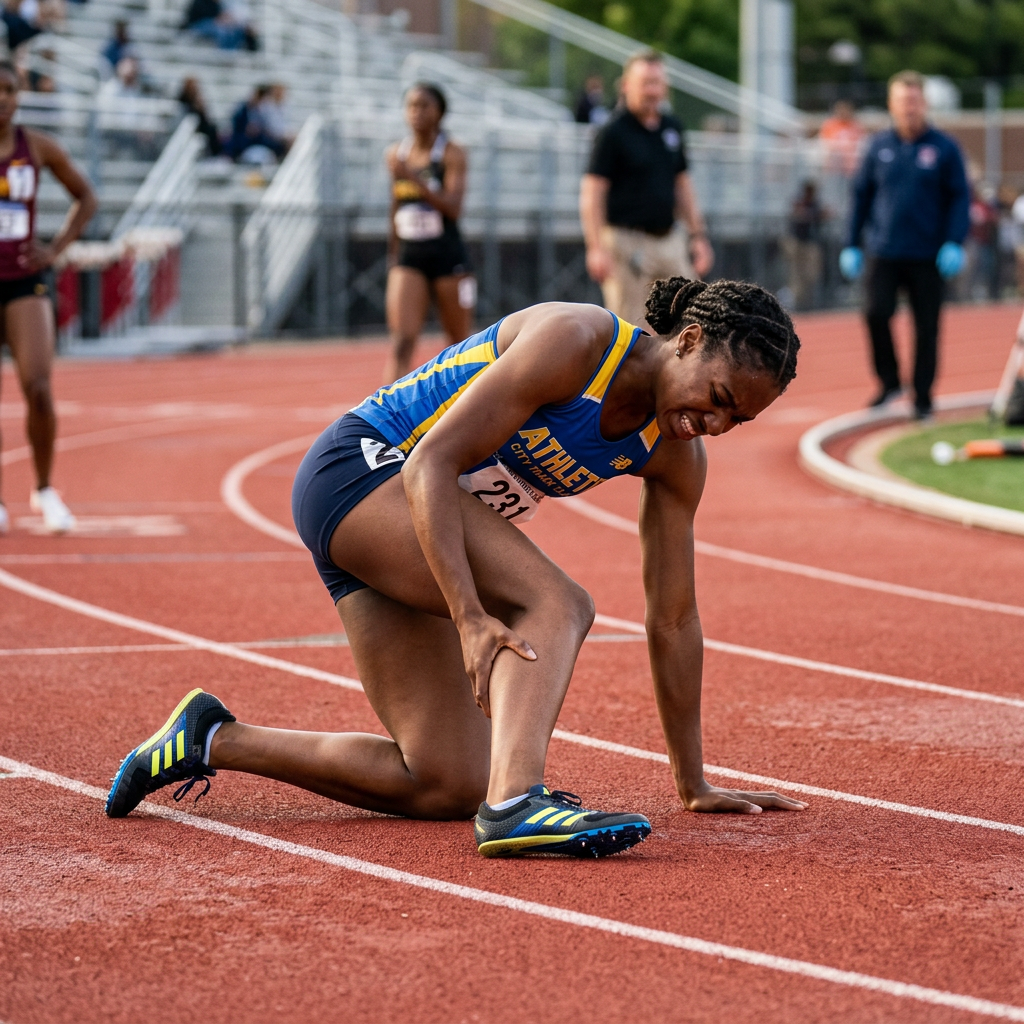
Calf strain is the injury runners under-rate until it ends a marathon block. Per a 2025 prospective study of elite track and field athletes published in Sports Medicine Open, calf muscle injuries are the third most common injury in athletics behind only hamstring strain and Achilles tendinopathy and account for 11.1% of total injuries across eight competitive seasons (Edouard et al., 2025). The same cohort showed the soleus muscle carries the biggest single-muscle burden and the highest reinjury rate.
Recurrence is the real story. A decade-long study in British Journal of Sports Medicine of elite Australian football players found that 13–21.3% of calf strains recur within two years of the index injury, with the risk concentrated in the first eight weeks (PMC12410626, 2025). Most of those recurrences happen at the soleus — not the more visible gastrocnemius runners typically blame.
That’s the gap this playbook fills. Clinical sites describe the injury well; almost none give runners a sequenced load progression with the actual gear that closes a soleus rehab properly. Below: a three-question self-triage, the contrarian load principle most runners miss, a 4-week return-to-running protocol with HowTo schema, and the five-tool stack that supports each phase.
Self-triage in three questions
This decision tree is built from the AAOS OrthoInfo gastrocnemius monograph, StatPearls on gastrocnemius strain, and the 2025 narrative review’s clinical-presentation table. It will not replace imaging, but it will tell you which phase to start in this week.
3-question runner’s triage
Question 1: Where and how did it happen?
- Sudden, sharp “kicked-in-the-calf” sensation at mid-stride or push-off, pain in the inner upper-third of the calf → likely medial gastrocnemius strain (the classic “tennis leg” pattern described in PMC11469716).
- Gradual tightening then a deep ache low in the calf, especially in distance runners during a long block → likely soleus strain (the harder one to feel, the one that recurs).
Question 2: Standing single-leg heel raise test (24 hours after injury, only if you can weight-bear):
- Can complete 1 single-leg heel raise without sharp pain → Grade I (mild). Begin Phase 1 load this week.
- Pain prevents a full single-leg heel raise but you can do 5–10 double-leg raises pain-free → Grade II (moderate). Phase 0 for 5–7 days, then Phase 1.
- Cannot weight-bear, visible swelling/bruising, palpable defect → suspect Grade III tear. See a physician before any home protocol.
Question 3: Seated heel raise (bent-knee) check:
- Reproduces pain low in the calf → soleus involvement. Add seated heel raises to your protocol from Week 2 (most runners skip this and recur).
- No pain seated but pain standing → gastrocnemius-dominant. Straight-leg protocol is sufficient.
If your answers point to a Grade III injury, stop here. The StatPearls Gastrocnemius Strain guidance is clear: a palpable muscle gap with profound weakness warrants ultrasound or MRI and physician oversight. For Grade I and most Grade II strains, the protocol below is the home framework that current evidence supports.
The 5-tool calf strain recovery stack: At a glance
Compare the five picks before reading the cards. This is the stack that maps onto the 4-week protocol; product cards below defend each pick with the underlying spec and evidence.
| Product | Phase | What it does | Price band |
|---|---|---|---|
| CAMBIVO 20–30 mmHg Calf Compression Sleeves | Days 0–28+ | Medical-grade graduated compression for venous return, swelling control, and proprioception during walking and easy runs. | $18–24 |
| flybold Slant Board Calf Stretcher (5 angles, 450 lb cap) | Week 2 onward | Adjustable 0/20/30/40/45° platform for graded eccentric heel raises, the load that rebuilds tendon tolerance. | $32–40 |
| Whatafit 11-Piece Resistance Bands (10–150 lb) | Days 3–14 | Banded isometric ankle plantar flexion and progressive concentric heel raises for Phase 1 reload. | $28–35 |
| RENPHO R3 Active Massage Gun (12 mm amplitude) | Week 2 onward | Percussive therapy for surrounding hamstring and gastro bellies, never directly on the strain site early. | $59–79 |
| TriggerPoint GRID 1.0 Foam Roller (13″) | Week 3 onward | Multi-density foam for gentle proximal calf and hamstring work as load increases. | $36–40 |
Quick Picks (read these first)
- Best overall daily-wear tool: CAMBIVO 20–30 mmHg Compression Sleeves the only item you wear from Day 0 through return-to-running.
- Most-skipped-but-essential: flybold Slant Board for the eccentric heel raises that close out the protocol.
- Best Phase-1 isometric tool: Whatafit Resistance Bands for banded plantarflexion.
- Add at Week 2: RENPHO R3 Active for surrounding-muscle work never on the injury site early.
- Add at Week 3: TriggerPoint GRID for proximal calf and hamstring as load increases.
- Why calf strain matters for runners
- 3-question self-triage
- The 5-tool stack at a glance
- The 4-week return-to-running protocol
- Product 1 — CAMBIVO Calf Compression Sleeves
- Product 2 — flybold Slant Board
- Product 3 — Whatafit Resistance Bands
- Product 4 — RENPHO R3 Active Massage Gun
- Product 5 — TriggerPoint GRID Foam Roller
- How to choose: 3 buying-guide questions
- FAQ
- Verdict + this-week action plan
The 4-week return-to-running protocol
The progression below is built directly from the Bayer NEJM 2018 randomized trial on early loading (a soccer cohort where Day-2 starters returned to sport 22.5 days faster than Day-9 starters, with no rise in re-injury PMID 29562148) and the 2025 Sports Medicine Open narrative review’s RTS framework. Anchor lifts: isometric → concentric → eccentric heel raises, knee-straight for gastrocnemius and knee-bent for soleus. Aim for 4 days of loading per week with a non-load day between. Internal link: pair this protocol with the cool-down structure in our post-workout recovery routine guide and the heat-vs-ice timing rules in ice or heat for sore muscles.
Phase 0 — Days 0–2 (acute)
POLICE protocol (Protection, Optimal Loading, Ice, Compression, Elevation) per Cleveland Clinic guidance. Wear the compression sleeve during all waking hours. Ice 15 min, four times daily. No running, no calf raises. Avoid stretching the strained muscle — early stretch can re-tear forming collagen.
Phase 1: Days 3–10 (isometric reload)
Begin banded isometric plantarflexion: looped resistance band around the forefoot, push into the band for 5 × 45-second holds at 30–50% effort. Do this twice daily. Add double-leg standing heel raises by Day 5 if pain is < 3/10 — 3 sets of 10 on the floor, full range. Walk as tolerated. Cross-train with cycling or pool running.
Phase 2: Days 11–17 (concentric load + soleus targeting)
Progress to single-leg standing heel raises on the floor: 3 × 12 daily. Add seated bent-knee heel raises with a weight on the knee: 3 × 15 daily. This is the soleus-specific load most runners skip. Walking jogs by Day 14 if single-leg standing heel raise is pain-free at 24-hour follow-up. Begin gentle massage gun work on the hamstring and proximal calf away from the strain site, 60 seconds per region at lowest amplitude. The 2024 Konrad et al. systematic review found vibration improves ROM acutely without strength decrement — useful in active rehab, not as a substitute for load.
Phase 3: Days 18–24 (eccentric on the slant board)
Now the slant board comes in. At 20°, perform 3 × 15 single-leg eccentric heel drops, slowly lower the heel below platform level over 4 seconds, use the non-injured side to assist on the way up. Repeat seated at 20° for soleus. Walk-run intervals: 1 min run / 1 min walk × 10, every other day at conversational pace. The 2024 Wulff narrative review notes early eccentric loading reduces re-injury when paired with conservative volume.
Phase 4: Days 25–28 (return to easy running)
Two pain-free continuous easy runs (20–30 min at conversational pace) on consecutive sessions = clearance to resume normal weekly mileage at 60–70% of pre-injury volume. Continue eccentric heel raises 3×/week. Resume foam rolling proximal calf and hamstring twice weekly. Re-introduce intervals only after one full pain-free week of continuous running. Internal link: the marathon recovery day-by-day guide is the natural follow-on if you’re returning to high-volume training.
The 5 picks (defended)
1. CAMBIVO 20–30 mmHg Calf Compression Sleeves: Top daily-wear pick

~$18–24 · pair · Amazon Choice
Graduated 20–30 mmHg compression is the medical-grade threshold cited in venous-return literature (vs. the 15–20 mmHg “athletic” tier, which delivers comfort without therapeutic compression). The CAMBIVO sleeves use that medical class, which is why they appear in our previous calf-injury and shin-splint posts. Pair-priced at $20 they are the cheapest evidence-anchored item in the entire stack. Wear them from Day 0 through return-to-running, then continue for the first three weeks of full mileage.
- Compression class: 20–30 mmHg graduated (medical class I)
- Material: 75% nylon / 25% spandex, moisture-wicking
- Best for: all phases — daily wear for swelling control and proprioception
- Limitation: not a substitute for load progression; sleeves do not heal tissue
This sleeve is appropriate for runners managing acute or recurrent calf strain, anyone returning from a soleus injury, and runners with a history of venous insufficiency. Readers with arterial disease, diabetes with vascular complications, or active DVT should consult a physician before use.
2. flybold Slant Board Calf Stretcher (5-angle, 450 lb cap) Week 2+ essential

~$32–40 · birch plywood · 5 angles
Adjustable 0/20/30/40/45° angles with a 450 lb weight capacity puts this board on the right side of the spec line for runners who need progressive eccentric load. The 20° setting is the sweet spot for Phase 3 single-leg eccentric heel drops; the 30–45° settings are for soleus stretching in Phase 4. The included spiky ball and resistance tube are useful add-ons but the slant board itself is the load tool. Birch finish with anti-slip tread holds through daily use.
- Angles: 0°, 20°, 30°, 40°, 45°
- Capacity: 450 lb
- Best for: Phase 3 eccentric heel drops; soleus stretching in late protocol
- Limitation: wood platforms shift on smooth tile, use on a rubber mat or carpet
Best fit for runners moving from Phase 2 concentric work to eccentric load progression, distance runners managing recurring soleus pain, and anyone rehabbing Achilles tendinopathy alongside the calf strain. Readers with acute Grade III tears should not begin slant-board work without physician clearance.
3.  11-Piece Resistance Bands Set (10–150 lb stack) Phase 1 reload tool
~$28–35 · 11-piece kit · 2-year manufacturer warranty
The Phase 1 isometric protocol banded plantarflexion holds at 30–50% effort, requires a band light enough to be controllable but heavy enough to recruit the gastroc-soleus complex. The Whatafit five-tube system stacks from 10 to 150 lb total resistance, which covers the Day 3 isometric range and the Phase 2 concentric range. Door anchor, handles, ankle straps, and carry bag are included. Two-year manufacturer warranty on band failure.
- Resistance: 10 / 20 / 30 / 40 / 50 lb tubes stacking to 150 lb
- Material: 100% natural latex, tested to 10,000+ stretch cycles
- Best for: banded isometric plantarflexion (Phase 1) and seated heel-raise loading (Phase 2)
- Limitation: tube bands stretch differently than loop bands — use the included handles and ankle straps for stable foot anchoring
This kit is the Phase 1 workhorse for runners who want measurable load progression without buying ankle weights or dumbbells. Best for runners rehabbing the gastrocnemius-soleus complex, anyone in early-stage banded ankle ROM work, and travelers who need a portable load tool.
4. RENPHO R3 Active Massage Gun (12 mm amplitude) Week 2+ adjunct
~$59–79 · 12 mm amplitude · 1.5 lb portable
Twelve-millimeter amplitude puts the R3 above the 8–10 mm “spa-tier” cutoff that JSCR percussion-therapy research treats as functional, while staying well below the $400 Theragun Prime price band. For calf strain rehab the rule is strict: never use it on the strain site in Weeks 1–2, only on adjacent musculature (hamstring, proximal gastroc, opposite-side calf) and at the lowest amplitude. The 2024 Konrad et al. systematic review on vibration interventions showed acute ROM gains without strength loss when used as a pre-load primer.
- Amplitude: 12 mm (functional, not cosmetic)
- Battery: 1–2 weeks per charge at 4 sessions/week
- Best for: adjacent-muscle work in Phase 2 and on-injury site only after Day 21 with physician clearance
- Limitation: percussive therapy on an acute strain in the first 14 days can disrupt healing tissue, wait or work around
Best fit for runners who already own a foam roller and want a more targeted Phase 2 adjunct, anyone in a Wave 3 rehab with proximal-calf or hamstring tightness restricting heel-raise depth, and travelers needing portable percussive work. Skip if you cannot tolerate the on-skin vibration well.
5. TriggerPoint GRID 1.0 Foam Roller (13″, 500 lb cap) Week 3+ maintenance

~$36–40 · 13″ multi-density · 500 lb capacity
The GRID 1.0 stays in our recovery stack because its multi-density EVA over a rigid hollow core maintains shape after years of daily use, Amazon long-term review data on the original 2009 design backs the durability claim. For calf strain rehab, foam rolling is a Week 3+ tool, after eccentric loading has begun. The patented Distro-density surface lets readers target proximal calf and hamstring fascia without the acute pressure of a lacrosse ball or massage stick. Pair it with the protocol in our foam roller use guide.
- Length: 13″ (compact, travel-friendly)
- Capacity: 500 lb
- Best for: Week 3+ proximal-calf, hamstring, and ITB maintenance
- Limitation: 13″ is short for full lower-body rolls, pair with a 36″ roller if you also roll back and quads
This is the foam roller for runners who want a single durable tool that survives the entire return-to-running block and beyond. Best for runners in Phase 3+ rehab, anyone managing both gastroc and ITB tightness, and travelers needing a compact rolling surface.
How to choose: 3 buying-guide questions
Are you Grade I, Grade II, or unsure?
If single-leg heel raise is pain-free at 24 hours, you’re Grade I start the whole protocol this week and you’ll need all five tools in sequence. Grade II runners should buy the compression sleeve, the bands, and the slant board first; the massage gun and foam roller can wait for Week 2–3. If you’re unsure, get an ultrasound. The 2025 narrative review in Sports Medicine Open emphasizes that imaging adds little to RTS prediction for Grade I but is decisive for Grade III.
Are you a runner or a lifter who runs?
Runners need the slant board and bands more than the foam roller, because eccentric heel raises are the highest-leverage load you can give a soleus rehab. Lifters who run as conditioning may already have bands and a foam roller — in that case the compression sleeve and slant board are the two new purchases. Internal link: lifters specifically should read our quad strain return-to-squat protocol for the muscle-strain framework applied to lower-body lifts.
Is this your first calf strain or a recurrence?
First-timers can run the 4-week protocol and walk back to full mileage. Recurrent calf strain, a runner with two or more episodes in the last two years, needs longer Phase 1 (10–14 days instead of 5–7) and longer Phase 3 (14 days instead of 7), because the elite athletics data shows the soleus needs more eccentric volume to drop reinjury risk. The compression sleeve becomes a daily-wear item for the entire training year, not just the rehab block.
FAQ
- How long does a calf strain take to heal in a runner?
- Grade I strains typically heal in 1–2 weeks; Grade II strains in 4–6 weeks; Grade III tears in 12 weeks to 6 months and often require physician oversight. Return to full running mileage is usually 4–6 weeks for Grade I/II if early loading is started on Day 2 rather than Day 9 (Bayer, NEJM 2018).
- Can I run with a calf strain?
- Not in Week 1. Walk-run intervals can begin around Day 14 for Grade I and Day 21 for Grade II only when single-leg standing heel raise is pain-free. Returning to running before pain-free single-leg heel raise is the single most common reason for calf-strain recurrence inside eight weeks.
- Should I ice or heat a calf strain?
- Ice for the first 48–72 hours to limit swelling. After that, heat or contrast bathing supports circulation and tissue remodeling. See our timing matrix in ice or heat for sore muscles for the hour-by-hour breakdown.
- Is it OK to stretch a strained calf?
- Not in the first 5–7 days. Early static stretching can re-tear forming collagen. Begin gentle stretching only after Phase 1 isometric work is tolerated pain-free, and even then favor active range-of-motion work (banded ankle circles, controlled heel slides) over deep passive stretching.
- Why does my calf keep tearing in the same spot?
- Roughly 90% of recurrent calf strains happen at the soleus. The most common rehab error is loading only the gastrocnemius (standing heel raises) while neglecting bent-knee soleus work. The 2025 elite athletics cohort and the JBJS Reviews 2022 analysis both flag inadequate soleus-specific loading as the primary driver of reinjury.
- Should I use a massage gun on a strained calf?
- Not directly on the injury site in the first 14 days. Surrounding muscles (hamstring, proximal gastroc, opposite calf) are fine at the lowest amplitude. Direct percussive therapy on an acute strain can disrupt healing tissue.
- What’s the difference between calf strain and Achilles tendinopathy?
- Calf strain is muscle-belly injury (tearing of muscle fibers); Achilles tendinopathy is tendon overload (collagen degeneration, no sudden tear). Pain location is the easiest tell: calf strain hurts in the muscle belly (upper or middle calf); Achilles tendinopathy hurts at or just above the heel. See our companion guide on Achilles tendinitis training around it.
Verdict
Editorial verdict
The CAMBIVO 20–30 mmHg compression sleeves are the only item you wear from Day 0 through return-to-running — the highest-utility purchase in the stack. The flybold slant board is the most-skipped-but-essential tool because eccentric heel raises are what close out the protocol. The Whatafit bands are the cheap Phase 1 reload solution. The RENPHO R3 and TriggerPoint GRID are Week 2 and Week 3 adjuncts respectively. Buy in that order if you’re staging the purchase.
What this means for your training next week
If you strained your calf in the last 7 days: put on the compression sleeve today, ice four times daily, and start banded isometric plantarflexion at Day 3 not Day 9. That single change (early load) is what the Bayer NEJM 2018 trial showed adds three weeks of healthy training back to your year.
If you’re a runner with a history of recurrent calf strain: add seated bent-knee heel raises (3 × 15) to two of your weekly maintenance sessions starting this week. That’s the soleus-specific load that the elite athletics cohort data says drops the reinjury rate.
Sources
- Edouard, P. et al. “Calf muscle injury in elite athletics: an 8-season prospective cohort study.” British Journal of Sports Medicine, 2025. https://pubmed.ncbi.nlm.nih.gov/40976717/
- Meek, W.M. et al. “Calf Strains in Athletes: A Narrative Review of Management, Injury Grading, and Return to Sport.” Sports Medicine — Open, 2025. https://link.springer.com/article/10.1186/s40798-025-00960-4
- “What is a recurrence? The onset, frequency and time-loss impact of recurrent calf muscle strain injuries in elite male Australian football players over a decade.” BJSM, 2025. https://pmc.ncbi.nlm.nih.gov/articles/PMC12410626/
- Bayer, M.L. et al. “Early versus Delayed Rehabilitation after Acute Muscle Injury.” New England Journal of Medicine, 2018. https://pubmed.ncbi.nlm.nih.gov/29562148/
- “Medial Gastrocnemius Strain: Clinical Aspects and Algorithmic Approach.” Cureus / PMC, 2024. https://pmc.ncbi.nlm.nih.gov/articles/PMC11469716/
- “Gastrocnemius Strain.” StatPearls (NCBI Bookshelf), updated 2024. https://www.ncbi.nlm.nih.gov/books/NBK534766/
- Wulff, A. et al. “Return to Sport, Reinjury Rate, and Tissue Changes after Muscle Strain Injury: A Narrative Review.” Translational Sports Medicine, 2024. https://onlinelibrary.wiley.com/doi/full/10.1155/2024/2336376
- Meek, W.M. et al. “Calf Strain in Athletes.” JBJS Reviews, 2022. https://journals.lww.com/jbjsreviews/fulltext/2022/03000/calf_strain_in_athletes.15.aspx
- Cleveland Clinic. “Pulled Muscle (Muscle Strain): Symptoms, Causes & Treatment.” Reviewed 2024. https://my.clevelandclinic.org/health/diseases/22357-pulled-muscle
- AAOS OrthoInfo. “Muscle Strains in the Thigh and Lower Leg.” American Academy of Orthopaedic Surgeons. https://orthoinfo.aaos.org/en/diseases–conditions/muscle-strains-in-the-thigh
Leave a Reply