
CrossFit Shoulder Maintenance: 5 Tools Every Athlete Should Own
By Wes — RollRestore gear tester · Last updated May 2026
9 min read · Recovery & Wellness · 5 tested picks

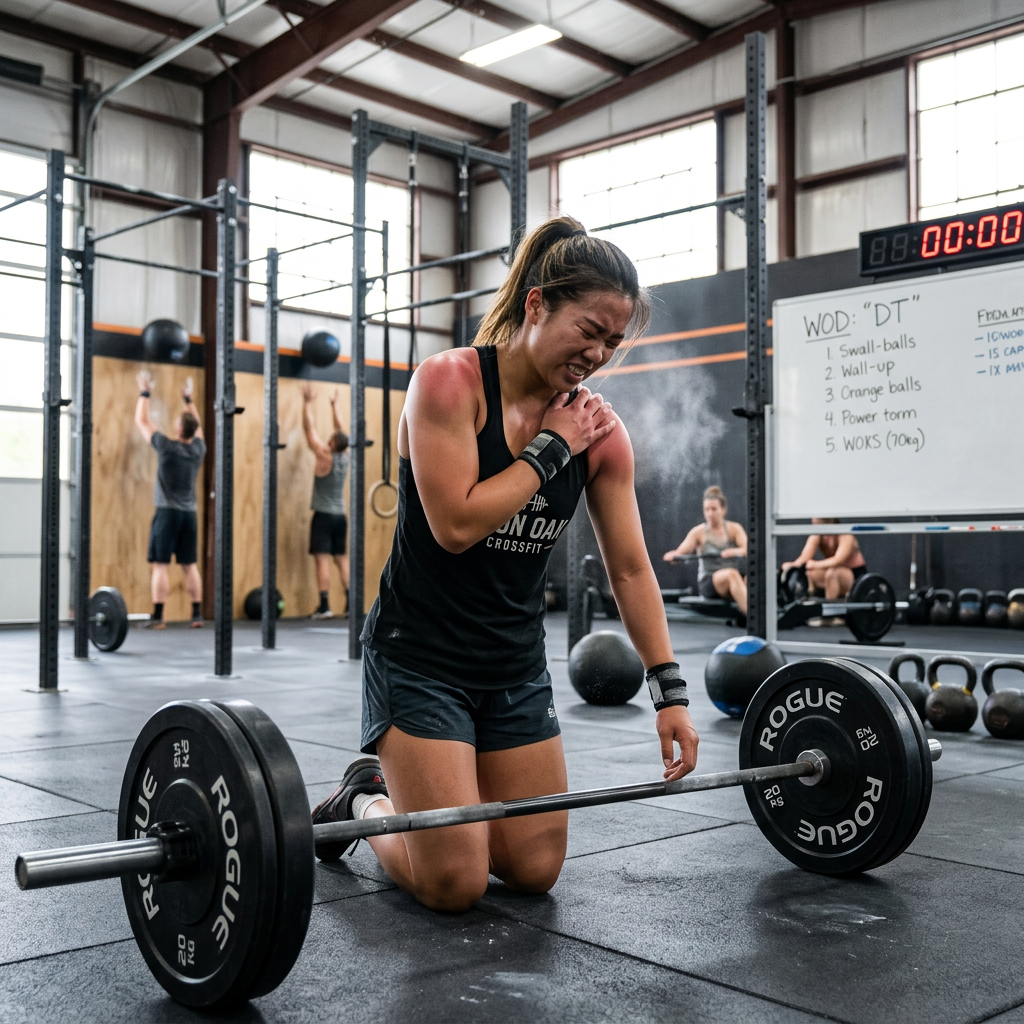
If you’ve done CrossFit for more than a year, you already know the stat: in the published injury surveys, the shoulder is the most commonly injured joint at roughly 39% of all CrossFit injuries, ahead of the back (35%) and the knee (15%) per O’Grady Orthopaedics’ review of the literature. The mechanism is no mystery: snatches, kipping pull-ups, ring dips, push presses, and overhead squats all load the shoulder at end-range under fatigue and most lifters do zero prehab between sets.
This guide is the gear half of that fix. I cover five tools every CrossFit athlete should own in 2026, what each one solves, and a simple 4-week maintenance plan to put them on rotation. None of these replace a physio if you’ve actually torn something but they’re the difference between a shoulder that holds up for a decade and one that pings during every Fran.
- Crossover Symmetry Shoulder System — Best Overall
- RockTape RockFloss Compression Band — Best for Joint Flossing
- Wincspace Peanut Massage Ball — Best for Thoracic Spine
- TheraBand Over-the-Door Shoulder Pulley — Best for Range of Motion
- Kieba Lacrosse Balls (Set of 2) — Best Budget Pick
1. Crossover Symmetry Shoulder System
~$169 · Check Price on Amazon →

The Crossover Symmetry system has been in roughly every CrossFit affiliate I’ve ever trained at and for good reason. The kit pairs two pairs of color-coded shoulder bands with a door-anchor setup and a structured Activation, Recovery, and Iron Scap protocol you can run in 6 minutes before a workout. It’s the most physical-therapist-adjacent product in the CrossFit space.
After three weeks of running the Activation set before every snatch session, the most obvious change wasn’t strength, it was that my warm-up sets felt smooth instead of crunchy. The high-rep band work (15–20 reps of pull-aparts, external rotations, and scapular punches) seems to wake up the rotator cuff and serratus in a way that no amount of arm circles ever did for me. Crossover Symmetry reports the system is used by 20 MLB teams, 10 NFL teams, and about 75% of NCAA Division 1 programs, that volume of pro-level adoption is rare in this category.
The honest downside: it’s not cheap, and the included paper guide isn’t as good as the online video library (which you’ll want to actually use). A few Amazon reviewers also note the bands can twist around the door anchor on aggressive reps, easy fix, but worth knowing.
2. RockTape RockFloss Compression Band
~$25 · Check Price on Amazon →

Voodoo flossing got popularized by Kelly Starrett and The Ready State, and the basic move, wrap a heavy latex band around a joint, then move through full range, has become a staple in CrossFit prep work. The RockFloss band is the version most affiliate coaches I know actually use. It’s a 2-inch wide, heavy-gauge latex strip with enough tack to grip skin without rolling.
The way I use it: 90 seconds of overlapping wraps around the deltoid and biceps insertion, then I run through 10 reps of overhead pass-throughs and 10 banded shoulder dislocates. When the wrap comes off, the shoulder almost always feels noticeably looser through the catch position of a snatch. CrossFit’s own shoulder-mobility resource emphasizes joint-by-joint mobility as the prerequisite for safe overhead loading, flossing is one of the faster ways to get there pre-WOD.
The complaint I’ve heard repeated on r/crossfit: it pinches if you wrap too tight or leave it on more than two minutes. Multiple users mention small bruise-like marks that fade in a day. Mine does the same feature, not bug. Just don’t leave it on while you forget about it.
3. Wincspace Double Lacrosse Peanut Massage Ball
~$15 · Check Price on Amazon →

The bridge between tight shoulder and real shoulder problem is almost always the thoracic spine. If your upper back doesn’t extend, your shoulders have to over-rotate to find the overhead position and that’s the reach pattern that flares the rotator cuff. The peanut ball is the cheapest, most direct fix.
The notch between the two lacrosse balls cradles your spine without pressing on it. Lie on your back, ball under the upper back, knees bent, and slow-roll an inch at a time from T1 down to T12, pausing 30 seconds at any tight segment. I do it for five minutes before any pressing day. The Ready State’s shoulder mobility content consistently puts thoracic mobility as the first lever to pull before chasing shoulder ROM directly.
One real complaint from Amazon reviewers: the seam between the two balls can crack if you’re 200+ lbs and using it on hard tile. I’m 175 lbs and roll on a wood floor, no issues at 6 months. If you’re heavier or rougher with gear, the RAD Roller Peanut is a step up at 2x the price.
4. TheraBand Over-the-Door Shoulder Pulley
~$15 · Check Price on Amazon →

If you’ve tweaked a shoulder, whether it’s a kipping pull-up that landed wrong or a snatch you bailed on, you need to get range of motion back fast. The shoulder pulley is the #1 tool every PT in America hands their patients on day one. It’s a cheap, color-marked rope on a wheel that anchors over any door. You sit, pull down with the good arm, and the bad arm goes up assisted, painlessly, into ranges your own muscles won’t let you reach yet.
I use it on deload weeks even when nothing hurts 10 reps of passive flexion, 10 of abduction, twice through. It’s the same tool I cover in the rotator cuff recovery guide, and for good reason: it’s how you build back ROM after any irritation event without re-tweaking it under load.
One detail Amazon reviewers consistently flag: the foam handle hardness drops over time, after a year of use mine still works, but the foam is compressed. Doesn’t affect function. The black-marked rope sections give you a measurable progress check from week to week, which I’ve come to like a lot more than I expected.
5. Kieba Massage Lacrosse Balls (Set of 2)
~$13 · Check Price on Amazon →

Every list ends with the cheap thing that punches above its weight. The Kieba lacrosse ball set is currently ranked #1 in Amazon’s Manual Massage Balls category and there’s a reason, these are real, dense, solid rubber and they go anywhere a $40 trigger ball goes for less than $15. For CrossFit specifically, they’re how you pin the posterior cuff, teres minor, and infraspinatus against a wall and grind out trigger points.
My go-to drill: stand with the ball pinned between the back of the shoulder blade and a wall, arm at 90/90, slow internal-external rotations for 60 seconds per side. Hurts in the best way. You can do the same against the lat insertion under the armpit, a spot most CrossFitters have a permanent knot in from too much hanging and not enough decompression. The same balls also work for plantar fascia, glutes, and calves, so this is the most-used tool on this entire list once you own them.
Real-talk Amazon complaint: the dye on the red ball can leave a faint mark on light-colored walls under pressure. Mine doesn’t, but multiple reviews flag it. Roll on a towel or against your gym mat to be safe.
Comparison Table
| Tool | Price | Best Use | Best For | Rank |
|---|---|---|---|---|
| Crossover Symmetry | ~$169 | Daily 6-min activation | Cuff + scap strength | ★★★★★ |
| RockTape RockFloss | ~$25 | Pre-WOD joint mobility | Anterior capsule + tack release | ★★★★½ |
| Wincspace Peanut Ball | ~$15 | 5-min T-spine roll | Thoracic mobility | ★★★★½ |
| TheraBand Shoulder Pulley | ~$15 | Post-irritation ROM | Passive flexion + abduction | ★★★★½ |
| Kieba Lacrosse Balls | ~$13 | Trigger point pin + roll | Rotator cuff + lats | ★★★★★ |
Buying Guide: Building Your CrossFit Shoulder Stack
1. Match the tool to the failure point
Shoulder maintenance only works when each tool addresses a different layer. The four layers, in order of priority: thoracic mobility (peanut ball), tissue release at the cuff and lats (lacrosse balls and floss band), passive ROM (pulley), and active stabilizer strength (Crossover Symmetry bands). Skipping a layer is why most CrossFitters cycle through gear without ever fixing the actual problem. Pair this gear stack with a smart cool-down, see our breakdown of the perfect post-workout recovery routine for sequencing.
2. Prehab is daily, not weekly
The published prehab research and CrossFit’s own coaching content converge on the same point: shoulder maintenance has to happen daily, in small doses, not weekly in a big block. Six minutes of band work before every WOD beats 30 minutes once a week and it’s the protocol Crossover Symmetry was designed around. If you’re not consistent yet, build the habit before you buy fancier gear. The mindset side of this is the same as preventing workout injuries generally, small, repeatable inputs beat heroic recovery sessions every time.
3. Know when mobility ends and strength begins
This is the most common mistake: lifters keep stretching and rolling a shoulder that’s actually weak, not tight. If your overhead position has full passive ROM (test it with the pulley) but still feels unstable under load, the problem is stabilizer strength, that’s a band and Iron Scap problem, not a roller problem. Reading the difference between mobility and motor-control deficits is most of getting better. We unpack this in the stretching vs. mobility work breakdown.
Frequently Asked Questions
What are the most common signs of shoulder pain in CrossFit?
The earliest signs are usually painful overhead pressing, a sharp pinch at the front of the shoulder during dips or push-ups, and a feeling of weakness in the catch of a snatch or jerk. Limited range of motion, clicking, and pain that persists more than 48 hours after a workout are red flags to back off and book a physio.
Why do CrossFitters get shoulder pain so often?
The shoulder is the most-injured joint in CrossFit at roughly 39% of all injuries. The mechanism is repeated end-range loading under fatigue, kipping pull-ups, snatches, overhead squats, and ring work, combined with most athletes doing zero daily prehab. Rotator cuff tendinopathy and impingement are the most common diagnoses.
Is the Crossover Symmetry system actually worth $150+?
If you train more than three times a week with overhead work, yes it pays for itself the first time it prevents a layoff. The system’s value is the structured 6-minute daily protocol and the protective band sleeves, not the bands themselves. If you’ll actually do the program, buy it. If you won’t, a cheap band set plus YouTube wins.
How long does shoulder rehab take for a CrossFit athlete?
Mild tendinopathy or impingement typically responds to 4 to 6 weeks of consistent daily prehab work and modified training. Significant rotator cuff strains can take 8 to 12 weeks. Full tears or labral injuries are months and usually surgical. The single biggest predictor of speed is whether the athlete actually deloads, most don’t, and that’s why shoulder things become chronic.
Can I keep doing CrossFit with a sore shoulder?
Yes, but you have to scale and substitute, not push through. Replace overhead movements with horizontal pulling, ring rows for pull-ups, push-ups for dips, and bench or floor press for overhead pressing. Pain during a movement is the signal to stop that movement, not stop training entirely. A coach who scales smart is your best resource here.
How often should I do shoulder maintenance work?
Daily. The sweet spot most CrossFit programs converge on is 5 to 10 minutes of banded activation pre-WOD (Crossover Symmetry style) plus 3 to 5 minutes of thoracic and cuff release post-WOD. On rest days, do the same activation work — it doubles as a primer for the next training day. Skipping more than 2 to 3 days in a row is when athletes lose the gains.
Are lacrosse balls or a peanut ball better for shoulders?
Both, they do different jobs. Single lacrosse balls pin individual trigger points in the rotator cuff, lats, and posterior capsule. The peanut ball cradles the spine and lets you roll the thoracic segments without pressing on the vertebrae themselves. If you can only buy one, a pair of lacrosse balls is more versatile. The peanut is the upgrade for serious T-spine work.
The Verdict
Best all-in-one daily system: Crossover Symmetry Shoulder System — the only product on this list with a complete 6-minute daily protocol. If overhead work is regular in your training, it’s the single best $169 you’ll spend.
Best budget starter kit: Kieba lacrosse balls plus Wincspace peanut ball — under $30 covers the rotator cuff and the thoracic spine.
Best post-irritation tool: TheraBand shoulder pulley — when something’s flared up, this restores ROM without re-loading tissue.
Bottom Line
CrossFit eats shoulders for breakfast but only when prehab is treated as optional. The five tools above cover every layer that needs maintaining: thoracic mobility (peanut ball), tissue tone (lacrosse balls, RockFloss), passive ROM (shoulder pulley), and active stabilizer strength (Crossover Symmetry bands). You don’t need all five tomorrow. Start with the lacrosse balls and the peanut ball today, add the Crossover Symmetry system when you’re ready to commit to a daily protocol, and keep the pulley on the shelf for the day you actually need it. The investment compounds faster than any single piece of training gear you’ll ever buy.
Shop the 5 picks:
- Crossover Symmetry Shoulder System
- RockTape RockFloss Compression Band
- Wincspace Double Lacrosse Peanut Ball
- TheraBand Over-the-Door Shoulder Pulley
- Kieba Massage Lacrosse Balls (Set of 2)
Related guides on RollRestore: Rotator Cuff Recovery at Home · Frozen Shoulder 90-Day Protocol · Post-Workout Recovery Routine · Stretching vs Mobility Work · How to Prevent Workout Injuries
Leave a Reply