
Affiliate disclosure: RollRestore is a participant in the Amazon Services LLC Associates Program. As an Amazon Associate we earn from qualifying purchases when you buy through links on this page at no extra cost to you. Product recommendations here are chosen for evidence-based fit to the topic, not commission rate. This article is educational and is not medical advice; if you had a fever, chest symptoms, or a diagnosed viral illness, clear return-to-training with a clinician first.
By the RollRestore Editorial Team · Updated September 2026 · 12-minute read

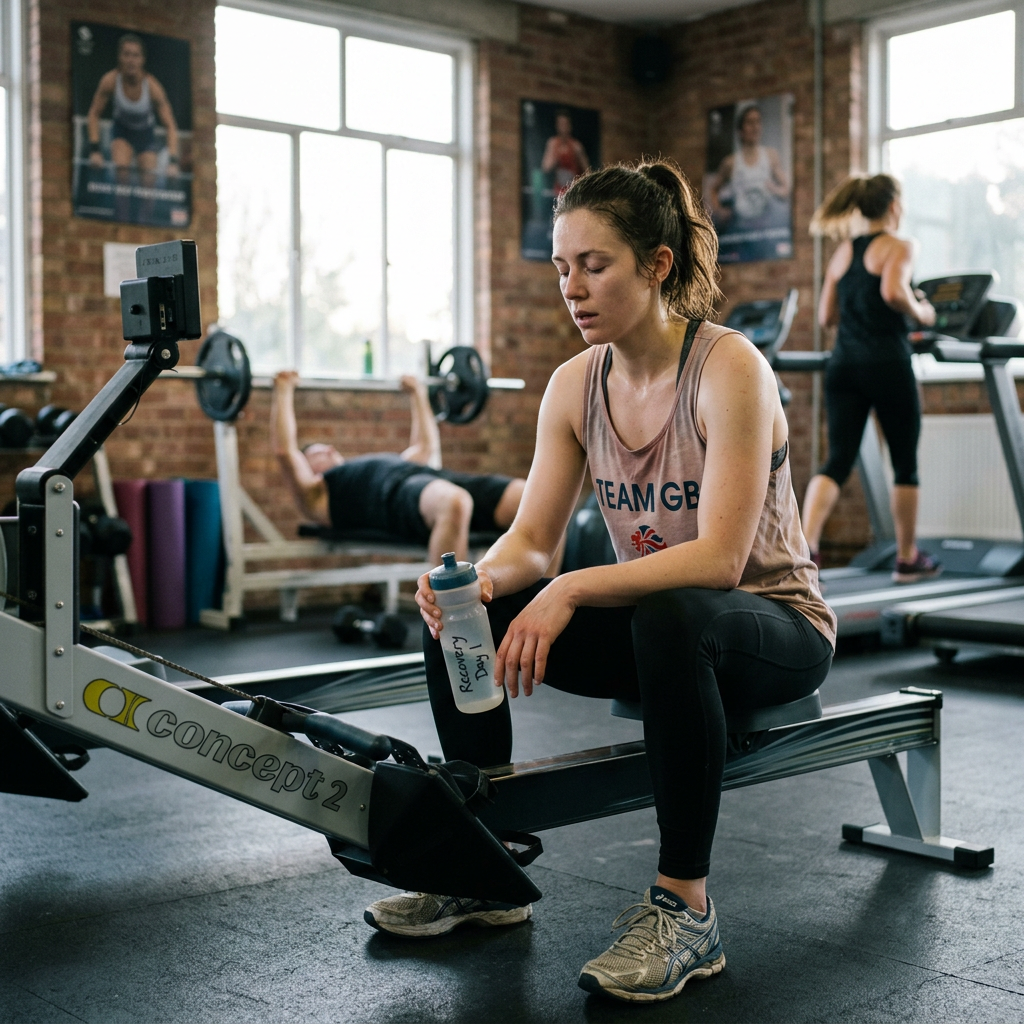
Getting sick is the training block nobody plans for. One week you are hitting Zone 2 sessions and stacking PRs; the next you are on the couch with a fever, and every day off feels like fitness bleeding out of you. Then the question hits: when and how do I start training again after a cold, the flu, COVID, or another virus?
Rushing back is the most expensive mistake in recovery. The 2022 American College of Cardiology expert consensus on COVID-19 return-to-play and the classic “neck-check” rule popularised by USA Triathlon both point to the same principle: match the intensity you resume to the severity of the illness and the symptoms that remain. Push through a chest-and-body virus and you risk myocarditis. Stay flat for two weeks after a sniffle and you lose fitness you did not need to lose. This guide gives you a practical 2026 timeline plus the five recovery tools that actually earn their spot on the comeback shelf.
Quick Picks — 5 Tools for the Comeback Block
- Best readiness signal: Polar H10 Chest Strap — the gold-standard HRV/heart-rate reference
- Best gentle stimulation: RENPHO Active Massage Gun — quiet, portable, easy on tender tissue
- Best low-load mobility: TriggerPoint GRID Foam Roller — proven multi-density hybrid
- Best hydration reset: LMNT Zero-Sugar Electrolytes — sodium-forward for post-fever fluid loss
- Best walk-back circulation: CAMBIVO Compression Calf Sleeves — support without heavy training load
What’s in this guide
- The neck-check rule (and where it stops applying)
- Cold vs. flu vs. COVID vs. post-viral: how the timelines differ
- Day-by-day return-to-training protocol
- The 5 recovery tools worth using during the comeback
- Full comparison table
- Buying guide: what to prioritize when you have a limited budget
- FAQ
- Verdict & further reading
The Neck-Check Rule and Where It Breaks
The neck-check rule is the most widely cited return-to-training heuristic in sports medicine. In its classic form: if all your symptoms are above the neck runny nose, mild sore throat, sinus congestion light to moderate exercise is generally fine. If symptoms are below the neck fever, chest tightness, productive cough, body aches, GI upset, or any cardiovascular symptoms — rest until the symptoms are gone, then add a graded return.
Mayo Clinic’s exercise-with-illness guidance and the American Lung Association both echo this framing. It is a useful first filter, but it has two well-documented failure modes:
- It underestimates fatigue load. Even a head cold measurably suppresses training output and blunts recovery for several days after symptoms clear.
- It misses cardiac involvement. Viruses like influenza, EBV, and SARS-CoV-2 can seed subclinical myocarditis. That is why the return-to-play post-myocarditis literature recommends a graded protocol with symptom re-check at each step — not a single go/no-go decision.
Practically: use the neck-check to decide whether to train today. Use a graded return protocol to decide how fast to ramp back up.

Cold vs. Flu vs. COVID vs. Post-Viral The Timelines
The window between “last symptom” and “back to normal training” varies more by illness than most athletes expect. The following ranges are consistent with the 2024 elite-athlete return-to-play meta-analysis and clinical return-to-activity guidance.
| Illness | Minimum rest after symptoms clear | Ramp back to full training | Extra caution flag |
|---|---|---|---|
| Common cold (above-neck) | 24 hours symptom-free | 3–5 days graded | None if no chest involvement |
| Flu (with fever) | 48–72 hours fever-free | 7–10 days graded | Fatigue is deeper than it feels |
| COVID-19 (mild) | 3–7 days symptom-free | 10–14 days graded, monitor HR/HRV | Any chest pain → clinician clearance |
| Post-viral (>4 weeks fatigue) | Individualized | Weeks to months, symptom-titrated | Rule out myocarditis / PVFS |
| Mononucleosis (EBV) | Minimum 3 weeks light activity, no contact | 4–6 weeks | Splenomegaly — no contact sport |
Two rules of thumb make this table easier to use. First: fever is the trump card — never train the day of a fever, and never in the 48 hours after it breaks. Second: HR and HRV are honest. If your resting heart rate is 8+ bpm above baseline or your HRV is 15%+ below baseline, your nervous system is still fighting something, whether you feel it or not.
The Day-by-Day Return-to-Training Protocol
This is the graded return most sports-medicine clinics use, distilled from the standard return-to-play framework and the ACC’s COVID-19 pathway. The days below refer to days after your last symptom, not days after diagnosis.
Day 1–2 — Walk & breathe
20–40 minutes of easy walking, nasal breathing, and 5 minutes of light mobility. That is it. No stairs sprints, no “just a quick lift”. You are re-introducing rhythmic movement, testing for lingering shortness of breath, and giving your heart a low-stress reference point.
Day 3–4 — Zone 1 aerobic
30–45 minutes of Zone 1 cardio (conversational pace, HR under ~65% max). Add a short flexibility circuit at the end. If your HR climbs above target for the pace, stop the session and add a day.
Day 5–6 — Zone 2 + technique
Reintroduce Zone 2 cardio at 60–70% of pre-illness volume. Add technique-only lifting: empty-bar work, light dumbbell circuits, no failure sets. This is where compression sleeves and light percussion earn their spot — support blood flow without adding training stress.
Day 7–10 — Load reintroduction
Return to structured strength work at ~70% of pre-illness intensity. Cap sets at RPE 7 (three reps in reserve). Skip conditioning finishers.
Day 10+ — Return to competition-level intensity
Only if HR, HRV, sleep, and RPE all sit inside your normal range for two consecutive days. If any single metric is still off, hold at Day 7–10 volume for another week. Adding a week here has cost almost no athletes their season; skipping this step has cost a lot of athletes theirs.
The 5 Recovery Tools Worth Using During the Comeback
1. Polar H10 Chest Strap Best readiness signal

The Polar H10 is the reference-grade heart-rate and HRV sensor almost every peer-reviewed sports-cardiology study benchmarks against. During a comeback block, it turns “how do I feel?” into a number: is my morning HR still elevated, is HRV still suppressed, is my Zone-2 HR climbing faster than pre-illness at the same pace?
Type: ECG-based chest strap · Battery: ~400 hours (replaceable CR2025)
Connectivity: Bluetooth + ANT+ · Water rating: 30 m
Best paired with: Elite HRV, Kubios, Polar Flow · Price band: $80–$100
Pros: Lab-grade accuracy · works with virtually every fitness app · onboard memory for pool workouts · long battery life.
Cons: Chest strap is less comfortable than a wrist wearable · strap needs a rinse after each session · no display of its own.
2. RENPHO Active Massage Gun Best gentle stimulation

Post-illness, tissues are more sensitive and joints are stiffer than usual. A quiet, low-amplitude percussion device gives you controlled stimulation for stiff calves, forearms, and traps without adding real training load. The RENPHO Active is the model we keep recommending because it is quiet enough for a bedroom recovery session, weighs under 1.5 lb, and has enough attachments to work for large muscle groups and smaller trigger points.
Amplitude: 10 mm · Speeds: 5 · Attachments: 5
Battery: ~3 hours per charge · Weight: 1.5 lb · Price band: $60–$90
Pros: Very quiet · travel-sized · carry case included · doesn’t overpower sensitive tissue.
Cons: Less powerful than a Theragun Pro · not the tool for a chronic deep-tissue issue · no touchscreen or app.
3. TriggerPoint GRID Foam Roller Best low-load mobility

The GRID is the multi-density foam roller most physical therapy clinics keep in their tool bins. Its firm inner core survives daily use, and the varied surface texture lets you dial pressure by how you position the target muscle. During the comeback, foam rolling is not a “flushing” magic trick it is a low-cost way to reintroduce gentle proprioceptive input and manage post-Zone-1 stiffness.
Length: 13″ · Core: Hollow rigid center · Density: Multi-density outer
Weight limit: 500+ lb · Warranty: 1 year · Price band: $35–$45
Pros: Won’t compress permanently like softer foam · portable · widely used in PT so guidance is easy to find · durable.
Cons: Firmer than beginner rollers · 13″ is short for full-body work · higher price than generic foam.
4. LMNT Zero-Sugar Electrolytes Best hydration reset

Fever, night sweats, and reduced appetite during an illness drain both water and electrolytes — especially sodium. Recovery fluid intake in the days after a virus is not just about “drink more water”; it is about restoring plasma volume so your heart doesn’t have to compensate on every Zone-1 walk. LMNT’s high-sodium (1,000 mg per stick) formula was built exactly for this problem.
Sodium/stick: 1,000 mg · Potassium/stick: 200 mg · Magnesium/stick: 60 mg
Sugar: 0 g · Sweetener: Stevia (some variants unflavored) · Price band: $20–$45
Pros: High-sodium formula matches post-illness fluid deficit · no added sugar · variety of flavors · travel packets.
Cons: Salty flavor takes a session to acclimate to · more expensive per serving than DIY salt+lemon · not intended for kids.
5. CAMBIVO Compression Calf Sleeves Best walk-back circulation

During the walk/jog reintroduction days, your legs get more DOMS from the same distance because the calf pump is undertrained. Graduated-compression calf sleeves (15–20 mmHg) add mechanical support and can reduce perceived fatigue on repeated bouts. CAMBIVO’s 15–20 mmHg model is the pair we keep recommending because the pricing lets you own two pairs and rotate them without a $60-per-pair commitment.
Compression: 15–20 mmHg graduated · Material: 4D knit, moisture-wicking
Sizes: S to XXL, unisex · Style: Footless · Anti-slip band: Yes · Price band: $15–$25
Pros: Excellent price · true graduated compression · low-profile fit under joggers · cheap enough to own multiple pairs.
Cons: Sizing runs slightly small · not enough compression for lymphedema or medical use · footless means no arch support.
Full Comparison Table
| Tool | Best for | When in the comeback | Price band |
|---|---|---|---|
| Polar H10 | Objective readiness | Every day, from Day 1 | $80–$100 |
| RENPHO Active | Gentle percussion | Day 3 onward, low speed | $60–$90 |
| TriggerPoint GRID | Low-load mobility | Day 1 onward, short sessions | $35–$45 |
| LMNT electrolytes | Plasma volume reset | Days 0–5, daily | $20–$45 |
| CAMBIVO calf sleeves | Circulation support | Day 1 walks, Day 5+ jogs | $15–$25 |
Buying Guide: What to Prioritize First
If you have a $30 budget
Start with the compression sleeves. They are the cheapest item that gives you a real biomechanical benefit during the first two weeks of walking and easy jogging. Add electrolyte packets to your grocery list — you can grade back into a full recovery stack later.
If you have a $100 budget
Add the TriggerPoint GRID and a box of LMNT to the sleeves. This is the “walk-back-to-running” starter kit and is what we would recommend to most amateur runners and lifters coming back from a bad cold or a mild flu.
If you have a $200+ budget or you take training seriously
Add the Polar H10 first — the data it produces will change how you make return-to-training decisions for the rest of your athletic life, not just this comeback. A quiet, portable massage gun like the RENPHO Active is the final piece and is worth it if you find that stiffness — not fatigue — is what keeps setting you back.
FAQ
How long should I wait to work out after a fever?
Wait at least 48 hours after your last measured fever before any exercise, and start with easy walking, not lifting or HIIT. If the fever lasted longer than 3 days or reached above 102 °F, some clinicians recommend a check-in before returning to intense training, per the ACC expert consensus.
Is it OK to lift weights with a head cold?
If your symptoms are strictly above the neck (runny nose, mild sore throat, sinus pressure), moderate lifting is generally safe. Drop volume 20–40%, skip max-effort sets, and stop if symptoms move below the neck during the session.
Why does my heart rate stay high for days after I recover?
An elevated resting heart rate for 5–10 days after a viral illness is common — it reflects both dehydration and residual immune activity. If it is still >8 bpm above baseline after 10 days, or you have any chest symptoms, that is a reason to see a clinician before returning to intensity, per the post-myocarditis return-to-play literature.
Do I really need an HRV monitor for this?
You do not need one, but if you have ever cut a comeback short and paid for it, the data pays for itself. Track morning HR and HRV for a week to establish your baseline; then during illness, watch how far both metrics move. The bigger the deviation and the slower the return, the more the illness has drained you.
What if I still feel wiped out weeks later?
Persistent fatigue >4 weeks after a viral infection deserves a clinical evaluation — it is the working definition of a post-viral fatigue syndrome, and the training rules change (see the 2024 elite-athlete post-COVID meta-analysis and the post-myocarditis return-to-play review). The rule of thumb: activity that produces post-exertional malaise is the wrong stimulus, no matter how mild it looks on paper.
Verdict
The comeback is a training block, not a coin flip. Use the neck-check to decide whether to train today; use a graded protocol to decide how fast to ramp; and use objective signals (HR, HRV, sleep, RPE) to catch a comeback that’s moving too fast before it costs you weeks.
If we had to name one tool from this list, it is the Polar H10 — because the whole point of a graded comeback is to have honest numbers to grade against.
Conclusion & Product Links
Coming back from a virus is a test of patience, not toughness. The athletes who lose the least time are the ones who take one extra easy week not the ones who “push through” in Day 3. Build a comeback with rules, not vibes, and you will find yourself back at pre-illness intensity in 10–14 days instead of a month.
Shop the guide
Sources
- 2022 ACC Expert Consensus Decision Pathway on COVID-19: Return-to-Play — American College of Cardiology
- Return-to-Play Post-Myocarditis for Athletes: To Play or Not to Play? — PMC / MDPI Diagnostics 2024
- Return-to-Play Timeline and Recovery Predictors After COVID-19 Infection in Elite Football Players — PMC 2024
- The Neck Rule — USA Triathlon
- Can You Exercise with a Cold? — American Lung Association
- Exercise and illness: Work out with a cold? — Mayo Clinic
- Return-to-play protocol for athletes — Parkview Health
Leave a Reply