
Tennis Elbow vs. Golfer’s Elbow: How to Tell the Difference and Fix Both
By Wes — RollRestore gear tester · Last updated May 2026
⏱ 11 min read · Category: Recovery & Wellness · 5 tools tested

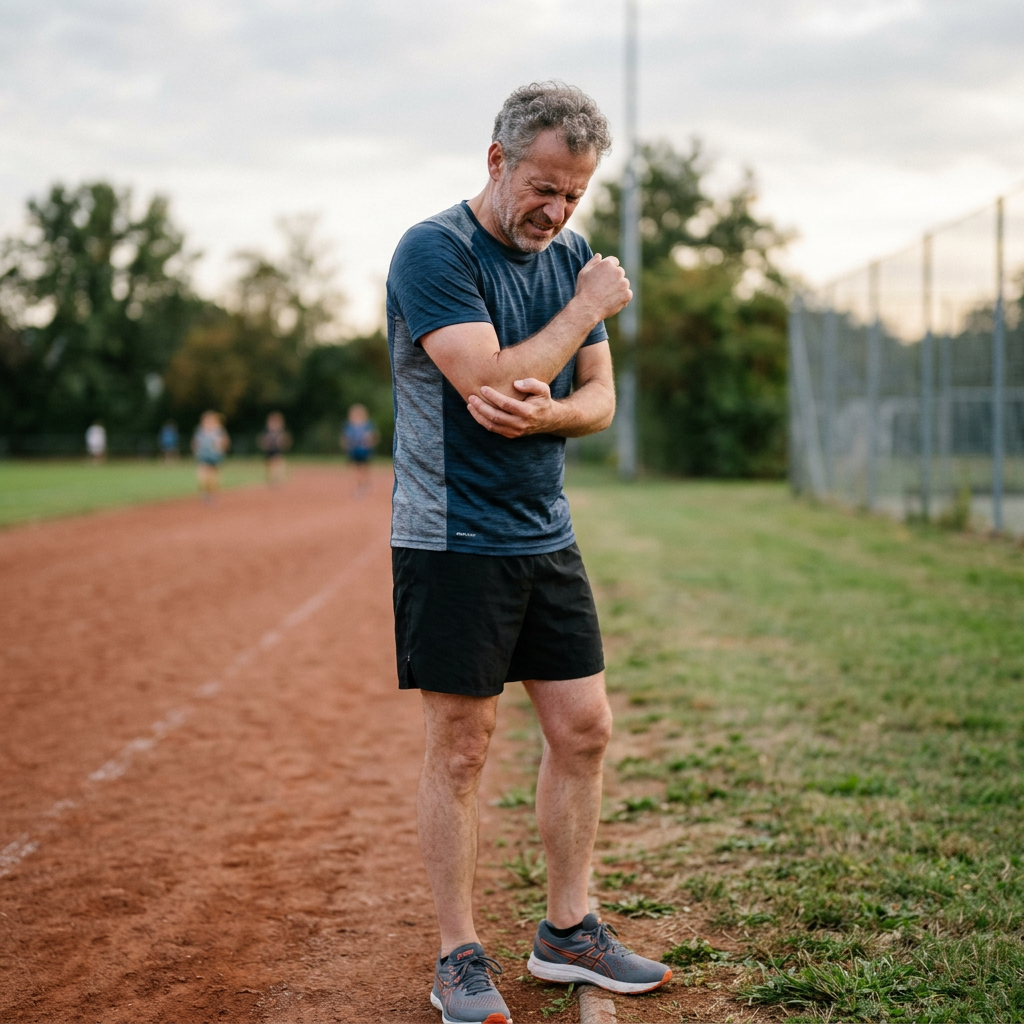
If your elbow is screaming and you don’t know whether it’s tennis elbow or golfer’s elbow, here’s the simple truth: they’re the same injury on opposite sides of the elbow. Both are overuse tendinopathies, the small tendons that attach your forearm muscles to the bony bumps of your elbow get loaded faster than they can repair, and the result is that bright, pinching pain you feel every time you grip a coffee cup, open a door, or pick up a kettlebell.
What separates them is just which tendons are angry. Tennis elbow (lateral epicondylitis) hits the outer elbow, the extensor tendons that straighten your wrist and fingers. Golfer’s elbow (medial epicondylitis) hits the inner elbow, the flexor tendons that curl your wrist and grip. Despite the names, you don’t need to play either sport to get them. Lifters, climbers, pickleball players, mechanics, and anyone hammering a keyboard for 8 hours a day can develop either one. According to TRIA Orthopedic / HealthPartners, both conditions resolve in 80–85% of cases within 12 months without surgery — but only if you load the tendon correctly. Pure rest makes it worse.
I’ve dealt with mild tennis elbow twice in the last three years (once from too much pull-up volume, once from a winter of heavy kettlebell work). Below is the exact 5-tool home stack that resolved it both times in 4–6 weeks and the diagnostic test you can run in 30 seconds before you spend a dollar.
The 30-Second Self-Test (Tennis Elbow vs. Golfer’s Elbow)
Sit at a table, forearm flat, palm down. Have someone press down on the back of your hand while you try to lift it. Pain on the outside of the elbow = tennis elbow. Now flip your palm up and have them press down on your palm while you curl your wrist toward you. Pain on the inside of the elbow = golfer’s elbow. If both light up, congratulations, you have both, and you wouldn’t be the first. As Midwest Orthopaedics at Rush notes, the treatment pathway is identical either way, so the test mostly tells you where to point the brace and which direction to eccentrically load.
⚡ Quick Picks — The 5-Tool Home Recovery Stack
- Best Overall (Eccentric Loading): TheraBand FlexBar — Red, Light
- Best Budget Counterforce Strap: Bodyprox Elbow Brace 2-Pack
- Best Gel-Pad Strap (Active Use): Mueller Tennis Elbow Support with Gel Pad
- Best Forearm Massage Tool: The Stick Original Body Stick
- Best Night Wrist Brace: Mueller Adjustable Night Support Wrist Brace
The 4-Week Home Recovery Protocol
Before the products, here’s the framework they plug into. This mirrors the conservative-care pathway from the AAOS OrthoInfo guide and the PT progressions taught by Ivy Rehab.
Week 1 — Calm the fire. Stop the aggravating movement (no heavy gripping, no hammer curls, no full-power forehands). Ice 10–15 minutes after any flare-up. Wear a counterforce strap any time you’re active. Sleep in a neutral wrist brace.
Week 2 — Light eccentric loading. Start the Tyler Twist (FlexBar) for tennis elbow OR the reverse Tyler Twist for golfer’s elbow. 3 sets of 15 reps, once per day. The exercise is allowed to mildly hurt during — it shouldn’t hurt for hours after.
Weeks 3–4 — Build tolerance. Continue eccentrics daily, progressing to a stiffer FlexBar (light red → medium green) when you can do 3×15 easily. Add forearm massage with The Stick before and after. Drop the brace gradually as pain fades.
For more on what active-recovery loading looks like across the body, see our guides on building a post-workout recovery routine and the matched rotator cuff home rehab plan.
1. TheraBand FlexBar (Red, Light) — Best Overall, Eccentric Loading Hero
Best Overall

Price: ~$24 · ASIN: B0BLJ4NQVB · Check Price on Amazon →
If you only buy one thing on this list, buy this one. The TheraBand FlexBar is the single most-cited tool in the published tennis-elbow rehab literature, and it’s been my go-to both times I’ve had a flare-up. The reason is a 2010 study by Tyler et al. published in the Journal of Shoulder and Elbow Surgery: chronic tennis elbow patients who added eccentric wrist extension with the FlexBar to standard PT saw an 81% drop in pain and a 72% gain in tendon strength over 7 weeks. The “Tyler Twist” exercise, twist the bar against resistance, then slowly let your bad-side wrist eccentrically uncurl it, is now standard in most orthopedic practices.
What I noticed first was how subtle the work feels. You’re not heaving against the bar — you’re just slowing the unwind. By week 3 of my second flare-up I could grip a 24kg kettlebell without that bright outer-elbow zing for the first time in months. The red (light, ~10 lbs) is the right starting resistance for almost everyone; progress to green (~15 lbs) only when red feels embarrassingly easy.
One real complaint I’ve seen on Reddit’s r/climbing and r/tennis: a few users mention the rubber has a faint odor for the first week. Mine off-gassed inside three days. Not a dealbreaker and the only knock on what is otherwise the most evidence-backed tool in this category.
- Clinically proven 81% pain reduction
- Works for BOTH tennis and golfer’s elbow
- Compact, fits in a desk drawer
- Color-coded progression system
- One-time purchase, lasts years
- Mild rubber smell first 3–5 days
- Tyler Twist takes 1–2 sessions to learn the form
- Not useful for acute pain, wait until you can grip without sharp pain
Who should skip it: Anyone whose elbow still has bright, knife-edge pain at rest, wait 5–10 days, then start.
2. Bodyprox Elbow Brace 2-Pack : Best Budget Counterforce Strap
Best Budget

Price: ~$11 · ASIN: B07253Z16J · Check Price on Amazon →
The Bodyprox Elbow Brace 2-Pack is the no-frills counterforce strap most people should start with. You get two, one to keep at home, one for the gym bag and they’re under $12. The thick EVA foam pad sits about an inch below the elbow, and when you cinch the Velcro the pad redirects load away from the angry tendon. Cleveland Clinic specifically calls out counterforce bracing as a first-line conservative measure during activity.
I wore one of these during a 3-week stretch of pull-ups and rows when I knew I needed to drop volume but didn’t want to skip the gym. It made the difference between training around the injury and stopping cold. The foam pad isn’t as targeted as a gel-pad design, but for the price-per-unit it’s hard to beat. Multiple reviewers on Amazon mention the Velcro shows wear after 6+ months of daily use, true in my experience, but at $5/strap I just replace them.
It works equally well rotated 180° for golfer’s elbow, same pad, same compression, just shift it so the pad sits over the inner forearm muscles instead of the outer.
- Excellent price-per-unit (2 for ~$11)
- Works for both tennis and golfer’s elbow
- Lightweight under shirts
- Easy one-handed adjustment
- Forgiving fit for most adult forearms
- Velcro shows wear after 6+ months daily use
- Foam pad less targeted than gel designs
- Not for sleeping and designed for activity
Who should skip it: Anyone with very thin or very thick forearms outside the 8.5–12 inch range.
3. Mueller Tennis Elbow Support with Gel Pad : Best Targeted Strap
Best Gel-Pad

Price: ~$13 · ASIN: B07FZVRPRN · Check Price on Amazon →
If the Bodyprox is the workhorse, the Mueller Tennis Elbow Support with Gel Pad is the precision tool. The integrated gel insert is firmer and more targeted than EVA foam, 1it concentrates pressure on a smaller spot, which makes a noticeable difference if your pain is very pinpoint (like one specific knot at the lateral epicondyle). Mueller has been a clinical sports-medicine brand since the 1960s, and this strap shows up in actual ortho clinics, not just on Amazon.
After 8 weeks of daily wear during my second flare-up (heavy kettlebell phase), the gel pad still snapped back to shape and the Velcro was still grippy. What I noticed compared to the Bodyprox: the gel feels denser against the forearm, it’s a “this is doing something” feel rather than the soft foam press. Mueller also runs slightly smaller in the adjustment range, so heavier-forearm lifters should size up to the larger Mueller models.
One pattern that shows up consistently in Amazon Q&A: people ask if it works for golfer’s elbow. Yes, Mueller confirms it’s reversible. You wear it with the gel pad on the inside of the forearm instead of the outside.
- Targeted gel pad outperforms foam for pinpoint pain
- Clinical-grade brand trusted by orthos
- Durable Velcro holds up to daily use
- Reversible for tennis or golfer’s elbow
- Low profile under long sleeves
- Pricier than budget 2-packs (single strap)
- Runs slightly small for forearms over 13″
- Gel pad firm, takes a session to break in
Who should skip it: Buyers who want two straps for under $15 and go Bodyprox.
4. The Stick Original Body Stick: Best Forearm Massage Tool
Best Forearm Release

Price: ~$45 · ASIN: B07MFBKBVP · Check Price on Amazon →
One under-discussed truth about tennis and golfer’s elbow: the tendon at the elbow is the downstream casualty of forearm muscles that have gotten chronically tight. Until you release those forearm muscles, the tendon keeps getting yanked on every time you grip. The Stick is the cleanest forearm massage tool I’ve used and the 17.75″ length is the sweet spot for one-arm forearm work (the longer versions are awkward solo).
The technique is dead simple: rest your forearm on your thigh, hold the handles with your good hand, and roll the toothed spindle from elbow to wrist on the painful side. Slow passes. About 60 seconds per side. The Stick is rigid enough to actually dig into the brachioradialis and wrist extensors and foam rollers and tennis balls are too soft for forearm work. After a hard pull-up session I’ll spend 90 seconds on each forearm and the next day my elbows are noticeably calmer.
Outdoor Gear Lab and multiple sports-PT YouTubers have ranked The Stick as the top roller stick for upper-body work, and it’s been on the market for 30+ years for a reason. One real complaint shows up in reviews: it’s pricier than knock-offs. True, but I’ve had mine for 6 years and the spindles still spin freely, which is more than I can say for the $15 versions that seize up after a few months.
- Rigid enough to actually release forearm muscles
- 17.75″ length perfect for one-arm use
- Lifetime warranty on spindles
- Works on calves, hamstrings, lats, too
- 30+ year track record with athletes and PTs
- Pricier than no-name competitors
- Plastic handles can feel hard on long sessions
- Not as deep as a lacrosse ball for one tight knot
Who should skip it: Anyone who already has a quality massage gun, a head attachment can substitute.
5. Mueller Adjustable Night Support Wrist Brace : Best Sleep Brace
Best for Sleep

Price: ~$18 · ASIN: B004YIFA04 · Check Price on Amazon →
This is the tool nobody talks about that quietly accelerates recovery. Most people sleep with their wrists curled and either flexed (which pulls on the golfer’s-elbow tendons) or extended (which pulls on the tennis-elbow tendons) for 7–9 hours every night. That’s the longest unbroken loading cycle in your day, and you don’t even know it’s happening. The Mueller Night Support Wrist Brace keeps your wrist in a neutral position so the tendons get an actual break.
I started wearing one on flare-side at night during my first bout of tennis elbow and the morning stiffness dropped from a 6/10 to a 2/10 inside a week. That’s not a cure, it’s just removing 8 hours of compounding irritation. The soft-shell design is forgiving (no rigid metal stay digging into the back of your hand), and the Velcro is light enough that I don’t wake up to readjust. Mueller specifically markets this for carpal tunnel and tendinitis, both of which share the same “stop overnight wrist flexion” logic.
One pattern in negative reviews: a small subset of users find it too loose at the wrist circumference if their wrists are very thin. If your wrist is under 6 inches, consider sizing notes carefully or look at a rigid splint instead. For most adult lifters and rec athletes it fits fine.
- Removes 8 hours of unconscious tendon loading
- Soft-shell is comfortable to sleep in
- Cuts morning stiffness within a week
- Fits left or right wrist
- Affordable for what it does
- Too loose for wrists under 6 inches
- Not designed for daytime sport
- Takes 2–3 nights to get used to sleeping in it
Who should skip it: Anyone with very thin wrists or who needs daytime-sport support.
Comparison Table
| Product | Price | Best Use | Tennis | Golfer’s | Rating |
|---|---|---|---|---|---|
| TheraBand FlexBar Red | ~$24 | Eccentric rehab | ✅ | ✅ | 4.7★ |
| Bodyprox 2-Pack | ~$11 | Active-use strap | ✅ | ✅ | 4.4★ |
| Mueller Gel-Pad Strap | ~$13 | Targeted compression | ✅ | ✅ | 4.5★ |
| The Stick Body Stick | ~$45 | Forearm massage | ✅ | ✅ | 4.6★ |
| Mueller Night Wrist | ~$18 | Overnight neutral wrist | ✅ | ✅ | 4.4★ |
Buying Guide: What to Look For
1. Pick the eccentric tool first, brace second
The single highest-leverage purchase is the FlexBar. Bracing reduces pain during activity but doesn’t heal the tendon. Eccentric loading does heal the tendon and it’s the only intervention with multiple randomized trials behind it. If budget is tight, buy the FlexBar and a Bodyprox 2-pack and skip everything else. See the Tyler protocol in our guide on stretching vs mobility work, short version: 3 sets of 15, daily, slowly let the bar uncurl over 4 seconds on the bad side.
2. Counterforce strap vs. sleeve: Pick the strap
Sleeves provide warmth and mild compression but don’t redirect load. Counterforce straps with a pad sit just below the elbow and actively absorb tendon tension during gripping. NCBI / InformedHealth notes counterforce bracing is among the most consistently studied conservative interventions for both conditions.
3. Don’t skip the night brace if you wake up stiff
This is the most counterintuitive part of the protocol. If your elbow is stiffest in the morning and loosens as the day goes on, you have an overnight loading problem. A soft night brace solves it for under $20 and accelerates everything else. Pair with our muscle-recovery sleep guide and morning stiffness usually fades within 7–10 days.
Frequently Asked Questions
What’s the difference between tennis elbow and golfer’s elbow?
Tennis elbow (lateral epicondylitis) causes pain on the outside of the elbow and is driven by overloaded wrist extensor tendons. Golfer’s elbow (medial epicondylitis) causes pain on the inside of the elbow from overloaded wrist flexor tendons. The mechanism is identical, overuse tendinopathy, only the location and aggravating motion differ.
How long does tennis elbow or golfer’s elbow take to heal?
Most cases improve significantly in 6–12 weeks with the right home protocol (eccentric loading + counterforce bracing). The AAOS reports 80–85% resolution within 12 months without surgery. Severe or chronic cases can take 6–12 months, especially if you keep training through pain. Stopping the aggravating motion early shortens recovery dramatically.
Can you have both tennis elbow and golfer’s elbow at the same time?
Yes and it’s more common than people think, especially in lifters and climbers who grip in both flexion and extension throughout a workout. The treatment is identical: eccentric loading on both sides (Tyler Twist for the outer, reverse Tyler for the inner), counterforce bracing rotated as needed, and forearm massage. Just expect recovery to take slightly longer.
Should I use ice or heat for tennis elbow?
Use ice for the first 48–72 hours after a flare-up to calm acute inflammation, 10 to 15 minutes on, an hour off. Switch to heat once the bright pain settles, because heat increases blood flow to the tendon and improves the response to eccentric loading. Cleveland Clinic recommends ice during flares and heat before rehab exercises.
Do tennis elbow braces actually work?
Yes, but with a caveat: counterforce straps reduce pain during activity by redirecting tendon load, they do not heal the tendon by themselves. Studies show pain relief in 60–80% of wearers during use. To actually fix the underlying tendinopathy you have to pair the brace with eccentric loading (FlexBar) and relative rest from the aggravating motion.
Can I keep working out with tennis or golfer’s elbow?
Yes, selectively. You should temporarily drop any movement that produces sharp pain (heavy pulling, hammer curls, full-power forehands). You can usually continue squats, leg work, hip thrusts, and most core training. Use a counterforce strap during anything that does involve gripping, and start eccentric FlexBar work daily. Total training pause is rarely necessary and may slow recovery.
When should I see a doctor for elbow pain?
See a doctor if pain hasn’t improved after 6–8 weeks of consistent home protocol, if you have numbness or tingling in the hand or fingers, if there was a sudden tearing sensation, or if you can’t grip anything without sharp pain. Imaging and a guided injection or PT referral may be needed. Most cases resolve at home, but persistent or worsening symptoms deserve a clinical eye.
🏆 The Verdict
If you only buy one thing: the TheraBand FlexBar (Red). It’s the only tool in this list with a published RCT behind it (Tyler et al., 81% pain reduction).
If you have $50 total: Add the Bodyprox 2-Pack strap and the Mueller Night Wrist Brace. That’s the entire active-passive load management story for under fifty dollars.
If you grip-load daily (climbers, lifters, mechanics): Add The Stick for daily forearm release. It’s the difference between recurring flares and a permanent fix.
Conclusion: Same Fix, Different Side
Tennis elbow and golfer’s elbow share more than they don’t. They’re the same tendinopathy on opposite epicondyles, they respond to the same protocol, and they resolve at home for 80%+ of people who load the tendon correctly instead of resting it into chronic stiffness. The 5 tools in this list cover the four needs of recovery: load the tendon (FlexBar), protect during activity (Bodyprox + Mueller straps), release the upstream muscles (The Stick), and stop overnight irritation (Mueller night brace).
If you’re 6–8 weeks into the protocol and still hurting, that’s your signal to escalate to an orthopedic visit. But for the vast majority of mild and moderate cases, specially first-timers and this stack does the work of a full PT cycle for less than the cost of a single PT copay.
For more body-specific home recovery protocols, see our recent guides on rotator cuff recovery at home, IT band syndrome fixes, and how to prevent workout injuries before they start.
Leave a Reply